

Places and landscapes
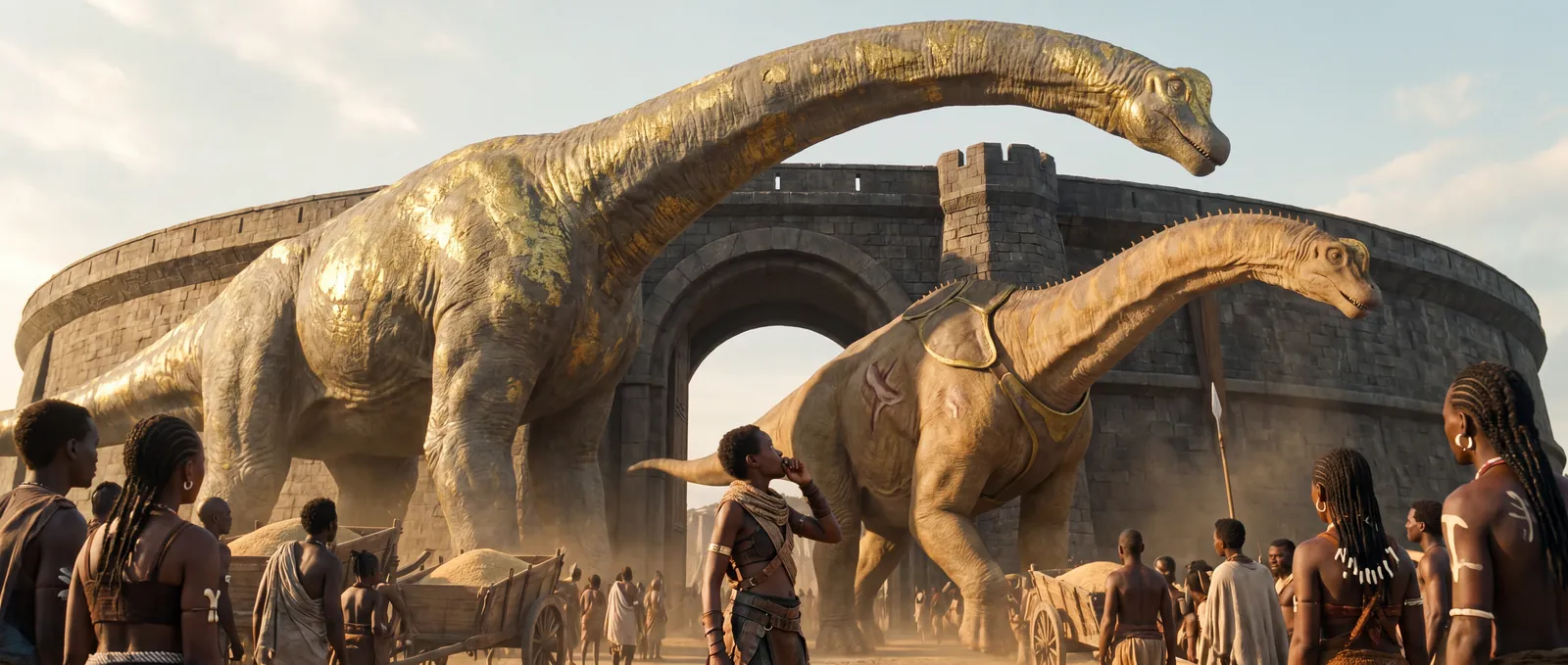
Urnok’s animal statuary
Urnok sculpts beasts rather than heroes. Statues of brachiosaurs, ultrasaurs and diplodocus, vertebra colossi and load steles honour animals as partners of civilisation.
Beasts rather than heroes
Urnokian statuary is first of all non-human. It depicts brachiosaurs, ultrasaurs and diplodocus, as well as the Longs-Pas, and raises vertebra colossi on the squares and heights of the capital. The Empire honours beasts as living infrastructure and partners of civilisation, not as mere mascots: it reveres function more than the hero.
This choice matches Urnok’s worship, which celebrates the living things that carry the Empire: the road, the granary, the colossus and the register. Depicting a beast recalls the place of breeding, food, care and transport in imperial life.
Load steles and engraved rings
Sculptors work alongside scribes. Load steles and rings engraved with laws or accounts bring memory and administration together: the monument carries a text as much as a form. In the palace, the Council chamber holds statues of sauropods with coiled necks cradling eggs, echoing the Egg Law.
Statues that serve
Urnok’s statuary is almost never gratuitous. Seated colossi hold out yoke-shaped arms through which ropes and banners pass; long-necked guardians form with their nape a portico one passes under; faceless Bearers carry beams and chains. Statues serve as counterweights, bollards and tie points, and dynastic busts are built into tie bollards, fountains and benches.
Other statues state the Empire’s knowledge: balances, weights, knots and pulleys carved as tool-ideas, statues of trades — scribe, saddler, veterinarian, seal-marker —, health steles recalling protocols, orientation needles marking winds, seasons and flows, gauge obelisks engraved with reserve levels, pierced statues that whistle in the wind. On the ground, circular frescoes record roads, weights, taxes and calendars.
Bralnor marble
The capital’s great statuary is cut from the white veined marble of Bralnor’s two great quarries, the same stone used for load-stelae and the façades of the heights. The blocks come down the quarry road on drays pulled by sauropods, and a life-size brachiosaur statue takes dozens of them. It is not carved in one piece: each section is roughed out at the quarry, finished in the workshops at the foot of the heights, then assembled on site with mortise and tenon and bronze cramps set in lead.
The statues used to be painted with ochre and lime, and traces of colour remain in the folds of the oldest. Today they are left to the stone, which weathers with soot and rain. The carving workshops also sell reduced copies, small marble brachiosaurs given as house gifts or brought back from the capital by pilgrims.
The little man at the beast’s feet
The human figure is not absent from the statuary, but it holds a precise place there. At the foot of many statues, a small figure carved to exact scale holds out a strap, carries a bucket or raises a hand towards the animal’s neck. This “little man” gives the measure: he shows the passer-by the beast’s true size and recalls that no colossus works without someone beside it.
The figure never has a name or a recognisable face. An old workshop rule forbids carving an identifiable driver next to his beast: the statue’s glory belongs to the animal and its function, not to the man who leads it. The great houses have sometimes tried to have their arms engraved on a marble colossus’s harness; the Crown has always refused it on public squares.
Washing the statues
Statues of beasts are cared for like the beasts themselves. Before the Procession of the Colossi, the quarters wash the statues on their squares with water from the troughs, brush the lichen from the legs and refill the basins around them. Families leave sheaves of fodder tied with a ribbon at the foot of the plinths, which keepers later collect for the living beasts: the offering is not wasted, it simply changes mouths.
Statues are also touched for more private reasons. Drivers lay a hand on the leg of a marble brachiosaur before a first convoy; the family of a keeper who died in service ties a piece of his strap to it. Some legs are polished to a shine by generations of hands, and sculptors leave those spots as they are when they restore a statue.
Statuary of the roads and marches
Outside the capital, statuary becomes humbler and more useful. Along the bearing roads, the milestones often carry a carved sauropod head turned towards the capital; leagues are counted by counting heads. At the duchies’ crossroads, smaller colossus-vertebrae engraved with distances and loads serve as meeting places for convoys.
In the marches, statues are low, squat and set into thick plinths, because raiders topple or deface them to show they have passed. A felled load-stela is raised again by the nearest garrison as quickly as a repaired bridge, and its return is noted in the march register: leaving a stela on the ground is letting people believe the Empire has retreated.
Gallery1 image
Two brachiosaurs pass through a fortified gate.