

Places and landscapes
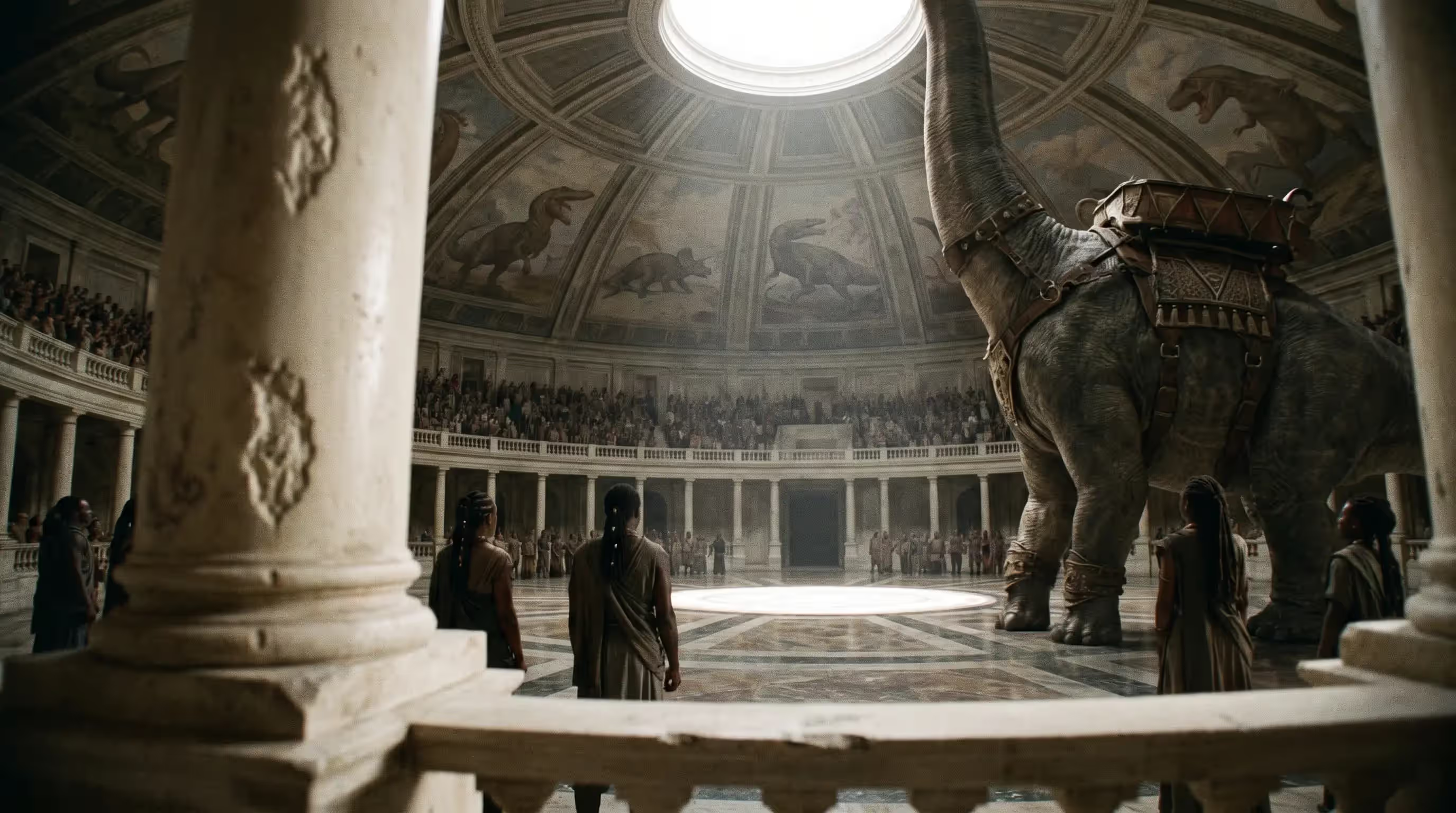
The Nervure Impériale
Urnok’s monumental style turns the constraints of the colossi into legible beauty: rings running from dirty to clean, great load-bearing roads, turning circles, ramps, ribs and oculi. Its rule fits in one formula: beauty is legibility and technical truth.
Legibility and technical truth
The Nervure Impériale is Urnok’s monumental style. It starts from a constraint: a capital that feeds, waters, tends and moves very large animals must be legible from afar and safe up close. Its rule fits in one formula: beauty is legibility and technical truth. A work is beautiful because one understands what it carries, ventilates, drains or lets through; the cathedral granary is beautiful through its ventilation, not its decoration.
From afar, the city reads as large simple masses: rings, terraces, granary towers, arches. Up close, repeated motifs — ribs, scales, chevrons — make the surfaces vibrate. At human height, ribs, curves, oculi and materials give an organic feeling; at animal height, spaces stay calm, legible and free of trap corners. From the street, one never sees a colossus whole.
Rings from dirty to clean
The city is organised in rings running from dirty to clean. Outside, the dirty zone receives arrivals, animals, raw markets, slaughterhouses and tanneries. The middle ring handles the transition: washing, fumigation, inspection and sorting. The clean core gathers archives, oaths, temples and treasury. Crossing a ring means passing a controlled threshold. Festivals follow this plan: during the Procession of the Colossi, the city crowds onto the terraces ring by ring, from the dirty districts to the clean ones.
These rings are not perfect circles. In the capital, historic districts, basins, granaries and terrain bend them, and irregular rings touch one another. The plan is a logic of passage more than a geometric figure.
Load-bearing roads, turning circles and ramps
Great load-bearing roads pierce the rings like spokes: these are the vertebra avenues, sized for the largest sauropods. Where they cross, turning circles let the colossi pivot. Height is gained not by stairs but by terrace and ramp: the city rises in strata, on a slow slope, for heavy loads. The curve rules everywhere. Nothing important is straight in Urnok: avenues have their turning radius, and public buildings use arches and galleries that guide without brutality.
Ribs, mouth-gates and oculi
Four forms recur. The rib: thick, repeated flying buttresses, legible from afar and pleasing up close. The mouth-gate: an airlock entrance with grilles and curved corridors, evoking a maw without caricature. The oculus and the lantern: controlled light that is also real ventilation. Finally the chest-building: thick envelopes, double walls, flexible timber dampers, façades without sharp corners, which protect against shocks, panics and storms and avoid alarming the animals.
Dark stone and pale lime
The ground is basalt or dark stone, the lines pale limestone. Lime serves for infrastructure and aqueducts. Walkways and shock-absorbing galleries are made of lashed flexible timber; membranes of stretched leather cover awnings and market roofs. Bone enters only as functional and symbolic parts — hooks, railings, knockers —, never everywhere. In the capital, stone is weathered by the centuries and blackened by soot, awnings are patched and the gold is worn: wealth there is lived in rather than varnished.
A city read without writing
Colour is a law. Pigmented renders state the function: smoke ochre for dirty zones, tanneries and raw markets; lime white for proof, oaths and archives; resin green for care and quarantine. Other renders mark tax, right or danger, so that districts can be read without reading, and façades echo the codes of textiles.
Sound completes colour. Bone bells, hide drums and singing corridors guide the convoys; sound codes announce march, halt, quarantine and alarm. To calm the animals, corridors avoid harsh echoes and repeat soothing patterns, while cadence towers beat the rhythm of the march.
One style among others
The Nervure Impériale does not erase other grammars. A capital gathers several, and Urnok keeps its old districts, its ill-suited places and its ducal dialects: the fine timber and plate roofs of Orlantis, the black stone of Velmor, the stores of Sarnor. Ten styles each develop part of its logic and can become the signature of a whole city. The Nervure also projects itself along the roads: regular relays carry its look to the horizon.
The workshops of the Nervure
The Nervure is manufactured as much as it is designed. Its profiles, the ribs, the arches, the rims of the oculi, are fixed in template books kept by the stone workshops and the builders’ offices; each profile has a name and a measure, and a stonecutter can produce the same rib in Sarnor and in Velmor to within a few fingers. The lime-burners supply the lime for renders and joints, the colour workshops the ochre, white and green pigments.
This standardised work does not rule out signatures. Stonecutters carve their mark on the hidden face of each piece, and restorers taking apart a rib sometimes find, side by side, the marks of several generations of the same family. An unmarked rib is regarded with suspicion: nobody knows who answers for it.
The Nervure beyond the Empire
The style travels with those who build it. Karûm-Brakh builds roads and bridges throughout the known world, and its works carry with them the thick ribs, the oculi and the airlock gates of the Nervure. They can be seen in Volonian port warehouses, in bridges in the passes of Korath, in relays on the trade roads.
Other peoples do not take the same thing from it. Volonian merchants appreciate the oculi that ventilate their warehouses but find the façades too heavy for their quays; Korath’s engineers respect the vaults and scorn the decoration. Within the Empire people joke that a traveller knows he is home at the first building whose purpose he understands without going in.