

Materials and resources
Nalen: fibres of movement
Haulage, rigging and nets depend on the same category of intermediate products.
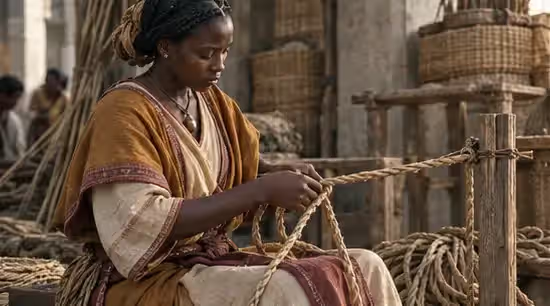
From workshop to net
Rope needs an anchor
Ropes, tackles and capstans are in common use. Mobile devices also need anchors and replaceable parts. Rope does not replace a missing support; it transmits force between two points. Haulage and rigging therefore have their constraints: no cable is indestructible.
Velmor depends on the forest
Velmor nets are among the dependencies that bind the Lines together. The military archduchy is not autonomous in fibres, tannins or other components. One piece of equipment thus brings several duchies together. Defence also depends on trades far from the fortress where the net finally becomes visible.
Resined ropes
The most sought-after ropes of Orlantis are the resined ropes. Once laid, the rope is passed through a bath of hot Aversin resin, sometimes mixed with pitch, then dried under cover and hung in long loops. It takes on an amber tint and a smell that never leaves it. Treated in this way, it rots neither in sluice water nor at sea, and it is what equips the barges, the timber rafts and a good share of the ships Volonia fits out with Orlantis wood.
Resined rope costs a little more than plain rope, a few tenths of a Draco per kilo, and it is stiffer to handle; boatmen complain about it for the first few days and then want nothing else. The chain thus links two neighbouring Lines: without Aversin resin, Nalen ropes would not last a season in the water, and without the Nalen, resin would lose one of its best outlets.
Fibre or tendon: two families of rope
Alongside fibre ropes, the Empire uses tendon cables. Sauropod tendon, dried, combed and twisted, gives a more elastic and much stronger cable, kept for uses where a fibre rope would give way: the skeins of ballistae, the winches of quarries and building sites, the fastenings that carry a platform on the back of a very-large animal. Tendon cable costs five times as much per kilo and fears damp, which slackens it, and drought, which makes it brittle.
The two trades are distinct. The Nalen work fibre; the tendon workers, in other workshops, work tendon, and the army employs its own to restore the tension of the ballistae at every change of season. They meet in mixed ropes, where strands of tendon reinforce the core of a fibre rope, and in nets, where the two are alternated so that one broken mesh does not open the whole net.
Rope at war
An Urnokian army carries leagues of rope. It is needed to haul siege engines and wagons up slopes, to lash the loads of the Living Silos, to raise temporary bridges and palisades, to fasten the firing platforms on the backs of the very large, to stretch the ladders and rope bridges of assaults. The anti-air nets of Velmor are only the most visible of these orders.
In the marches of Qor Zaï, weighted anti-raptor nets are also used, smaller and tighter, which are thrown over a pack or stretched across a narrow passage to break a charge. They are sold by the piece, a few Dracos each, and wear out quickly. Every campaign is therefore also prepared in the ropewalks of Orlantis, and the quartermasters count rope along with grain and arrows among the things a column must never lack.
A rope needs care
A rope ages, and it often hides its age. Lifting masters inspect it before each important use: they untwist the strands slightly to see inside, where rot begins, look for broken fibres, areas hardened by salt or browned by damp, and smell it, for a rotting rope has a sweet smell. Lifting ropes carry a register of use, and one that has reached its number of lifts is withdrawn even if it looks intact.
A withdrawn rope is not thrown away. It passes down from use to use: from lifting to hauling, from hauling to lashing bales, then to tying in the gardens. It ends unpicked into oakum, which caulkers drive with pitch into the seams of hulls. In Orlantis they say a rope always ends up in a boat, and the saying is readily quoted to young people who would throw away an end too soon.