

Trades
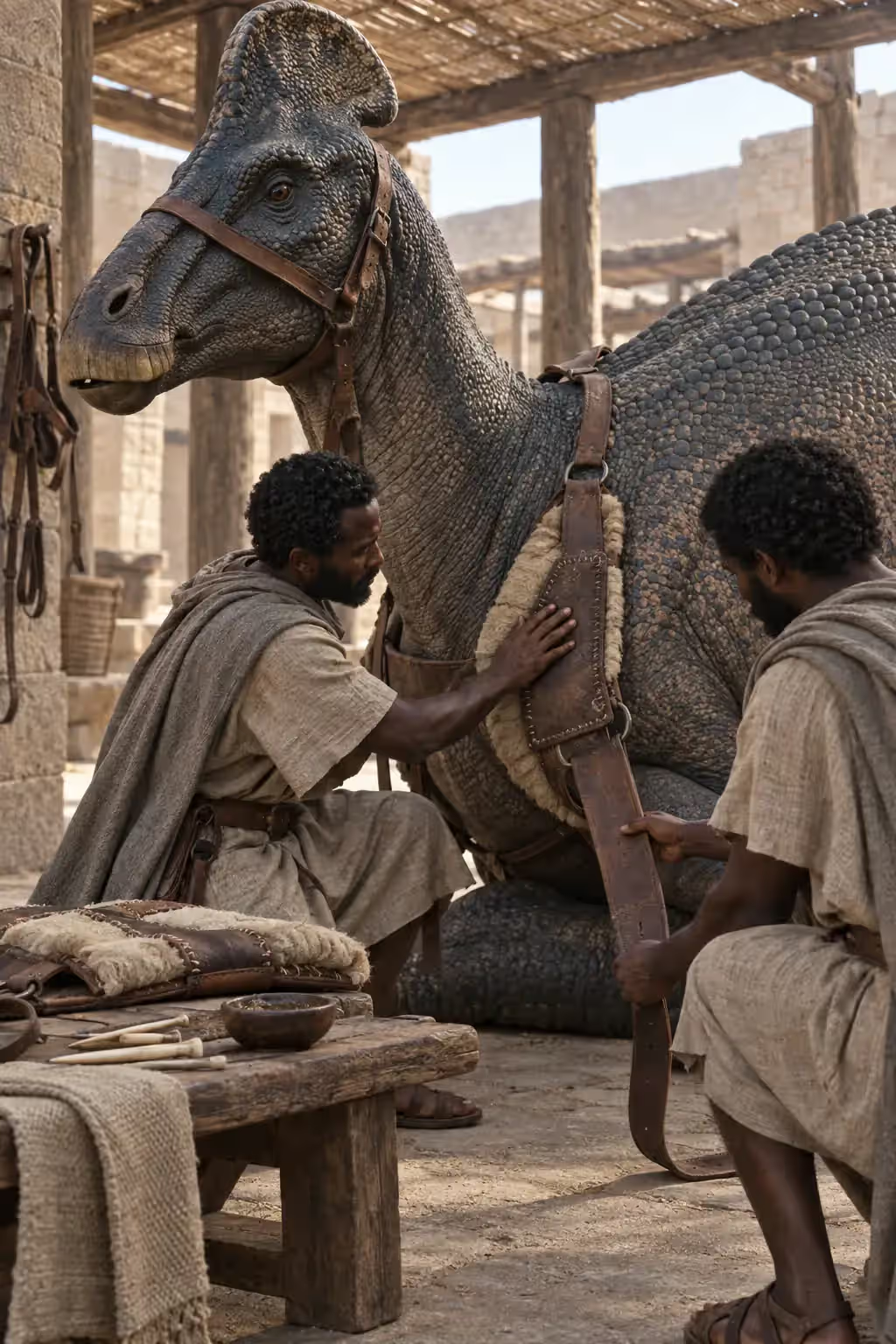
The harness inspector
When a convoy sets out, the harness inspector looks at the join between load, beast and vehicle; there he reads sabotage, and sometimes the war being prepared.
Equipment betrays politics
The harness inspector enforces standards, checks safety and looks for sabotage. His eye also falls on what a harness reveals: sabotage, or an offensive load. The trade thus ties equipment to politics; in Urnok as in Korath, equipment betrays politics before people do.
In the march of Qor Zaï, they say a harness too long can reveal an invasion.
A departure has several people answerable
A convoy does not depend on a single order given in the morning. The convoy inspector checks what must leave; the harness inspector looks at the join between load, animal and vehicle; the imperial rationer counts water and fodder; the load-gauger compares the real weight with the road available. Any of them can flag a shortfall, and a refusal postpones the work until the faulty link has been put right.
The straps he inspects often come from workshops that test and stamp them, such as the House of Certified Straps: a standard that reduces fatal accidents.
An inspection at departure
The harness inspector works with few tools: a graduated leather gauge, a punch, a stick of ochre chalk, a knotted cord and his tablet. He first walks round the animal without touching anything, to see how the load is set and whether the animal stands straight. Then he runs his hand over each strap, from collar to breeching, tests the buckles, looks at the seams and rivets, and slips two fingers under each piece to judge how tight it is.
He then reads the marks: the stamp of the workshop that tested the strap, the hallmark of the Line that supplied the buckle, the number entered in the animal’s register. An accepted piece receives an ochre stroke; a doubtful one is set aside. When all is in order, he signs the departure slip beside the convoy inspector and the rationer. His signature commits his name: if a strap he accepted breaks within the hour, he is the first who will be asked about it.
Recognising sabotage
Wear and sabotage do not leave the same traces. A worn strap frays at its edges, thins where it rubs and hardens under sweat; a sabotaged strap shows a clean cut hidden beneath a seam, a stitching thread replaced by a weaker one, a buckle filed on the inside, a hollow rivet that rings differently from the others. Some saboteurs smear the leather with a sour grease that eats it away in a few days while showing nothing to the eye.
When he suspects sabotage, the inspector repairs nothing. He removes the piece, has it sealed before a witness and sends it, with his report, to the incident archivist; an inquiry then seeks out who has handled the harness since its last inspection. In the marches these affairs are followed closely: a strap cut on a patrol iguanodon is an act of war as much as an offence.
Reading war in the leather
At the borders, harness inspectors also do intelligence work. On the black road linking Velmor to Korath, at the bone customs of Qor Zaï, in the ports of Orlantis, they see harnesses pass before the animals that will wear them. They note sizes, quantities, attachment pieces. A convoy declared as trade that carries platform fittings, anti-raptor straps in large numbers or collars sized for a war sauropod says something other than its papers say: it is preparing an offensive load.
Korath knows the same skill in another form. It is said that its pass riveters understand a war by the length of a chain, as Urnok’s inspectors understand it by the length of a harness. The two trades watch each other on the black road, and sometimes, over a relay meal, exchange information that neither of them records.
A power to say no
The inspector commands nothing, but he can hold everything back. His refusal suspends a departure until the faulty link has been put right, and a convoy leader who overrides him answers for it alone. For convoys of several animals yoked together, he works with the Yoke Masters, who certify yokes, frames and traces; without their seal, such a convoy does not pass the first relay. For the very large, it is the Harness-Master who answers for all the gear, and the inspector reports to him.
Most inspectors are former harness makers or saddlers, later trained at the schools of the Road. They are paid by the convoy or by the Chancellery depending on the road, and disliked by hurried merchants. Their rule fits in a sentence the apprentices repeat: a strap is worth a battle, and it is better to lose a morning than to lose an animal.