
Institutions
The Imperial Forges of Korath
Korath’s nationalised industrial apparatus: heavy metallurgy, strategic alloys, arsenals, stocks and standards, at the centre of the economic square.
A total institution
The Forges are nationalised and placed under sovereign control. They control heavy metallurgy, strategic alloys, arsenals, stocks, standards and the weapon chains used against great dinosaurs. They form a total institution: they combine the functions of a ministry of industry, an arsenal, a standards authority, an industrial intelligence service, a laboratory, a logistics service and a mobilisation apparatus. Their nationalisation amounts to the military capture of the technical ecosystem.
A name that does not make Korath a duchy
“Imperial Forges” designates Korath’s industrial apparatus; the name does not mean that Korath is a duchy of Urnok. They are also called the National Forges.
Signature, licence and scale
The citizen owns the signature of an invention and the workshop its licence, but the state controls the temperature and scale at which an idea becomes power. Political favour does not replace technical proof; it often decides whether a patent stays a prototype or becomes national infrastructure. The Seal of Requisition lets the regime impose secrecy, production, standardisation and military use, without erasing the inventor’s authorship.
The centre of the square
Four great bourgeois families structure Korath’s economic square: the Four Sides of Measure, Form, Movement and Breath. The Forges and military power occupy its centre. The families carry weight in workshops and licence portfolios, while sovereignty and strategic industrial means remain concentrated around the state.
Organising whole systems
Military production chains depend on precise parts and on their coordination. A battery, a recoil platform, an ammunition hoist and a protected passage form a whole in which each element must work at the right moment. The Forges’ power rests on this organising capacity as much as on the materials they transform. It remains bound to supplies the mountain cannot provide alone: imported grain, heavy and fine tendons, anti-rot resins. In wartime, Korath can suspend licences, parts, engineers and certifications, which reveals how dependent its clients are.
The Master of the Forges
The national Forges are headed by a Master of the Forges, who works hand in hand with the Marshal of the Mountain.
The state furnaces
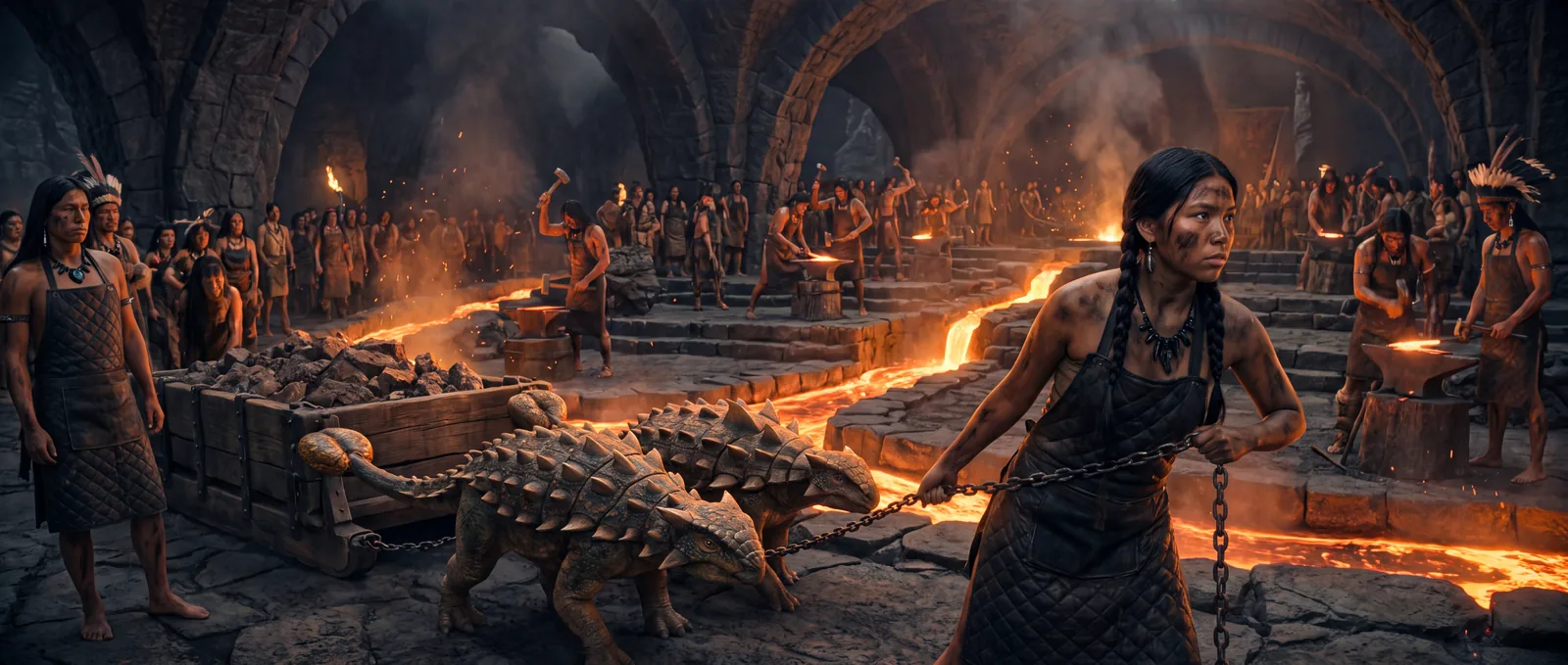
The great national forges stand where the heat is strongest, in the Failles rouges and in the warm layer of the great cities. They are works of stone: basalt benches, crucibles, moulds, tongs, gauges, patent plaques, slag drains and cooling basins, under redundant ventilation. No factory chimney rises there, no metal framework covers them; smoke and heat escape through ducts carved into the rock.
Bronze and copper above all are cast and hammered there, for weapon parts, ballista fittings, gears and chains, and the obsidian of the Failles rouges is worked there too. The noise of the forges is one of the sounds of Korath: hammers in polyrhythm, released steam, and above all the breathing of the furnaces, that giant bellows which gives the cities their continuous bass. Korathians say of their country that it never sleeps, it only lowers the fire.
Standards and gauges
As the authority for standards, the Forges keep the country’s reference measures: lengths, weights, chain pitches, bolt calibres, rivet and pin diameters. The original standards lie in a strongroom, and verified copies, the state gauges, are sent to the workshops working for the army. A part that does not fit its gauge is rejected, whatever the reputation of the workshop that made it.
This control has a very concrete military reason. A link forged in one pass must fit a chain mounted in another; a bolt fired by one battery must suit every ballista of the same model; a spare pin brought by a convoy must go into a mechanism that cannot be dismantled under fire. Standardisation is one of Korath’s silent strengths: it allows a country of seven million people to maintain a defence its neighbours would take years to copy.
The Forge inspector
The concrete face of the institution is the Forge inspector. He checks alloys, stocks and mobilisation: he takes metal samples, counts an arsenal’s reserves, checks that a contracted workshop respects its gauges and that a pass depot holds the planned number of spare parts. His rounds are unannounced, and his arrival in a workshop silences the hammers.
The trade inspires as much respect as fear. An unfavourable report can withdraw an arms contract, and so ruin a workshop; a complacent report, if discovered, is treated as false precision. Workshops nonetheless know that a good inspector protects them: he is the one who warns in time that a casting is bad or that a stock of tendons is starting to rot, before the fault costs lives in a pass.
Switching to war
The Forges are also Korath’s mobilisation apparatus. In peacetime they hold stocks of weapons, parts and materials, and they know the capacity of every workshop in the country. When the regime so decides, they can switch part of civil production to armament: under the Seal of Requisition, winch workshops produce gun carriages, clockmakers assemble sighting mechanisms, bell founders cast fittings.
The switch has its rules. Spare parts come before new parts, because a repaired ballista fires the next day; exports can be suspended, and with them the licences, engineers and certifications on which foreign clients depend. Requisitioned workshops keep their signature on what they make, but lose control over what they produce and for whom.
Knowing where one’s parts are
The Forges’ industrial intelligence keeps a register few powers possess: the list of Korathian parts in use abroad. Which recoil systems equip Volonia’s great hulls, which hinges hold the doors of an imperial fortress, which Arkhan batteries take up the logic of the Shared Recoil with a local tendon: all of it is recorded, with delivery dates and probable wear.
This knowledge serves peace as well as war. It makes it possible to sell spare parts at the right time, to spot copies and to know where a suspension of deliveries would hurt most. It also serves to keep watch on what former foreign students have learned: they do not hold the black secrets, but they can recognise the logic of a Korathian system, and the Forges prefer to know where they work.
What the mountain does not provide
The might of the Forges rests on materials the massif does not produce. Heavy sauropod tendons come from Urnok, fine theropod tendons from Arkhan, anti-rot resins from N’Goro; without them, ballista skeins and pass cables rot within a season. The workers’ grain and the draught animals’ fodder also come from outside.
Korathian prices reflect this: metal costs about 0.78 times the average rate there, fodder and timber about 1.25 times. Industry and crafts account for 42% of the country’s output, the highest share among the nations that count in Dracos. The Forges are thus both Korath’s most powerful institution and the one most exposed to a cut in the roads: they turn other peoples’ tension into weapons, but that tension must first cross the passes.