

Places and landscapes
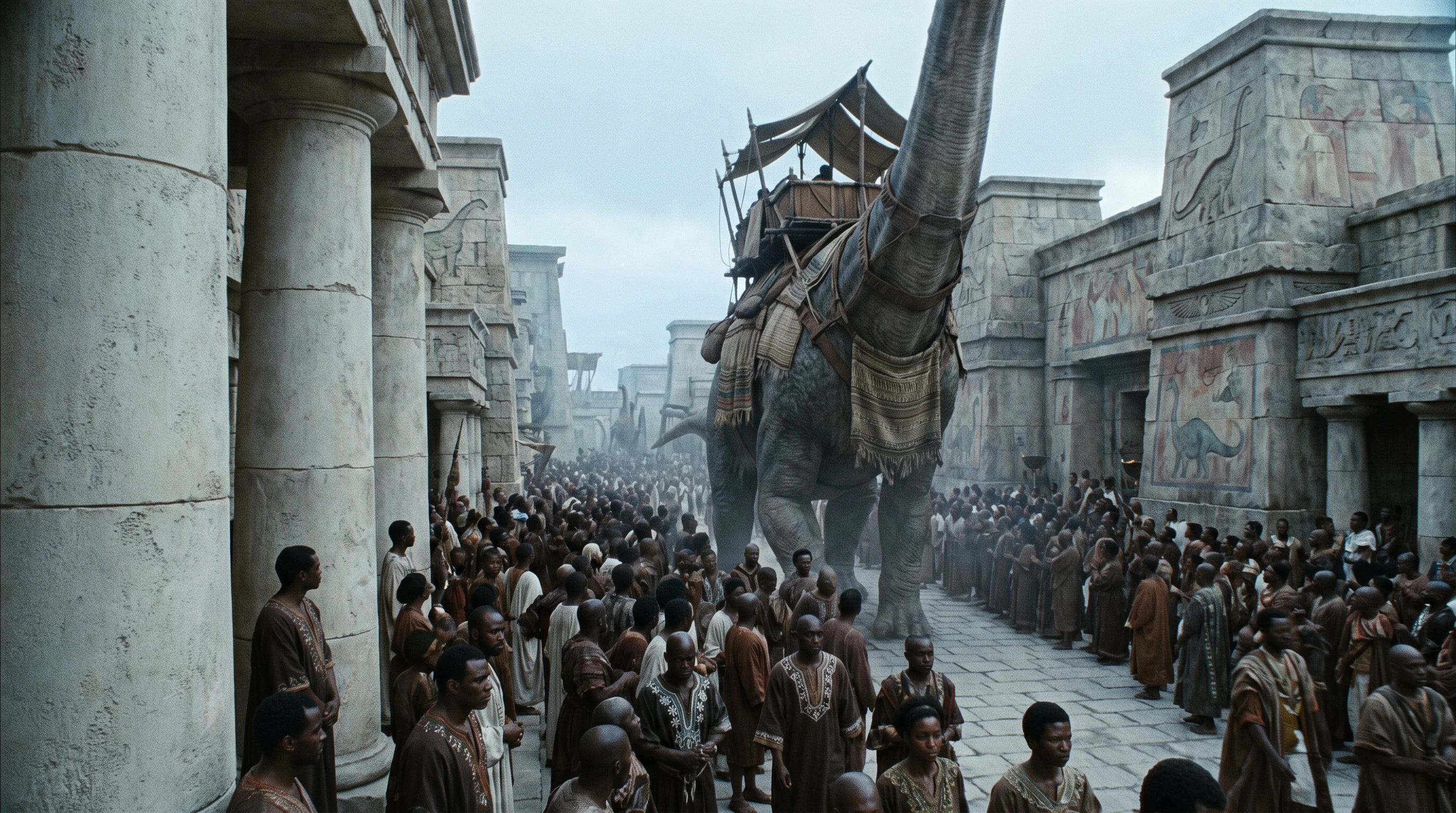
The vertebra avenues
Very long and wide enough for the largest sauropods, Urnok’s vertebra avenues take convoys, parades and withdrawals. The passage of a colossus follows a schedule, closures and a written liability.
Roadways for the colossi
The vertebra avenues are very long ways wide enough for giant sauropods to pass. They serve for traffic, parades, withdrawals and the crossing of convoys. Side passages are kept for people. They are a kind of ancient highway that makes the imperial scale immediately legible to anyone entering the capital.
They occupy the city’s middle level, between the palaces, archives and banks of the heights and the canals, collection works and dirty trades of the lower levels. Their upkeep falls to pavers and load inspectors. The slow tread of sauropods on the paving forms the “pulse” of imperial cities.
A street with its hour of mass
A great animal does not simply cross the city. Its passage triggers closures, mobilises ground crews, diverts people and engages a written liability. Streets work in slots of mass, with their stops, water, fodder, inspection and cleaning; the small human passages go around the load-bearing routes.
The capital never stops entirely. At night, some routes change direction to let heavy convoys through. From the street, a colossus appears only in fragments; only high points and galleries allow it to be seen whole.
Ribbed slabs and engraved floors
A load-bearing avenue is first of all a floor. Its ribbed slabs of stone and binder are laid with flexible joints; deep gutters line it, and traction grooves guide the animals. The road is tended like a crop: slabs reset, joints refilled, edges planted against erosion.
These floors have their trades. Lime drawn from sauropod eggshells, bound with collagen, is used to precast grooved, non-slip, draining slabs for the convoy rings, bridges and great squares. Other workshops trace the traffic code into the stone, groove, polish and mark the colours: the road becomes a register as much as a guide. Fresco painters map the floors in administrative frescoes that they restore every year.
The First Vertebrae
The oldest of the capital’s avenues is called the First Vertebrae. It was the first way broad enough for a titan to turn round without leaving the roadway, and it remains reserved for parades and solemn withdrawals. A double row of brachiosaur statues lines it along its whole length. Its oldest slabs are hollowed by two parallel grooves, worn by centuries of footfalls in the same place, which the pavers have always refused to replace.
Custom has a new sovereign’s first procession travel the First Vertebrae from end to end, at the walking pace of the great beasts escorting it. Residents of the neighbouring quarters then rent out their galleries and roofs at a fortune, and the whole city lines the avenue to watch the Crown pass at the colossi’s step.
Measuring an avenue
A vertebra-avenue is measured in width before it is measured in length. The largest reach some sixty paces from parapet to parapet: enough for two sauropod convoys to pass each other, for tails not to sweep the verges, and for the side passages for people to stay out of reach. Width markers set at every crossroads recall the avenue’s class and the beasts it can take.
The paving follows the same logic. In the centre, where the heaviest pass, slabs of hard, heavy Bralnor basalt are laid; on the sides, grooved slabs of lime and collagen, easier to relay. The verges are planted with ferns and close-rooted shrubs that hold the earth of the banks. An avenue of this size costs more to maintain than a whole quarter, and the city carries the expense as a permanent debt.
Beneath the slabs
Beneath some avenues open massive vaults, built to carry the weight of the colossi without sagging. They house drains, reservoirs and above all cool cellars that the city lets. Brewers make Calaron’s barley beer there, dark and thick, which improves with ageing in the dark at an even temperature; merchants keep their jars of oil and grain there.
These cellars have their rules. No fire is allowed without permission, because the smoke rises through the roadway grilles and unsettles the beasts; tenants must keep access to the drains clear; and when a particularly heavy convoy is announced, the load inspectors go down to check the vaults. In the capital, a good beer is said to have “heard the colossi pass”, because the most sought-after cellars lie under the busiest avenues.
Avenues for gathering an army
In war, the vertebra-avenues become the capital’s parade grounds. Legions form there before marching out, columns of great beasts are drawn up in marching order, and quartermasters check the loads before the residents’ eyes. The city is then closed to civilian convoys for days, and the departure of a great army lasts from morning to evening.
The avenues are also designed for defence. At the Opening of the Rings, the Empire’s last level of mobilisation, they would be cut by barricades of carts and blocks, and colossi posted across the roadway would serve as living gates. A dreadnoughtus planted across an avenue closes it better than a wall, and the city’s defence plans show at every crossroads where to place one.