

Places and landscapes
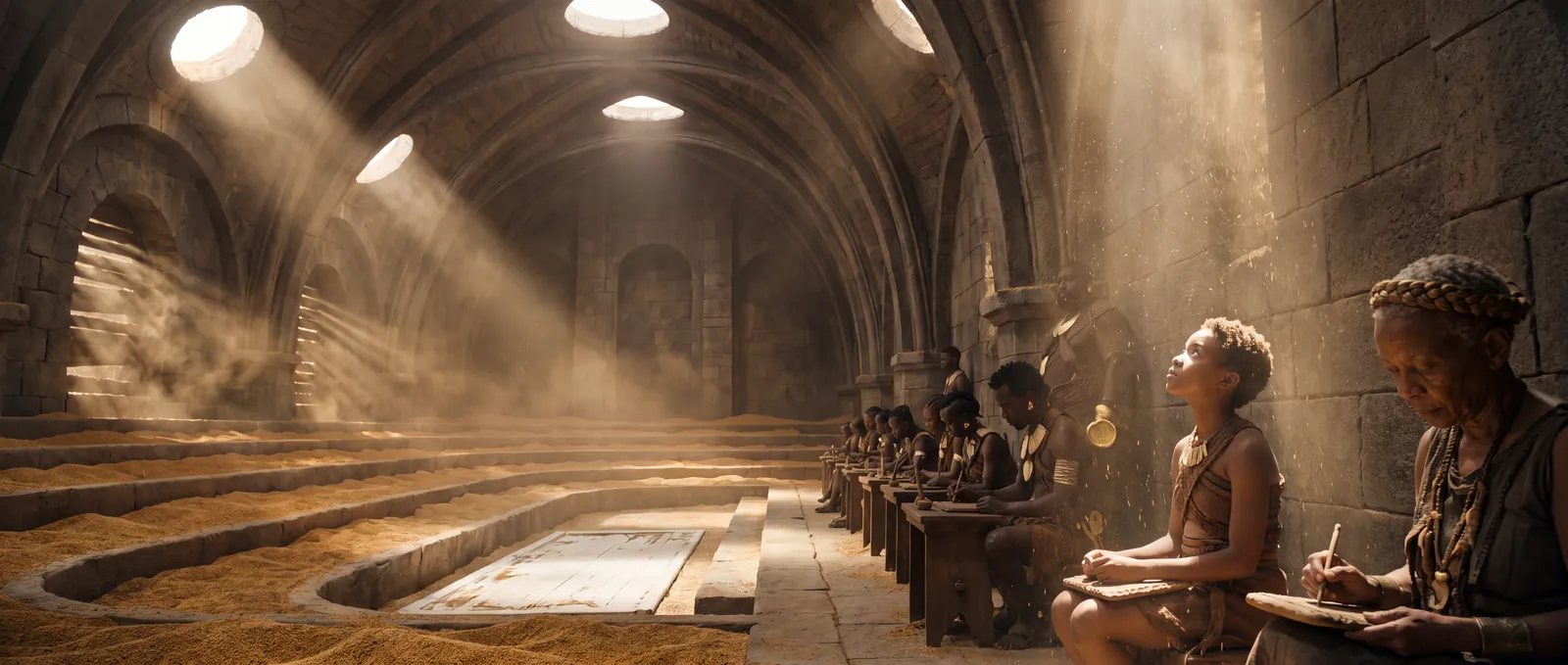
The cathedral granaries
Graduated, ventilated storage towers, the cathedral granaries keep the Empire’s grain, seed and fodder. Their mass makes one of Urnok’s rules visible: power is a capacity to feed.
Graduated, ventilated towers
The cathedral granaries are massive, graduated and ventilated towers, built to store grain and fodder on the scale of the titans. They are not merely monuments: their ventilation protects the reserve, and their mass displays a territory’s ability to weather a bad season. In the capital they occupy the upper and middle levels of the city; the sauropods depend on them through supply.
Inside, stacked vats are checked from above with gauges and probes. Ventilation chimneys carry air, and with it the smell of the grain, up through the floors. At the Gué-Long, warm niches hold seed reserves, drains carry water away, and a lower hall can host an audience. Granaries are distinguished by generation of construction: Sarnor’s Gué-Long is a third-generation cathedral granary.
The memory of famine
The cathedral granaries descend from the famine that founded the Empire: the first Urnokians were starving people who had sworn “never again”. Sarnor, the granary duchy, is guarded like a sanctuary, and the smell of grain in the silos remains the smell of safety. The heavy granary bells are part of the sound of imperial cities.
The reserve also backs the currency. The Gold Scale is backed by stocks, and the Great Treasury of the Granaries is made of grain rather than gold. Grain credits are secured on the granaries’ declared reserves: a granary thus commits building sites and roads far beyond its own walls.
A distributed reserve
A cathedral granary does not necessarily belong to the House that holds the duchy. In Sarnor, House Orlenox owns the Gué-Long, but the duchy’s grain is divided among several dozen granary Lines: about ten High Lines and forty to sixty Lines beneath them. The Karnil hold the cathedral granaries of the Upper Ford, under the duchy’s oldest registration, older than the Unification. The Ulmen keep the seed and draught lineages, the Corsen the basins and irrigation, the Tanoris the right to move grain, the Marlen the mills.
This dispersal makes the Empire hard to bring down in a single blow: when one family falls, the others keep delivering. Every twenty years, the granary chiefs vote for the Diet of the Great Granaries, which certifies the reserves morally without managing the grain day to day.
Opening a granary
The imperial inspection of a granary follows a fixed procedure. The granary to be checked is chosen by lot: one bone marble per declared granary, a bag and a child’s hand to draw, so that no one can dispute the choice. The minimum legal notice is twenty hours. A granary is not opened with an army but with surveyors, counters, lineage scribes, a probe master and the escort the law requires.
A granary is inspected by the nose before the registers: sound grain smells dry, of soft dust; damp grain smells of earth and ferment. Load surveyors can redo the calculation vat by vat, with cord and plumb line, while the counters read the official gauges.
Grain and clutches that are not eaten
Granaries distinguish what will be consumed from what extends harvests and lineages. Some, like the Gué-Long, also keep clutches in reserve in warm niches: chests of eggs declared as seed, status S, are exempt from the table tax and take priority for fodder, because the Egg Law protects the future before the belly. Lineage scribes record them and can candle them by lamplight; declared seed losses are written off by the Crown.
A beauty of ventilation
The cathedral granaries are beautiful through technical truth rather than decoration. Their hollow buttresses serve as air ducts, their lanterns and oculi as extraction outlets, and their ribs carry at once the structure, the airflow and a sacred signal: the reserve means survival. Public measuring marks, in bands and gauges, run along their flanks, and carved squares are laid out around the reserve gauges, where faith merges with security.
Fire and mould
A silo fears two enemies more than raiders: damp and fire. Damp grain moulds, ferments and heats; packed fodder can catch fire by itself when heat builds up at the heart of a bin. The ventilators open and close the chimneys according to the humidity of the air, the probers lower their rods at several heights to feel for heat, and the fire watchers keep vigil day and night at the top of the towers.
Small creatures do the rest of the damage. Insects and small saurians move into the bins as soon as a crack opens, and every silo employs its hunters, who set traps, seal cracks with lime and burn bitter herbs in the empty galleries. No one ever goes down into a bin alone: the air becomes unbreathable when the grain ferments, and one enters roped, with a test lamp that goes out before a man would fall.
A silo in time of war
In war a silo-cathedral is both a fortress and a target. Its thick walls withstand assaults, its gates are narrow and guarded, and the Silo Pikemen who defend it are trained to stop a beast charging into a crowd; silos in threatened regions receive extra garrisons and water stores to hold out through a siege.
The Empire also has a harder rule: a full silo is never left to the enemy. When a region can no longer be held, the grain is taken to the rear by convoy, and what cannot leave is destroyed. Burning a silo requires a written order from a senior officer, countersigned by the silo chief, and the act is entered in the register with the quantity lost. It is one of the heaviest decisions an Urnokian commander can take, and many prefer to hold out to the end.