

Places and landscapes
The Vertebra-Temple
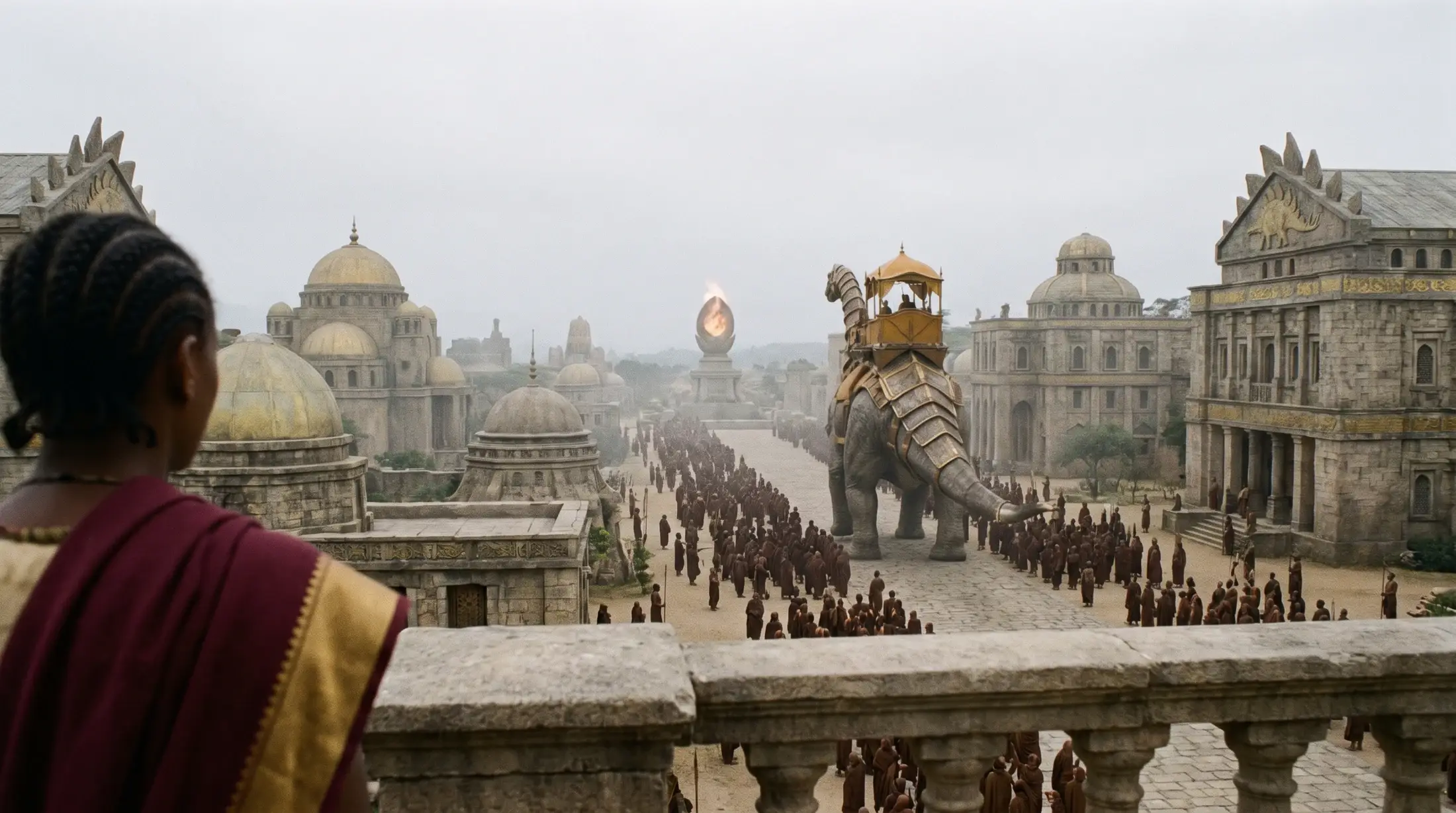
An Urnok style in which the city becomes a monumental skeleton: vertebra-shaped buildings, thick arches pierced with elongated openings, lined up in collars. The sacred there means bearing the load, and its statues are faceless Bearers.
A ribcage laid on the ground
In the Vertebra-Temple, the city takes on the look of a monumental skeleton. Its buildings are “vertebrae”: thick arches pierced with elongated openings, lined up in concentric collars. Each vertebra is a mixed module bringing together housing, fodder store, workshops and ramped terraces. Seen from afar, the city forms overlapping crowns of arches, like a giant ribcage laid on the ground.
Ornament follows the same logic: bone striations, growth rings and tension lines show that everything was designed for weight. The form states an economic reality in stone: the city exists because a single sauropod can move monoliths, and because its works are calibrated for enormous masses. It stays alive through repetition and its variations, like a bone at once strong and light.
The Bearers
Statuary does not depict human gods. It raises Bearers: faceless colossi carrying beams or chains like ligaments. The sacred, here, means bearing the load, literally and morally. The capital’s vertebra colossi and load steles belong to the same family of monuments.
Vertebra terraces
A variant stacks the masses in tiers, like geological layers. Each level is a terrace climbed by ramp, without stairs; ribbed buttresses hold it up, and circular knots let convoys turn. The buildings are blocks of great inertia, with striated façades and softened corners: they seek weight, stability and legibility at the scale of a brachiosaur rather than slender height. Their walkable roofs, served by spiral ramps, are both streets and service platforms.
Vaults there follow the curve of a hanging chain, giving wide masonry spans and natural stability. A neighbouring form, the sediment terraces, turns the city into a mountain of tiers in which each layer has its function: fodder, water or archives. Urnok needs works that resist crushing: the city becomes an artificial relief, walkable and sturdy.
Building a vertebra
A vertebra is built like a bridge. Broad foundations are dug first and loaded with rough blocks to spread the weight; then quarry brachiosaurs lift the voussoirs of the great arches, which masons set on wooden centring. The elongated holes piercing the arches are not windows: they lighten the mass, let the air through and serve as holds for scaffolding and lifting ropes during repairs.
A vertebra takes several years of work, and a whole collar several generations. Building therefore always leaves a toothing stone at each end, so that the next module can hook on. In the old quarters these toothing stones sometimes jut out for centuries, and children climb on them.
The people of one collar
A collar of vertebrae forms a community. The families living in it share the same ramp, the same terraces and often the same granaries, and they owe one another days of work for its upkeep: redoing a joint, clearing a drain, resurfacing a terrace. People speak of “folk of the same collar” as elsewhere they speak of street neighbours.
Life there follows the order of the levels. Below, fodder stores and workshops; in the middle, homes, kept cool by the thickness of the stone; on the terraces, gardens, washing lines and evening feasts. A collar has its quarrels like any quarter, but one rule is beyond dispute: no terrace is loaded beyond what the marker carved at its entrance says.
Touching a Bearer’s shoulder
The faceless Bearers are the porters’ best-loved statues. Before taking up a heavy load, a porter lays a hand on a Bearer’s shoulder, where the stone beam rests on the statue; over time that shoulder has been polished paler than the rest. Because the Bearers have no faces, anyone can see themselves in them: the street porter, the mason, the pikeman, the mother carrying a child.
When a porter dies at work, his companions tie a strap around the ankle of a Bearer in his quarter. The straps pile up over the years, and the temple wardens remove them once a year, at a ceremony where the names are read aloud before the straps are burned.