

Religion and rites
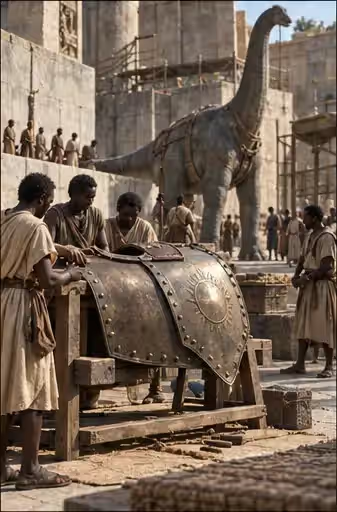
The Kindling of the Forges
The festival of Urnok’s armouries: the fires are lit together and the metal and the armour of living beasts are blessed.
Fires lit together
The Kindling of the Forges (Embrasement des Forges) gathers the armouries around the simultaneous lighting of their fires. At night the forges catch one after another; sheaves of sparks rise beneath the stone ribs of Calaron’s armouries. Metal is blessed, and so is the armour of living beasts, the plating that protects the great working and war animals.
Showing what equips the Empire
The festival makes visible a work that usually stays hidden. A cuirass is fitted hot onto a harnessed beast; apprentices carry plates at arm’s length, legionaries stand in rank, children climb the ramps to watch. Metal from Korath passes from hand to hand. Animal armour requires fitted pieces, fastenings and precise knowledge of the body it must protect.
The night of the Kindling
The Kindling of the Forges takes place one night a year, at the end of the wet season, when the roads become passable again and the armouries take up the year’s orders. In the days before, the forges of Calaron are put out and cleaned, their bellows re-stitched, their anvils greased. When night falls, a first fire is lit in the capital’s oldest armoury; runners carry embers in closed clay pots and race to light the next forge, then the next, until the whole city is ablaze from one to the other.
The chain must not break. A forge that has not caught when the next embers arrive shames its master for the year, and the apprentices spend the whole evening watching over the charcoal and the draught. The sheaves of sparks rising under the armouries’ stone ribs tell the neighbouring quarters that the fire has passed.
What is blessed
What is blessed is metal and the armour of living beings: articulated plates mounted on sauropod leather to follow the animal’s breathing without hurting it, gorgets protecting the throat and base of the neck of breakthrough sauropods, war soles, the black harnesses of Velmor, attachment rings and rivets. The most awaited moment is the fitting on a living animal. The plate is shaped hot on the anvil, then cooled before it goes near the animal; the leather, moulded warm, takes the shape of the body under the harness makers’ hands, while a vet watches the beast’s breath and eye.
The blessing itself is short. The armoury master presents the piece to the handlers, names the animal that will wear it and the workshop that made it, and the piece is entered in the armoury register. A cuirass is not blessed for its beauty: it is blessed for the body it must keep alive.
Metal from elsewhere
The festival also shows where the metal comes from. Rivets, chains and rare parts arrive from Korath along the black road, black stone and black leather from Velmor; during the night ingots and sacks of rivets pass from hand to hand, from merchants to masters, from masters to apprentices. Korathi envoys sometimes attend the lighting, and the Armouries of Urnok in turn send their representatives to the front row of Korath’s great forge festivals, where the year’s metal contracts are engraved in basalt.
Urnokians do not hide this dependence. If anything they celebrate it: an imperial armour is made of the Empire’s leather, the Empire’s tendon and other people’s metal, and every year the festival is a reminder that a cuirass is also paid for in treaties.
A neighbourhood festival
Around the armouries the night is also a popular festival. Flatbreads are baked on the hot iron sheets, barley beer from the capital’s cellars is drunk, and the smiths’ families open their courtyards. Children climb the ramps to watch the sparks; the armourers’ children often receive their first tool that evening. Apprentices who have finished their time present their first piece, and the master who accepts it puts it into the chain of blessed pieces.
Across the rest of the Empire, armouries and garrison forges light their fires the same night. News of the lighting in Calaron runs along the great roads by the relays’ beacons, and in the marches they say that a smith who lights up before seeing the signal has got the year wrong.