

Armies
Urnok — Arsenaux et matières du vivant
De l’atelier au terrain d’exercice, les os, les tendons, les cuirs et les cornes deviennent des pièces choisies pour une fonction précise.
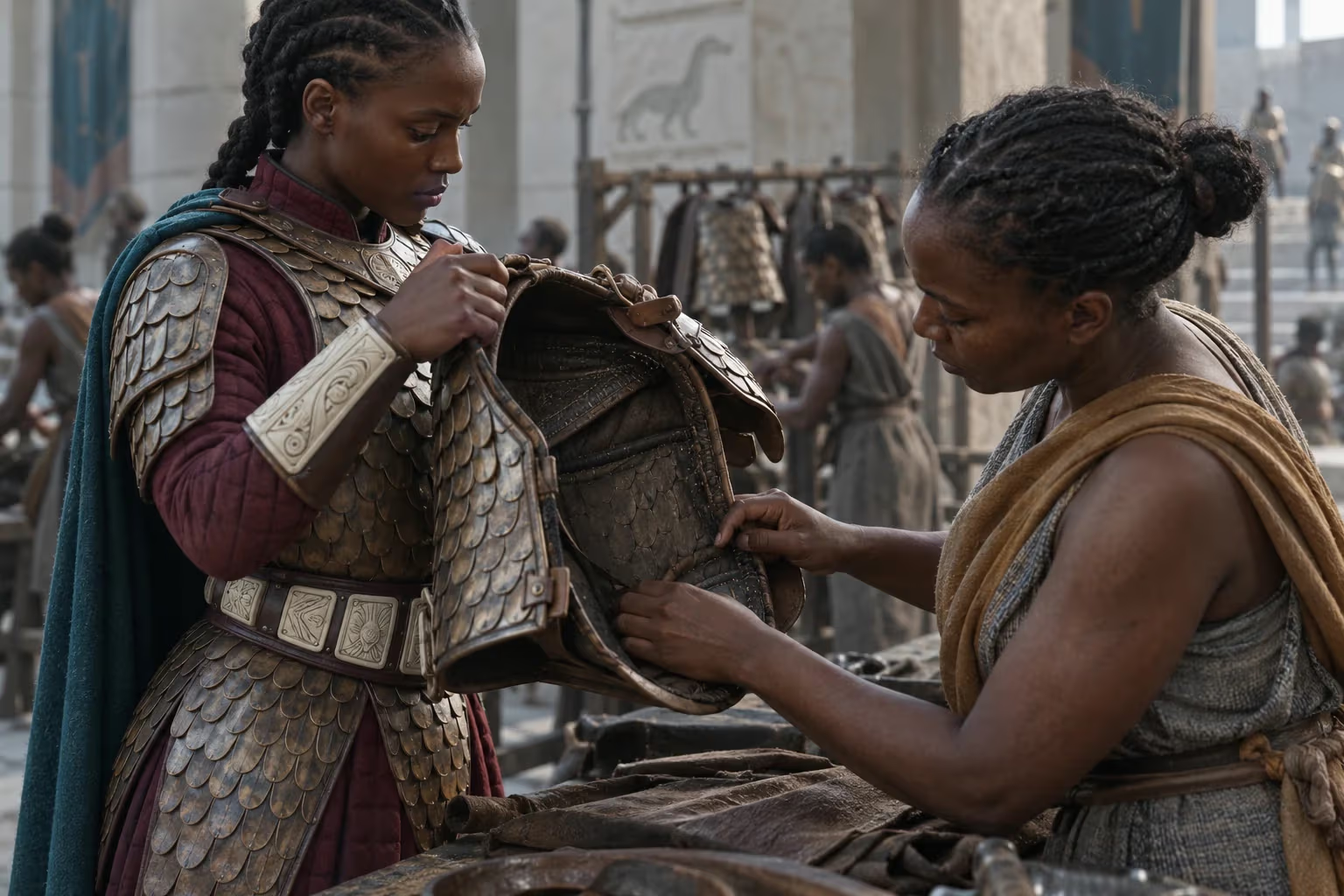
Choisir, assembler, réparer
This extended reading is currently available in French.
L’arsenal urnokien se construit à travers les Lignes et leurs responsabilités. Les matières, les pièces intermédiaires, les harnais et les équipements ne suivent pas tous le même trajet. La capacité militaire dépend de ceux qui savent fabriquer, acheminer, vérifier et réparer. Une arme ou une protection achevée garde ainsi la trace d’une chaîne de travail ; la puissance d’une unité repose aussi sur la continuité de cette chaîne pendant sa marche.
Observe gestures and materials · 4 images
Les pointes d’Orlantis
Orlantis · tri des pointes de queue.
Le harpon des routes forestières
Orlantis · exercice d’arrêt de monture.
Deux matières, deux marchés
Orlantis · atelier décoratif et stocks militaires.
La réserve des pointes adultes
Orlantis · équipement d’une garde forestière.
Les matières biologiques ne rendent pas toute arme supérieure au métal. Une doublure doit rester souple, une protection laisser respirer et une pièce usée pouvoir être remplacée. Les plaques dorsales décoratives se distinguent des pointes adultes destinées à l’armement.
Éprouver le matériel
Inspection, manipulation et entraînement révèlent la place de ces équipements dans une formation. Les gaines de griffes et les couronnes d’Apex restent des prototypes ; les équipements scellés gardent le secret de leur fabrication.
Observe gestures and materials · 5 images
Briser la course
Cour de légion · déploiement d’un filet.
La corde des grands ouvrages
Parc du génie · manœuvre de treuil.
L’abri avance avec la section
Cour de siège · progression sous mantlet.
L’odeur de la résine
Orlantis · approvisionnement d’un arsenal.
L’ordre traverse la brume
Route de convoi · signal militaire.
Armour is a work chain
The Living Armouries can operate as a state-contracted company tied to command armour, plates and shock dissipation. Their activity connects prepared material, fitted component, testing, repair and inspection.
Military work depends on several territories
The Armouries work in contact with Velmor, Calaron and Korath. They can therefore be read as coordination among materials, chancery and manufacturing knowledge, without assigning them a territorial monopoly. Every military order remains subject to procedures, component inspection and the supply chains that provide materials.
A contract does not replace institutions
The Armouries replace neither imperial decision makers, ducal Houses nor workshops responsible for a component.
Four scales of work
A House holds a duchy or an imperial function. A High Line handles a supply chain; a Line, an intermediate product; a Short Line, a workshop or a non-inheritable working life. The register connects a part to those responsible for it. This organisation makes work between raw material and final use visible.
A duchy does not own all its grain
The Orlenox hold the duchy of Sarnor; its reserves are distributed among many Lines. Karnil handles silos, Ulmen seeds and draught lineages, Corsen irrigation, Tanoris rationing and convoys, Marlen mills. Producing, storing and moving grain are therefore separate responsibilities.
The register identifies who is responsible
In the Register of Trades, a Line is first an address of responsibility. House, High Line, Line and Short Line do not hold the same link: one holds a duchy or function, another a supply chain, an intermediate product or a workshop. When a part fails under load, the register is used to find those answerable for it. Prestige may follow, but it never replaces that concrete function: knowing which door to knock on.
Orlantis intermediate products
In Orlantis, some Lines make what allows others to make. Corvel prepares glues and birdlime; Nalen holds ropes and fibres; Ombrin provides soot-black and pigments; Tanoris draws tannins from bark. These materials then enter an assembly, haulage, ink, tannery or harness. Forest wealth therefore does not stop with a felled tree: it continues through intermediate products whose absence halts several trades at once.
The material order of districts
An Orlantis city is read upstream to downstream: arrivals and log yards, floating basins, dryers and steaming rooms, turning, framing, resin boiling, then port. Boiling stays downwind and outside the walls; stegosaur enclosures sit in an outer belt connected to forest and carrying route. These choices shape working neighbours, smells and risks. They also keep the urban centre from being treated as a simple square through which everything can pass.
Dependencies between duchies
An Urnok supply chain crosses materials no one duchy holds alone. Orlantis bark can become tannin, then leather, then a harness in Velmor; that harness accompanies a Bralnor sauropod and a load paid in Sarnor grain. The ink recording the accounts can itself depend on Ombrin. This chain does not name a secret alliance or a single market: it shows why a local break spreads, and why imperial power depends on work carried out far from one another.
Mobility and closure of Lines
A Line can be taken over, struck from the register or rebuilt; a Short Line can become a Line over several generations. Being without a Line describes a day labourer who works without answering for a registered link. Mobility exists, but remains slow, notarial and costly. This separates productive responsibility from absolute birthright. Lines do not form a collective power: they supply, inherit, sometimes marry, close and leave behind chains that must be repaired.
Weight must be distributed
A harness joins a load, vehicle, person and living body. Straps, padding and tension parts distribute effort and keep fastenings inspectable. Care starts before departure, in how a load is placed and in the ability to remove it.
Practices that prevent wear
Harness inspectors, saddle repairers, carers and convoy leads do not hold the same post, but their work follows in sequence. They observe fit, the condition of a component and resumption of movement. Their cooperation explains why a working animal is not a machine that can simply be replaced when a strap wears out or a crossing puts it in difficulty.
Work responsibilities in Urnok
Responsibility has an address
The Lines register does more than classify families. It provides an address of responsibility: a House, High Line, Line or Short Line answers for an identifiable part of work. This granularity makes it possible to follow a component, delivery or defect without claiming one name owns an entire economy.
Work responsibilities in Urnok
Work can be transmitted without enclosing
A Line can endure, end, be struck off or change scale. This transmission is slow, notarial and costly, but it does not erase mobility.
Work responsibilities in Urnok
No Line stands alone
Grain, timber, stone, harnesses and armour pass through several workshops, roads and checks. A Line holds one link; it does not replace the ducal House, convoy, carer, load inspector or neighbour providing an intermediate component. Responsibility becomes legible because dependencies remain legible too.