
Places and landscapes
The Terres Englouties
Ruins, wild titans and taboo zones: the part of N’Goro that keeps the continent’s deep memory and escapes the human corridors.
Ruins and deep memory
The Terres Englouties hold ruins, wild titans, taboo zones and the continent’s deep memory. They belong to a land most of which remains wild. An old building there guarantees neither present access nor a possible settlement: water, vegetation and animals may have changed the conditions that once allowed it to be occupied.
An unadministered space
About seventy per cent of N’Goro’s territory remains wild, unadministered, unsurveyed and sometimes impossible to map durably. In the Terres Englouties, the limits of a known sector are not stable and promise no administration. Crossing depends on local knowledge, protections and timing; some places resist any lasting map, because the useful signs change faster than the recorded lines.
The limit of intervention
Taboo marks limits to human intervention. N’Goro is not just the communities that master a passage: it includes what lies beyond their control. The wild sectors hold titans and cycles that escape human settlement, and an allied animal does not turn the waters and vegetation around it into safe ground.
What can be seen of the ruins
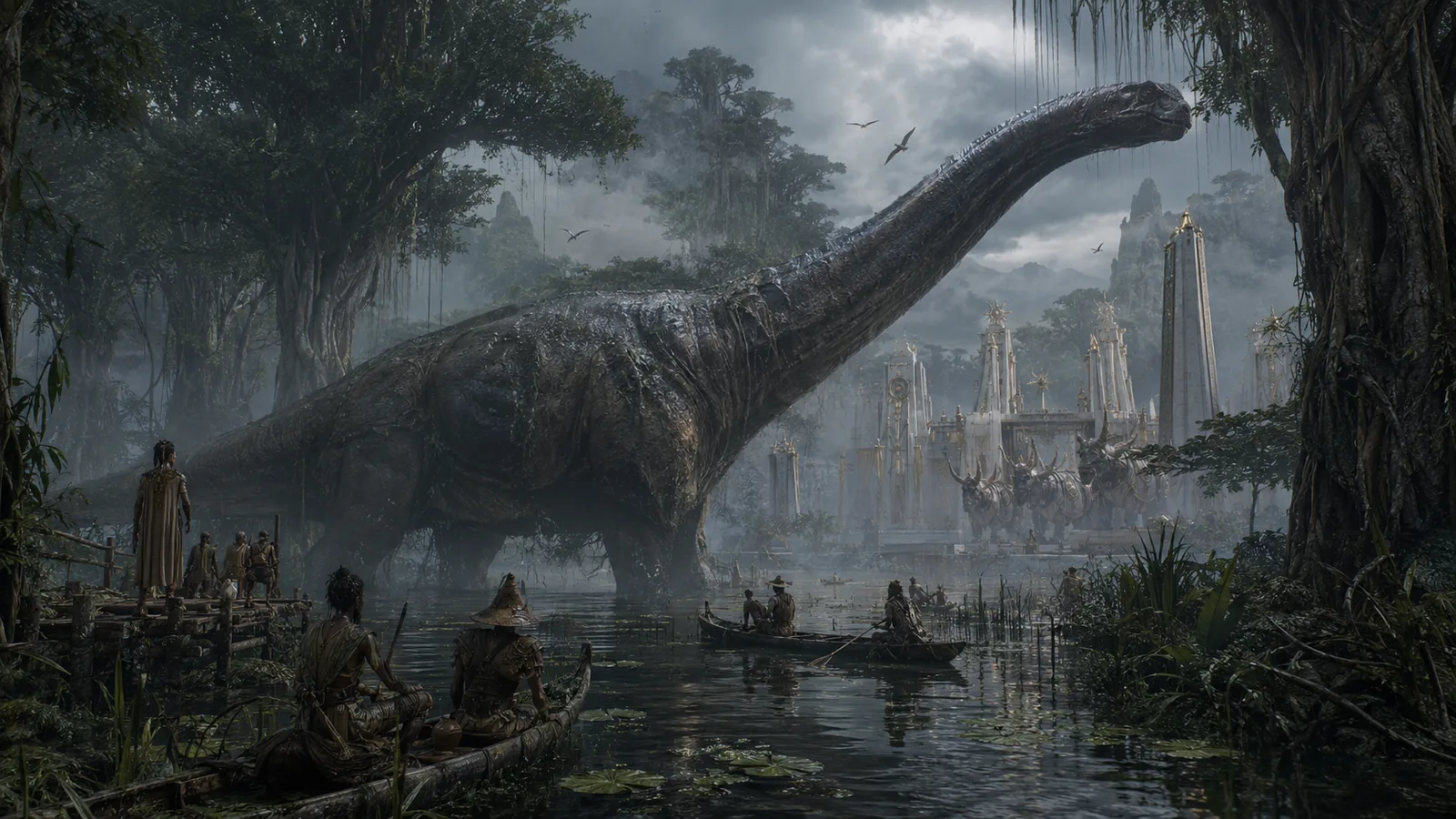
Those who have come back from the Terres Englouties describe things that resemble nothing N’Goro builds. Terraces of dressed stone vanish beneath black water; standing pillars, taller than young mangroves, are gripped by roots that have slowly split them; steps lead down into lakes whose bottom cannot be seen. Some surfaces carry worn carvings that no one can read and that the Ngoro take good care not to copy.
The clans tell several stories about them. Some speak of a world older than the Empire, others of a time when the waters were low and people lived on dry land; the Sap-Keepers, more cautious, say only that these places belong to the continent’s deep memory. The known world covers only part of Pangaea, and the Terres Englouties are a reminder that another history took place before the one the registers tell.
The titans no one owns
The Terres Englouties are the domain of wild titans. The marsh sauropods there belong to no one: colossal beasts covered with mosses and plants, moving slowly from lake to lake, around which maps must change, because their mere passage crushes floating mats, opens channels and shifts mudbanks. The great crocodilians, among them the Sarko-Brume, hold the deep waters and bar entry to them.
Wild spinosaurids also hunt there, warier and less predictable than the Siirmuu of the estuary. Trainers do not try to capture them: a great living creature cannot be commanded, and no ally is made of a beast that has never known the scent, food and rhythm of a human team. The Ngoro regard them as the guardians of a balance they do not master.
The keepers of the ruins: the House of Saek
One house holds the approaches to the Terres Englouties: the House of Saek, the house of sealers and tanners. Its people hunt the great beasts of the wild lands, take their hides, blood and glands — the latter go to the Basins for anti-rot glue — and tan the leathers with cakes of black spores and peat to make spore-black leather, the anti-marsh leather all N’Goro buys. The trade is hedged with prohibitions, and the tanners live somewhat apart.
The house also guards the sealed ruins that no one is allowed to dig, around Nguwa-Ma, where stand the City of Olthune and the Obelisk of Vorah-Kai, two names that resemble nothing in the N’Goro tongue. Its founder, Vahku, is held to have been the first sealer of the Forbidden Mires and the first keeper of the taboos; his sanctuary at Vah-Ku still receives offerings from those setting out for the ruins.
What the taboo commands
The taboo zones are not merely forbidden: they have their rules, which the few authorised travellers observe strictly. No fire is lit in the open; no blood is shed on purpose, not even a fish’s; no mark is left, and one carries one’s refuse back out. The names of the dead are not spoken there. Guides explain these prohibitions in very practical terms — fire draws, blood calls, a mark deceives whoever comes next — but they respect them as sacred laws.
Some limits are marked by lines of stakes planted along the edge and mud seals, like those renewed elsewhere during the Sealing of the Mires. Others are signalled only by the memory of neighbouring clans. Crossing a taboo without cause earns no fine: whoever comes back must go through a full quarantine, and his clan answers for whatever he may have brought back.
Going in all the same
A few go there all the same. The keepers of Archive-Tourbe, who hold the memory of the marshes, go to record signs; the priests of Fossile-Chant seek bones said to “speak”; harvesters take materials found nowhere else. Every expedition goes first through the Circle, which registers it, and through the Sap-Keepers, who prepare the kits: Silent Water to mask body scent, Clear Breath against spores, Red Moult for wounds, and counter-doses in quantity.
An expedition rarely numbers more than a dozen people, and always includes a guide who has been there and come back. They set out for a few days, rarely more than two weeks. The Ngoro keep count of the missing without drama: one traveller in three comes back diminished, and it happens that a whole expedition does not return. In wartime the Terres Englouties serve neither as refuge nor as battlefield; they merely remind both sides that at the heart of the country there are places where no one wins.