

Armies
Maintaining living weight
Straps, padding, tension parts and inspection give military equipment a working life.
A harness does not have a single workshop
Inspection belongs to movement
Inspection and cleaning are part of Urnok movement, alongside stops, water and fodder. Written responsibility accompanies great animals’ passage. Between movements, a part and its condition matter as much as its provenance. Maintenance therefore extends beyond a spectacular repair after an accident.
Materials keep their limits
Leather, sinew and binders remain sensitive to treatment, moisture and fatigue. Orlantis chains supply tannins, fibres and adhesives; Velmor receives materials from elsewhere. Military maintenance therefore depends on suppliers and intermediate parts before any tactical decision. No material becomes indestructible through animal or imperial prestige.
The Living Gears
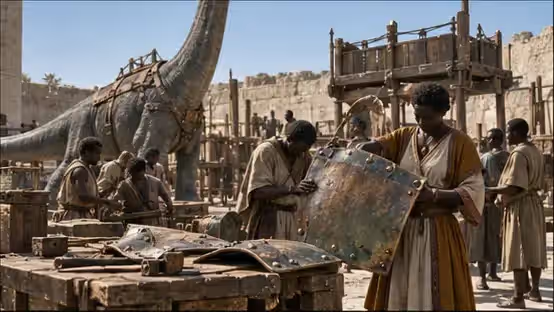
In war, maintenance has its own branch of great living beasts: the Living Gears. These are mobile workshops carried by sauropods, with their bellows, winches, stocks of rivets and parts, and the craftsmen who serve them. An animal does not carry a lit forge on its back: it carries the dismantled workshop, which the team sets up at the halt. Within an hour a relay yard or a roadside meadow becomes a forge, a saddlery and a ropewalk.
The Gears follow the army at a distance, together with the Living Silos. They replace what breaks most often: straps, plate rivets, attachment rings, the wooden parts of platforms. Their presence changes the way a campaign wears an army down. An army without a workshop loses its equipment at the rate of its accidents; an army that repairs on the march loses only what it cannot bring back.
The inspection round
Every evening on the march the harness teams go over the animals. They look for the seam that is running, the strap fraying at its edge, the rivet working loose in its plate, the skin chafed under a pad. A checked piece receives a mark — a punch, a stroke of colour, a notch — and the harness inspector signs the list. Good straps arrive already stamped by the workshops that tested them under traction; a missing or worn stamp is enough for a piece to be set aside.
The rule is to repair as early as possible. A seam redone in the evening costs an hour; the same seam breaking under a platform loaded with archers costs lives, a panicked animal and sometimes a day on the road. For this reason the imperial armies use standardised armour and bardings made of modular pieces, which are replaced at the bivouac without sending the whole kit back to the workshop.
Parts without a plan
Some parts are State secrets. The neck collars of the titans, made by the Triple Harnesses of Qor Zaï, are sold on their own and always without their assembly plan: the Crown spreads the pieces among several workshops so that no one outside its own teams knows the complete harness. The command cuirasses of the Living Armouries fall under even tighter contracts.
This caution has a price for maintenance. A piece of titan harness is not mended in just any village saddlery: it waits for authorised hands, numbered, with its origin recorded. The orders’ equipment masters therefore keep counted spare parts, and a collar lost on campaign is declared like a lost weapon.
Grease, leather and seasons
Leather and tendon live with the weather. In the wet season harnesses swell, seams rot and ballista cables slacken; they are greased with tallow and marrow, dried under cover and protected with the glues and anti-rot preparations bought from N’Goro. In the dry season leather cracks and compressed padding hurts the animals; it is oiled and beaten, and the linings are replaced. Tendon workers check the tension of the ballista cables at every change of season.
For the orders of great living beasts, the period before a campaign is the season of seams: things are taken apart, redone and replaced, and the leather workshops work through the night. Equipment back from campaign stays in the workshop for weeks before it is declared ready. Officers know it: the last battle can be read for a long time in the repair registers.