

Power and institutions
Urnok — Commandement et haute société
Audiences, décisions, inspections et rencontres privées : le pouvoir se lit dans la place donnée à chacun, dans les vêtements et dans l’organisation des salles.
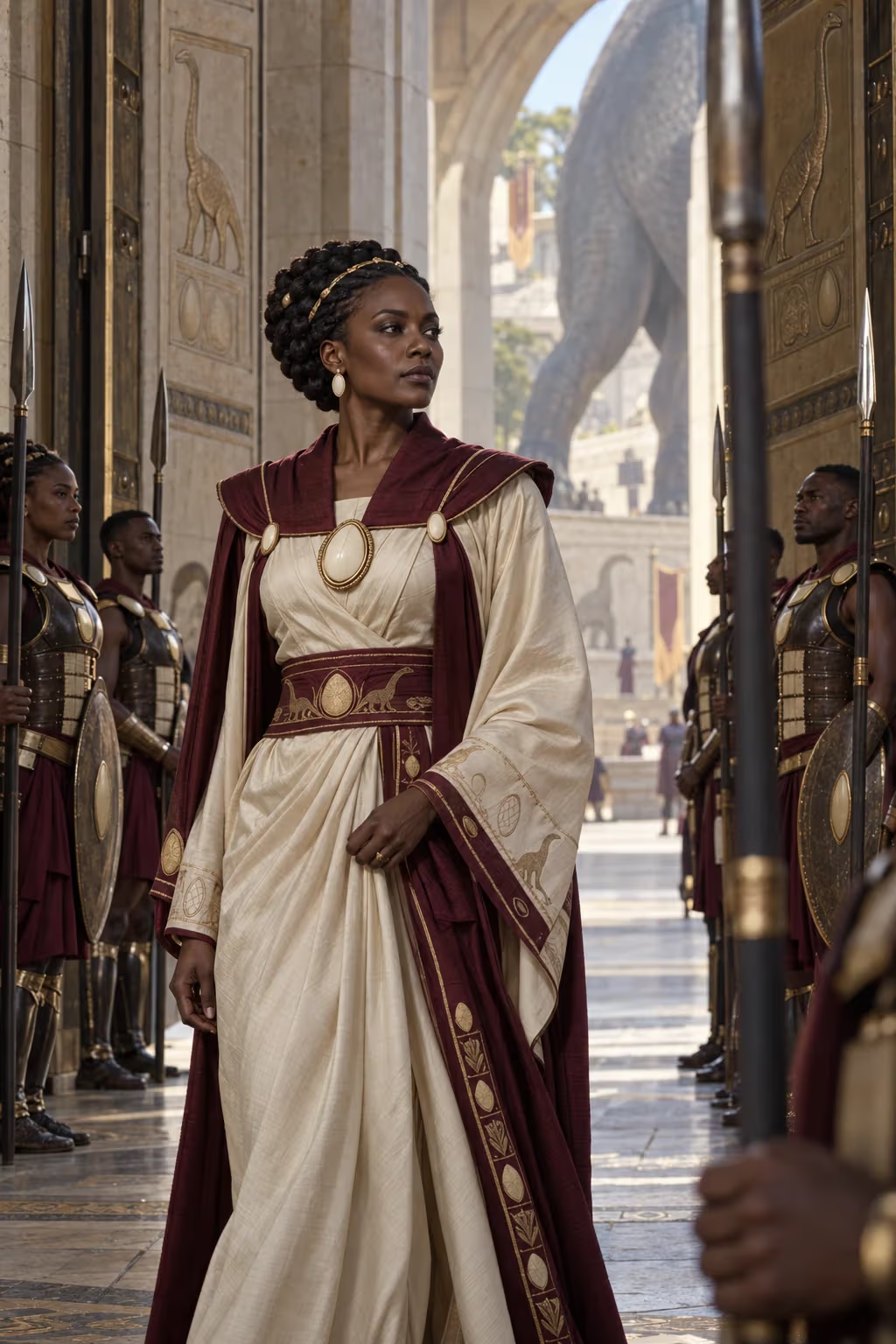
Dans les salles de décision
This extended reading is currently available in French.
L’Empereur arbitre entre les ducs, mais un ordre n’abolit ni les distances ni les capacités locales. Le commandement doit rencontrer les réserves certifiées par la Diète, les routes suivies par la Chancellerie et les responsabilités des Maisons et des Lignes. Une audience prend ainsi place dans une chaîne de travail. La haute intendance de Sahina relie la décision centrale aux vivants, aux équipes et aux matières qui permettront de l’exécuter.
Observe gestures and materials · 2 images
Le silence avant la décision
Calaron · conseil impérial.
La réserve fait autorité
Sarnor · administration des silos.
Les tenues et les fonctions de chacun disent les institutions de la civilisation.
L’autorité en mouvement
Une revue, une réception ou une conversation de cour engage un rapport de force. Tout se joue au moment précis où l’espace, les gardes et les regards donnent un poids à la parole.
Les alliances dans les plis
Calaron · haute société et diplomatie.
Decision is not enough
The Emperor holds sovereignty, supreme justice, war and arbitration between dukes. This authority gives the Empire direction, but it does not by itself move food, animals or materials. Roads, reserves, credit and local holders of responsibility determine what can actually follow an order. Imperial command is therefore a decision-making centre connected to a network of capabilities, not a word that abolishes distance.
An heir of continuity
Sahina is the designated heir and acts in high stewardship, logistical crises and the Long-Pas. Her role makes an essential part of Urnokian power visible: a decision about war, relief or movement matters only if bodies and animals can be sustained for its entire duration. An established succession does not remove tensions of government; it simply prevents reducing them to a rivalry between claimants.
Duchies, orders and services
The Grand College brings together the dukes, the Archduchess of Velmor, great orders and major institutions. There the Crown meets the territorial and technical powers on which it depends. Duchies are not interchangeable provinces: Calaron concentrates the administrative centre, while other territories carry specific materials, skills and roads. The College gives political form to this interdependence without making maintenance, reserve or priority conflicts disappear.
Offices better known than their holders
Several services are defined by their duties: issuing, guaranteeing, maintaining, examining and certifying. Some offices have no identified holder; they are understood through the work they demand and the institutions they answer to.
Certifying reserves
The Diet provides moral certification of reserves. Its function is ritual and symbolic rather than that of an executive ministry managing all grain on a daily basis. Its place in the Empire makes stocks publicly recognisable as a promise kept. It replaces neither the owners of reserves, their working teams nor other financial institutions.
The silo chiefs’ vote
The silo chiefs vote every twenty years. They elect a Grand Keeper. Term and selection belong to the institutional arrangement. They give the rite its own continuity, distinct from daily appointments to handling or transport services.
Many silos, many responsibilities
Certification can produce confidence or panic even when its function is symbolic. In Sarnor, reserves are distributed among many Lines: House Orlenox holds the duchy without owning all its grain. The Diet acts within this landscape of distributed responsibilities. Affirming the strength of reserves requires considering a network of stocks and trades rather than one ducal granary.
The High Chancellery of Living Ways
A road is a chain
The Chancellery oversees imperial roads, bridges, relays, watering places and fodder stations. Its responsibilities include the movement of working animals and great sauropods. A road surface alone is insufficient: a journey must also allow its living load to drink, eat and continue moving. Structures and reserves together constitute a usable route.
The High Chancellery of Living Ways
Holding and meeting standards
Disputes with Karûm-Brakh concern compliance and maintenance in particular. To repair a major road, the Chancellery must work with the builder, local duke and Bank. Paving, bridges and watering places are assessed against their actual function. Asking whether a road holds does not by itself answer whether it meets standards for the loads it claims to accommodate.
The High Chancellery of Living Ways
An animal comes with knowledge
Importing a foreign animal involves the Chancellery, the duchy and trainers from its place of origin. Importation also concerns expertise, labour, public health and funding. A species does not become an imperial tool merely by arriving. Its movement and use must be made compatible with roads, care practices and available skills.
Houses, Lines and responsibilities
Four levels, four uses
House, High Line, Line and Short Line do not name four interchangeable degrees of prestige. A House carries a ducal or imperial function; a High Line answers for a supply chain; a Line handles an intermediate product; and a Short Line names a workshop not yet inheritable. This separation makes visible who decides, who supplies and where a defect can be raised.
Houses, Lines and responsibilities
A name is not a monopoly
The name of a House or Line does not give one family an entire duchy, material or every animal working there. The Orlenox do not absorb Karnil’s silos, the Voranis do not replace forest Lines, and those responsible for a supply chain remain dependent on neighbouring workshops. Useful genealogy therefore starts with documented responsibility, not a decorative family tree.
Houses, Lines and responsibilities
Transmission can stop
A registration can be removed, closed or replaced; a Short Line can become inheritable over time. Shared names between duchies do not prove kinship. The register records work connections and legal succession between people and workshops.
Houses, Lines and responsibilities
Quatre étages, des responsabilités distinctes
This extended reading is currently available in French.
Une Maison tient un duché ou une fonction d’Empire. Une Ligne haute tient une filière ; une Ligne répond d’un produit intermédiaire ; une Ligne courte correspond à un atelier ou à une vie et n’est pas transmissible. Ces étages rendent visibles différentes portions du travail. Ils ne décrivent pas quatre familles qui fabriqueraient chacune le même objet.
Un grand équipement peut dépendre d’une matière préparée ailleurs, d’une pièce tournée, d’un assemblage et d’un contrôle de charge. Le registre permet d’identifier l’adresse de responsabilité de chacun de ces maillons. Le prestige vient de cette continuité, mais il ne dispense pas de répondre d’un défaut. Le nom inscrit relie une activité à une porte où l’on peut demander réparation.
L’organisation donne ainsi une profondeur aux districts : un quartier peut se construire autour de pièces intermédiaires indispensables que le visiteur ne reconnaît pas comme des produits finis. Moyeu, essieu, poulie, colle ou ligature ont une provenance et un responsable. Le registre doit rendre ces dépendances lisibles, et non masquer la diversité des ateliers derrière le seul emblème d’une grande Maison.
Houses, Lines and responsibilities
Du grain de Sarnor aux grumes d’Orlantis
This extended reading is currently available in French.
Le duché de Sarnor appartient aux Orlenox ; cela ne signifie pas que chaque réserve de grain leur appartient. Plusieurs dizaines de Lignes silotières participent au grenier impérial. Les grands silos de la maison ducale sont les plus visibles, mais ils ne résument pas toute la capacité du territoire. Confondre le gouvernement du duché et la possession du grain ferait disparaître les familles qui continuent de livrer.
Les responsabilités se différencient au sein de la filière. Ulmen tient les semences ; Corsen intervient dans l’irrigation ; Tanoris organise le rationnement et le déplacement. Posséder du grain et détenir le droit de le faire circuler ne sont pas la même chose. Une décision concernant une Maison atteint certains maillons sans effacer nécessairement tous les autres.
À Orlantis, les Voranis gouvernent le duché-forêt. Berlan intervient dans l’abattage et le flottage ; Lomvar tient les stégosauridés de débardage ; Mirvane travaille les charpentes ; Tolmen la menuiserie fine et les pièces calibrées ; Aversin prépare les résines ; Marlen relie l’aval aux ports. La grume suit plusieurs responsabilités avant de devenir une poutre livrée. Le dinosaure emblématique dépend lui aussi d’un travail distinct du gouvernement ducal. C’est cette couche intermédiaire qui explique les ateliers, les mouvements de charges et la nécessité des contrôles.
Gallery2 images
A Council matriarch before the chamber's egg. A noble of the imperial court.