

Places and landscapes
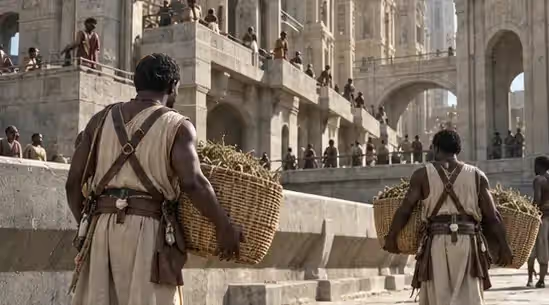
The City of Two Skies
An Urnok urban system that separates levels of movement: on the ground, great animals advance on a base of infrastructure; above, a continuous pedestrian city spreads as a mezzanine, with covered streets, markets, schools, courts and temples.
Two levels of movement
In the City of Two Skies, animals and people do not share the same plane. At ground level, a base of infrastructure receives the great animals: massive slabs, deep gutters, stone guides and resting areas. Above spreads a continuous pedestrian city of bridges, galleries and hanging streets, holding covered streets, markets, schools, courts, counting houses and temples.
The crossing towers are not keeps but viaduct pillars climbed by spiral ramps, gently sloped for loads. High windows and oculi regulate light in the mist and steam. Command balconies let the administration see everything. The ground stays in shade and coolness, life and light are above, and people watch rivers of sauropods pass beneath the inhabited avenues.
Carers’ walkways
An aerial network of inspection balconies, the carers’ walkways, lets people watch, calm and treat the animals without going down to the ground: a colossus is tended there at neck height. The same principle gives the arcades of the noble districts their double height, the lower level for passers-by, the upper for carers and observers.
The carpet city
Pushed to the extreme, the idea gives the spine bridges: a carpet city set on giant viaducts, walking above the plains while convoys pass beneath. In the capital, the City of Two Skies remains one logic among others: small human passages also skirt the load-bearing roads at ground level, and each district keeps its own solutions.
From plank galleries to stone
The City of Two Skies was not designed at a stroke. Its first walkways were plank galleries that scribes, merchants and porters strung above the yards of the old capital so that they could keep moving during the hours when convoys held the ground. They were hooked to house walls and linked by ladders, and every quarter had its own, more or less safe.
When the avenues were widened for the largest sauropods, these galleries became inadequate and dangerous: a flank brushing a post can bring down an entire street. The Empire replaced them, section by section, with stone vaults carried on pillar-viaducts, along routes that were surveyed and entered in the city register. A few plank galleries survive in the old quarters, above lanes too narrow for the great beasts; the residents maintain them themselves and are proud of them.
Living on the mezzanine
In Urnok people say “living up top” and “going down to the ground”, and the second phrase first of all means going to work. The mezzanine is the realm of shops, schools, offices and homes; the ground belongs to the beasts and to those who serve them: keepers, canal-cleaners, fodder porters, pavers. A family of scribes can go weeks without setting foot on a roadway slab.
Life up top still feels what goes on below. The warm breath of the beasts rises through the light wells, with the smell of fodder and dung; the floor shudders under a colossus’s tread, and cups tremble on tavern tables. Solid parapets line every upper street. Throwing anything over them is a serious offence: a fruit landing in a sauropod’s eye can start a panic, and the register records the name of whoever threw it. Children learn this rule before they learn the colours.
Going up and down
Pillar-viaducts follow one another at regular intervals along the avenues, close enough that one never has to walk far to find a way down. Their spiral ramps wind through the thickness of the pillar, at so gentle a slope that a laden porter can climb without stopping and a small mount can pass. Heavy goods take other routes: counterweight hoists, whose basalt weights come from the halls of Bralnor, lift sacks, jars and fodder bales from one level to the other.
At the foot of each pillar a guard post controls passage between the two cities. During a heavy convoy’s slot it closes the lower gate and has pedestrians wait under shelter; at feeding times it lets the care teams down first. Pillar wardens know the timetables of every nearby avenue, and they are the ones people ask for directions.
When the ground overflows
The separation of levels proves its worth above all on bad days. When a beast panics, the keepers’ walkways become a command post: the animal is followed from above, orders are passed by horn and pennant, and the lower gates of the pillars are shut so that no one goes down into the street at the wrong moment. People up top watch; those below take cover in the refuges built along the walls.
Storms bring the opposite. When the gutters overflow, water floods the beasts’ level; small animals are led up to the high yards while the colossi wait on the cambered slabs. The mezzanine stays dry, markets carry on, and upper-level merchants sometimes lend their galleries to families from below. Fires, finally, are feared more up top than below, because roofs and stalls burn, whereas the ground slabs do not.