

Creatures
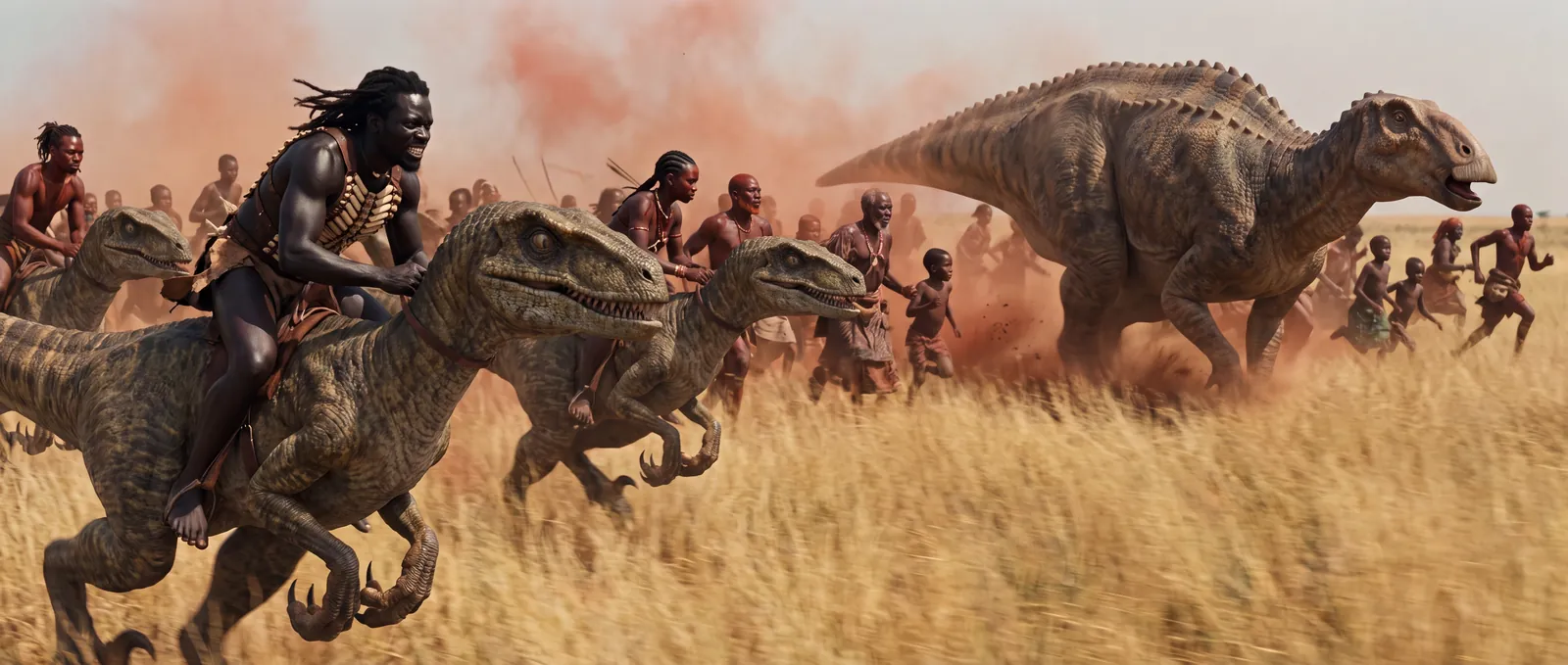
Raptors
Scaled dromaeosaurids, Arkhan’s trail mounts: a raptor, the Vrii, was the first dinosaur ever domesticated.
The Vrii, the first domesticated dinosaur
The first dinosaur ever domesticated by humans was an archaic raptor, the Vrii; that first domestication is also linked to the name Falaa. How the bond began remains unclear. It is attributed to cooperative hunting, shared carcasses and the adoption of young. The most widespread ancient tale is deliberately ordinary: a child is said to have taken in an egg, hidden it from the family and, without knowing it, begun the greatest break in human history.
The prestige of the V sound survives in many myths, towns and families, though today’s cultures no longer know where it comes from. Arkhan has kept more of its words and gestures than any other: there, the mount, riding, movement and the trail came before great administrative machinery. The raptor remains present in its emblems, its statuettes and its village totems.
A dromaeosaurid, not a bird
Raptors are dromaeosaurids: dinosaurs, not birds. Their skin is scaled and reptilian; none of them bears feathers. Their tail is used for balance. Their claws and behaviour require riders to provide suitable holds and clearances.
Observe gestures and materials · 2 images
Un raptor écailleux bondit en pleine charge sur une place en feu ; un homme lâche une jarre dont le grain se répand.
L’œil d’un jeune raptor, cerné d’écailles en relief.
L’œil d’un jeune raptor, cerné d’écailles en relief.
Riding and leading
Riders lead raptors along the trails and through certain adapted districts. Fast lanes combine ramps, landings and gripping surfaces; turning requires space, and these lanes stay separate from slow human routes. Training yards and pack grounds have feeders around the edges, resting niches and emergency exits.
Observe gestures and materials · 2 images
Un chef au torse tatoué de blanc, monté sur un raptor harnaché, devant une arche d'os géant au soleil couchant ; d'autres raptors et guerriers derrière.
Des cavaliers montés sur des raptors à écailles encadrent une longue colonne de marcheurs chargés, sous une arche d’os.
Training works through habits, signals and knowledge of the animal. In Arkhan warfare, which favours movement and outflanking, raptors are central: a fast passage becomes dangerous if the mount gets stuck in it or if those following cannot manoeuvre there.
Feeding a pack
Domesticated raptors eat flesh, carcasses and offal. Open herds and carcass recovery supply part of this: feeding raptors depends on other animals and on the people who prepare and store the reserves. At halts they are watered, harnesses and saddles are checked and their condition observed; a raptor is not available indefinitely just because it runs fast. Its tendons go into composite bows; human bone, for its part, is excluded from all craft.
Beyond Arkhan
Urnok imports a few raptors for controlled imperial uses: licences, transport clauses and lineage rights go with the transfer, and breeding does not become free once the border is crossed. In imperial Qor Zaï, some raptors enter legally under strict control, without becoming ordinary imperial fauna. The Empire also trains anti-raptor units that use nets, hooks and lances to bring a raptor down and pin it, and keeps anti-raptor forts along its march.
Breeds and uses in the bestiary
Arkhan breeds several races of raptors, each tied to a khanate and an environment. The raid raptor, the Vur-khi, with a light saddle and nervous claws, serves for raids, harassment and hunting on the dry steppe; it needs meat, and its packs remain unstable. The trail Velociraptor, small, nervous and fast, called Vek-vek, tracks, raises the alarm and guards camps. The roof raptor, the Draak-vaa of the Fils de la Faim, leaps onto rooftops; ridden on a short saddle, it serves for raids and pursuits.
The Sand Serpents have their dune raptors, the Saa-vek, painted the colour of sand, whose claws carry poisoned hooks: a trick some consider dishonourable, and worthless on wet ground. The Marcheurs du Vent ride long-distance raptors with long legs for scouting, flanks and messages, as well as a large red raptor for heavy scouting and shock; their lightest scouts cannot carry much. Around Qor-Zaï, a heavy raptor painted with bone guards the necropolises and serves for ceremonial hunts.
Vrii, Falaa and the others
Arkhan breeders still use the two oldest names for domestic raptors, Vrii and Falaa, but not all in the same way. In most camps, Vrii means the light saddle and racing raptors, of about a hundred kilos and a little longer than a man lying down, and Falaa the stronger stocks, more faithful to a single rider, among them those ridden by captains. Elsewhere the two words merge and mean any mount that is not a Vur-vaa; the Serpents de Sable thus count their small tunnel raptors among the Falaa, and the bands their convoy beasts.
Beyond these names, each khanate has its breeds and uses, which breeders recognise by silhouette, colour and temper. A single stock is then shaped by training: a racing Vrii, a message Vrii and a stocky counting Vrii descend from the same ancestors, yet have neither the same gait nor the same temperament. Trainers say a good stock lets itself be trained for anything and gives itself to one use only.
From clutch to old age
A raptor female lays four to eight eggs depending on the stock, which she buries in warm sand or which breeders bury for her in the hatcheries. Incubation lasts about two months. The hatchling is imprinted by whoever feeds it: it follows that person, knows them by voice and smell, and stays attached to them all its life, which explains why so many riders have raised their mounts themselves. The young hunt together from their first month, on live prey bred for the purpose.
A Vrii carries a light rider at about two years old, a Falaa at about three; the large beasts wait longer. A mount then serves for ten years or so in war or racing, before passing to breeding, guard duty or the education of the young, where old females are often worth more than a war beast. Killing a mount without need is surrounded by taboos. When it dies, its rider gladly keeps a tooth or a claw, and its material follows the rule of its lineage.
Senses and moods
The raptor lives by its ears and its nose. It hears a step on the sand long before a man sees it, follows a trail several days old, and recognises a person by smell before recognising their face. That is why trainers rub themselves with calming resin before entering an enclosure, and why night bands wrap themselves in vûrskel. Its sight is good by day, less good at night than people think, and it distrusts anything that moves without a sound.
It is a pack animal, with a hierarchy riders must respect: beasts are fed in order, rival males are kept apart, a dominant beast is not humiliated in front of the others. It has its own language, which every Arkhan learns as a child: the hiss that warns, the teeth-clacking of impatience, the low growl of threat, the small shrill cry of young ones calling. Foreigners who have never been near a raptor often mistake curiosity for hostility, and the reverse, which sometimes costs them a hand.
Part of this article covers events of season 1. Turn spoilers on in the menu to read it.