

Religion and rites
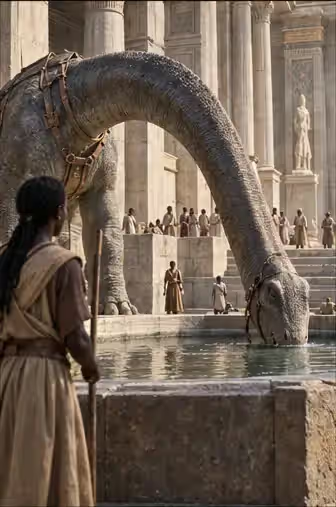
Urnok: life consecrated and counted
Egg Law connects civic religion, breeding, ownership and justice.
Status before species
An egg is a legal asset before it is food. Seed, Table, Technical and Ritual identify different destinations: reproduction, eating, material recovery or consecration. Status determines permitted uses. Urnok law therefore cannot be reduced to a uniform dietary ban applied to every egg.
Protecting continuity
Protecting an egg concerns the animal lineage, future work and rights entered in the register. Deliberately destroying a Seed or Ritual egg constitutes ovoclasm, a religious, productive, financial and political offence. This connection gives the sacred an everyday reach: keeping life also means keeping what others depend on.
Animals honoured as infrastructure
Urnok worships no gods: it honours the great animals that carry the Empire as living infrastructure. Statues of brachiosaurs, diplodocus or ultrasaurs stand at crossroads; they are not mascots but reminders of continuous work, load and service. What the cult venerates is the life that carries the Empire: the road, the silo, the colossus and the register.
Respect keeps a material basis. An animal may serve several decades in the same unit; those who drive it know its name, its scars and the way it turns, and pass that memory on to newcomers. Ceremonies honour this relationship without ever excusing anyone from feeding, resting and caring for the animal.
The memory of hunger
The Empire was born of a famine: starving Arkhans stopped in the fertile plains of the centre and settled there. This origin gives storage, rations and eggs a religious weight. During the famine people ate the eggs, the seed of living things; eating a lineage egg means repeating that gesture, eating the future. Egg Law writes this memory into the registers.
Three festivals of the Empire
Three festivals mark Urnok’s religious year. The Reading of the Annals seals the register of births, debts and opened roads. The Kindling of the Forges lights the armouries’ fires together and blesses metal and the armour of living beasts. The Procession of the Colossi parades the great working animals along a load-bearing road. All three stage what the Empire depends on: written proof, equipment and moving mass.
The Sacred Annals
Urnok’s faith keeps its books like a register: these are the Sacred Annals. Truth there is what is recorded and verifiable. Every year the Reading of the Annals seals the register.
A cult without a single clergy
The Urnok cult has neither a supreme head nor a single clergy able to cast out a believer. Its officiants are officials, keepers and craftspeople. The Master of the Annals seals the year’s register; a Counter closes the names of the dead; silo chiefs bless the Silo Dreadnoughtus before every campaign; the Order of Sacred Eggs guards the status of ritual eggs, consecrates the temple’s eggs and brings charges of ovoclasm. Armoury masters preside over the Kindling of the Forges, and colossus handlers lead the Procession.
This diffuse authority explains the shape of Urnok piety. One does not ask a priest to forgive a fault: one asks a register to record it and a responsible person to make it good. The sacred merges with the charge, and whoever holds their own well is seen by the neighbours as a pious person.
Consecrated places
The capital’s main sanctuary is the temple of the Egg, which houses a consecrated ritual egg; beneath it a conservation crypt keeps seed eggs under seal, on beds of sand. The cult’s other places are useful works: the cathedral silos, whose forecourts host the Reading of the Annals, the crossroads where statues of brachiosaurs, diplodocuses and ultrasaurs stand, the avenues of the Procession, the armouries of the Kindling. In every quarter a house of rites receives births and deaths and keeps the neighbourhood’s small ritual eggs.
Along the roads stand the load stelae, carved with the loads a very-large animal carried before dying in service, beside the road it used to travel. Travellers stop there, lay a hand on the stone or leave a handful of fodder. Statuettes of brachiosaurs in Bralnor marble, small copies of the statues in the squares, are sold to visitors to the capital as souvenirs and house gifts.
Everyday piety
Urnok religion is practised above all in the gestures of the day. At dawn, in the great cities, the titans are fed at the upper levels of the feeding towers, and this meal served at neck height has become a daily rite that inhabitants watch on their way to work. People step aside and fall silent when a colossus passes; they greet with a gesture the carved boundary stone that marks the start of a road; they name animals, even those they do not own. Swearing on a register commits one more than swearing on one’s life.
The gravest religious fault is to lie to the register or to destroy what must last: a lineage egg, a seed, a reserve. An Urnokian who wastes grain in front of witnesses is regarded as impious, even if he has stolen nothing.
The cult and war
The cult goes with the campaigns. Before a Grand Host departs, the silo chiefs bless the Dreadnoughtus that will carry the armies’ grain and water, and the armouries hand over the pieces blessed at the Kindling. Animals killed in battle have their stele. The bone relics of the sauropods of the Heritage lineage, property of the Crown, are never sold: they can only be given, and their gift seals alliances or honours services rendered.
The other powers judge this cult in their own way. Ishtir, which worships the Sun-Dragon, sees in it a religion without a sky; Arkhan, which follows the Way of the Raptor, takes it for a larder piety. Urnokians do not try to convert anyone: their cult is not exported, it is administered.