
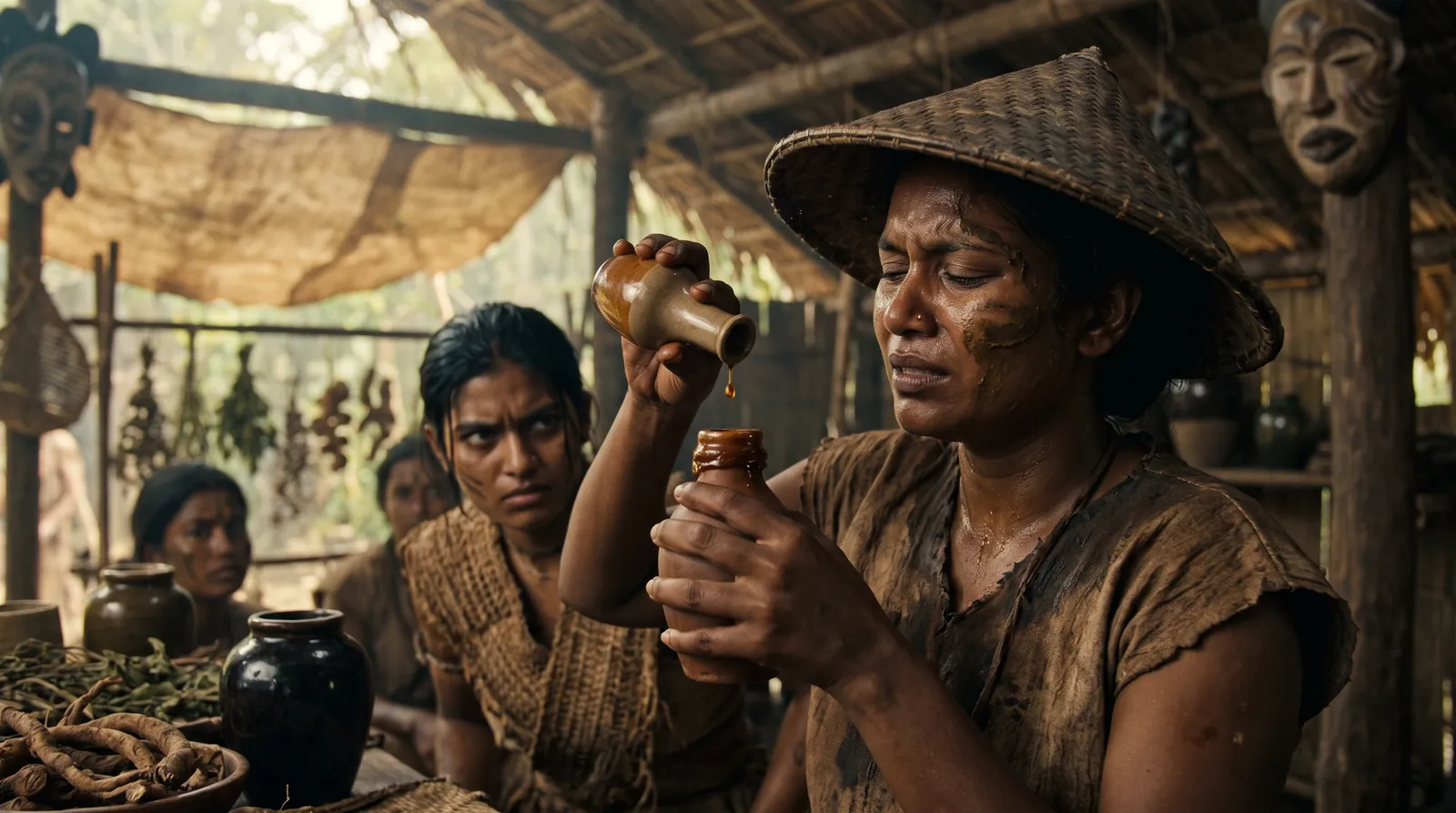
Medicine, venoms and antidotes
Venom distillers, mist herbalists, marsh doctors, bone surgeons, court toxicologists and scale embalmers: healing and poisoning are neighbouring trades.
Healing bodies
The mist herbalist prepares spores, balms and remedies against fevers; the marsh doctor treats parasites, infections and amputations; the burn dresser tends injuries from fire, ash and acid; the bone surgeon operates on humans, shells and horns; the resin apothecary prepares glues, dressings and varnishes. The water purifier filters with charcoal and plants.
The venom and its answer
The venom distiller extracts toxins and antidotes and trades in them; the antidote maker sets their protocols and doses. The court toxicologist knows political poisons. The scale embalmer prepares the dead, between rite and preservation. In N’Goro, this knowledge is framed by a law of poison and by the mist houses, schools of venoms, remedies, fibres, filtration and masks.
What care costs
Healing costs money, and prices say a great deal about the value of remedies. At the average rate of the known world, a healer’s consultation is worth a little under a Draco, a lot of ten resin dressings a quarter of a Draco, a flask of antiseptic a third, a suture kit with its needles and tendon thread a little under half a Draco. Antidotes are in another category: a dose against marsh venoms exceeds four Dracos and is sold only under licence.
Venom itself heals. Stabilised and reduced to tiny doses, it serves as an anaesthetic, an anticoagulant and a remedy for fevers; outside the marshes of N’Goro, its medical use requires a licence. The distillers who prepare it and the antidote preparers who set its doses form a closed world, where one learns to recognise a poison as much as to neutralise it.
These prices are not the same everywhere. Remedies cost less where they are made, and far more in the marches and on the roads, where an antidote may be worth a life and is sold as such.
N’Goro: poison and its answer
In N’Goro, healing and poisoning belong to the same knowledge, and that knowledge is regulated. The Sèveurs filter, inspect and heal; their threshold care combines antidote, filter, dosage and surgery, and life-saving care opens a Dette de Souffle, recorded by the physician, which binds the patient to reciprocity. Every adult carries a threshold kit, a chitin case holding the emergency flasks chosen for a particular journey.
The law of poison requires that every poison prepared have its answer. The counter-flask is an antidote matched to a specific poison and sealed in its name: one copy is deposited with the Sèveurs, the other goes with the vial. Whoever makes a poison without a counter-flask commits a grave fault, even if he never uses it.
Foreigners mostly buy what protects them: clear breath against spore irritations, the filters that make the water of an unknown pool drinkable, antidotes against centipedes and reed serpents. An army that enters the marsh uses more filters than arrows.
Operating on people and great bodies
The bone surgeon operates on people, but also on the shells, horns and limbs of animals. On a great animal, an operation takes a team: trainers to calm it, assistants to hold the straps, tool-bearers, a surgeon and his seconds. In Arkhan, the Apex jaw surgeons treat the jaws of great predators, reputed to be the most dangerous work in the trade; in Urnok, the relays keep in reserve an ointment of tallow and herbs for the split soles of road sauropods, counted like grain.
The instruments are simple and well kept: bronze saws, obsidian blades, hooks, needles and threads of tendon or chitin. Anaesthesia relies on venom distillates, heavy-dose sedatives and the trainers’ know-how. To protect a wound during a journey, surgeons apply a purified anti-rot kept in a wax ampoule.
The burn dresser completes this work. War fires, ashes, forge spills and marsh acids send him their wounded; in Korath, an ointment of sulphur and fat treats both the founders’ burns and the mange of ankylosaurs.
Venom at war
In war, poison is never magic: it is a named, dosed and signed substance that acts on a specific body. N’Goro fighters use irritants that blind a great beast for a few dozen seconds, preparations that stop a wound from ceasing to bleed, toxins reserved for human drivers. Their ampoules are colour-coded, and a soldier learns above all not to confuse an irritant with an antidote.
The other nations distrust it and use it. Arkhan lost-head lances sometimes carry a N’Goro paste on their sacrificial point, and armies crossing the marshes carry their own antidotes. Ishtir, on the contrary, forbids itself poison on religious principle, as it forbids itself night combat.
At court, poison serves another war. The court toxicologist knows the political poisons, those that kill slowly, those that imitate a fever and those that leave nothing to see; he tastes, examines, prepares counter-poisons and investigates when a great person dies too quickly. His trade is one of the most discreet in the known world, and one of the best protected.
Preparing the dead
The scale embalmer prepares the dead, between rite and preservation, and every nation asks something different of him. In Urnok, he prepares the body for the pyre, and the ashes join the grass plots along the roads. In Ishtir, bodies are exposed to the sun on high terraces, then the bleached bones join the ossuary of the cohort. In N’Goro, the body is returned to the marsh, on immersion platforms overseen by the Synod, because a dead person badly returned is a health risk.
In Volonia, where one prefers to die at sea, the embalmer preserves the bodies of the wealthy who die on land, with resins, salt and preparations against rot, so that they can be brought back to port and entrusted to the sea. The Korathians return their dead to the magma of the Mountain.
In Arkhan, the trade touches the strictest taboo. The mortuary teams sort out human remains, from every nation, before any animal carcass enters a workshop: a human bone never becomes a material. The clan’s dead, for their part, remain persons, and their bones join the family house.