
Armies
The forces of Korath
Forges, passes, armour and artillery shape Korath’s defence.
The mountain as a weapon
Korath has no institutional giant dinosaur. Its military power rests on forges, passes, chains, winches, armour and ballistae. The prestige of invention and counter-testing sustains workshops and technical publishing; mastering matter becomes a strategic advantage.
Passage fortifié taillé dans le basalte
Vue de détail.
Animals in the lower marches
Closing and evacuating
Lock-gate districts combine double doors, airlocks, counterweights and manual emergency closure. They hold air, water and heat reserves. Isolating a district must preserve evacuation: defence also organises flows and failures.
Making the other break first
Korath seeks to make the other break first: every army has a part that breaks, and Korathi doctrine consists in finding it. Its sword is ballistics, its armoured beasts and the mountain itself; its shield, passes, galleries, geometry and industry. Its advantage is to fight great living animals without owning any, through precision and synchronisation: chains, galleries, avalanches, steam, sacrificial bridges, false routes and buried batteries.
Its weaknesses are hunger, low mobility and outside dependence. Away from its terrain, Korath projects its force poorly, and its workshops depend on biological imports.
No colossus
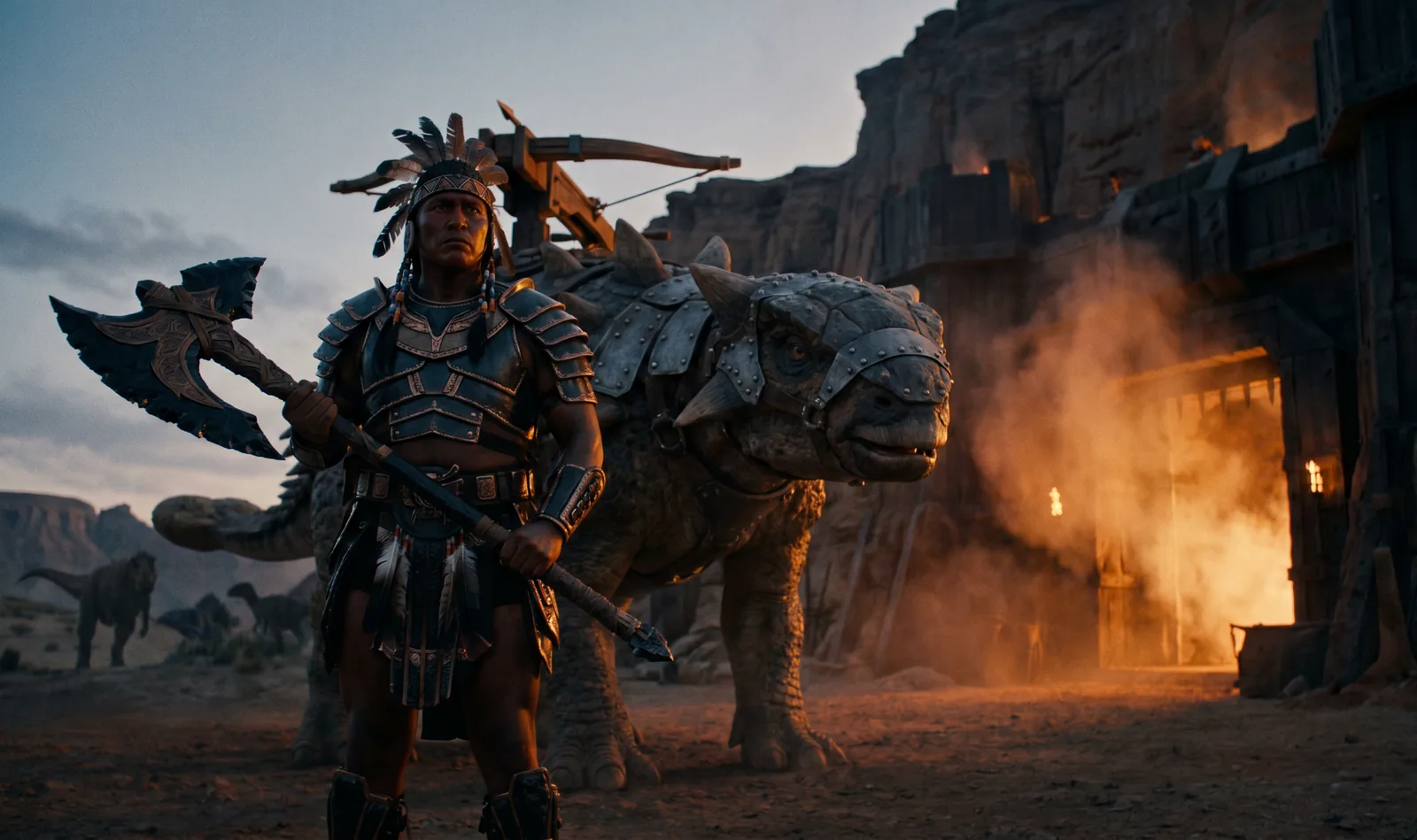
Korath owns no great living animal, without exception. Its war animals — ankylosaurs, nodosaurs, battering pachycephalosaurs — are imported and kept in the lower marches. This absence is not a gap left in the army: it has produced a civilisation in which the mountain, matter, proof and synchronisation take the place of animal gigantism. Korathi mechanisms turn up in the ships, gates, pumps and artillery of the whole world: an Arkhan or Volonian weapon can bear a Korathi signature without having been made by Korath.
A nation of reservists
Korath has the highest ratio of active soldiers and reservists among the great powers. The army’s permanent core brings together the pass garrisons, the artillery corps, the ballista gallery crews, the animal units of the marches and an elite guard. Behind them stands an immense reserve, drawn from almost the entire adult population.
This reserve is organised by district and by workshop. Each workshop provides its contingent, which drills several times a year and knows its alarm post: a winch to man, a door to close, a battery to supply, a refuge hall to hold. Journeymen who work together by day serve together in war, and workshop rivalries carry over even into shooting rankings. The system allows a country of seven million to mobilise quickly, without ever matching Urnok’s demographic mass.
The infantry of the mountain
Korathian infantry is made for narrow places. Its heavy crossbowmen shoot from ledges and slits, downwards, at whatever the works have stopped; their crossbows are strung with imported tendon and treated against rot, because the damp of the galleries ruins a badly kept bow. Shield bearers form moving walls in front of them, advanced or withdrawn step by step along the corridors.
Other troops meet specific needs. Miner scouts go down first into a pass to measure its width and mark firing positions; cable shooters launch harpoons tied to tendon cables, able to tear a wing out of the sky when flyers threaten the ridges; sappers wear digging helmets and work under the rock as well as in the open. None of these soldiers seeks a duel: each holds a place in a sequence.
Artillery, queen of arms
Korath’s sword is ballistics. The Shared Recoil, one of the country’s legendary patents, made its ballistics the ancestor of the weapons used against great dinosaurs and of the naval artillery Korath exports. The Rhaud ballista, a pass machine with a black metal frame, strung with sauropod tendons, bound with Arkhan ligatures and protected by anti-rot resins, serves to defend the passes and can be mounted on an ankylosaur platform.
In the mountain, artillery is built into the rock. Multiple batteries hide behind rock faces, served by rails, recoil platforms, ammunition lifts and protected rooms; the buried-battery master coordinates their fire. Outside the galleries, the army also has field ballistae and catapults. Korathian know-how can be recognised even in others’ hands: Arkhan batteries take up the logic of Korathian recoil with a local tendon.
Holding, striking, carrying
Each of Korath’s war animals has its function. The ankylosaur holds: its low carapace and tail club make it a living anvil in the middle of a passage, and its broad back can carry a ballista. The nodosaur defends passages, compact and hard to dislodge. The pachycephalosaur strikes: it is launched like a ram at a weakened point, wearing a forged ram helmet, then withdrawn before it is spent.
The doctrine that links them comes in three beats: absorb, channel, counter-strike. Ankylosaurs and nodosaurs absorb the shock, the works channel the adversary towards the chosen place, then pachycephalosaurs and artillery strike. All these animals are imported and live in the lower marches; they do not climb into the deep cities, and their yards must leave room for a turn and a free arc for a tail.
Command
Korath is a military dictatorship embodied by a single man. He is commonly referred to as the Marshal of the Mountain. The army is his direct instrument, and sovereignty is not up for discussion: mechanisms are debated, never the right to command.
The Master of the Forges works hand in hand with him: the national Forges supply the army, control stocks and standards, and can switch industry over to war. Officers come from schools where geometry, ballistics and the art of composing heterogeneous systems are taught, the skill that Prince Helvast, more militarist than the established power, made famous. A good Korathian officer is judged by the accuracy of his sequences more than by his courage.
The eve of battle
Before combat, Korathian soldiers do not shout: they wait. The rite of the eve of battle has them set a heated stone among them and wait until it can be touched with a bare hand; it is matter, not the clock, that gives the signal to start. The gesture recalls the virtue of the Moment and the Cooling Time: one does not act while the thing is still burning.
Many carry an obsidian shard received at the Black Kindling, the ritual lighting of the forges, when blessed obsidian is broken into votive shards distributed to warriors. Some clench it in their hand while waiting for the stone to cool. Foreigners who have seen a Korathian unit wait like this in silence say it is one of the most unsettling sights of war.
When Korath attacks
Korath is not only a fortress. When it carries war outside, it applies the same doctrine as in defence: make the other break first. It looks for the part that gives way in the enemy’s arrangement, a badly guarded gate, a city emptied of its defenders, a road that is too long, and then concentrates its artillery, its siege animals and its sapper teams there.
Its limits remain the same. Outside its own terrain, Korath projects its strength poorly: its armies are slow, expensive, dependent on imports and few in number compared with the great powers. It does not pursue, does not seek pitched battle on the plain, and prefers to take what it can hold. Its officers put it their own way: one does not attack a giant, one attacks what keeps it standing.
Part of this article covers events of season 1. Turn spoilers on in the menu to read it.