
Economy
Korath: the Patent and counterproof
An invention must prove its form, material and use before earning full recognition.
Three dimensions of proof
The Seal of Form requires demonstrated geometry, forces, limits and tolerances. The Seal of Material checks the stated materials under stress and wear. The Seal of Use asks the object to solve a real human problem. A major patent then requires reproduction and methodical challenge by a rival workshop: an appealing demonstration is insufficient.
A name surviving exclusivity
The Right of Signature preserves authorship, the inventor’s name and the record of corrections. Income and licences remain exclusive only for a limited period. Afterwards, Return to the Mountain brings the patent into shared technical heritage. Lasting recognition of the author and later sharing of knowledge belong to the same system.
Assembly of chains and equipment
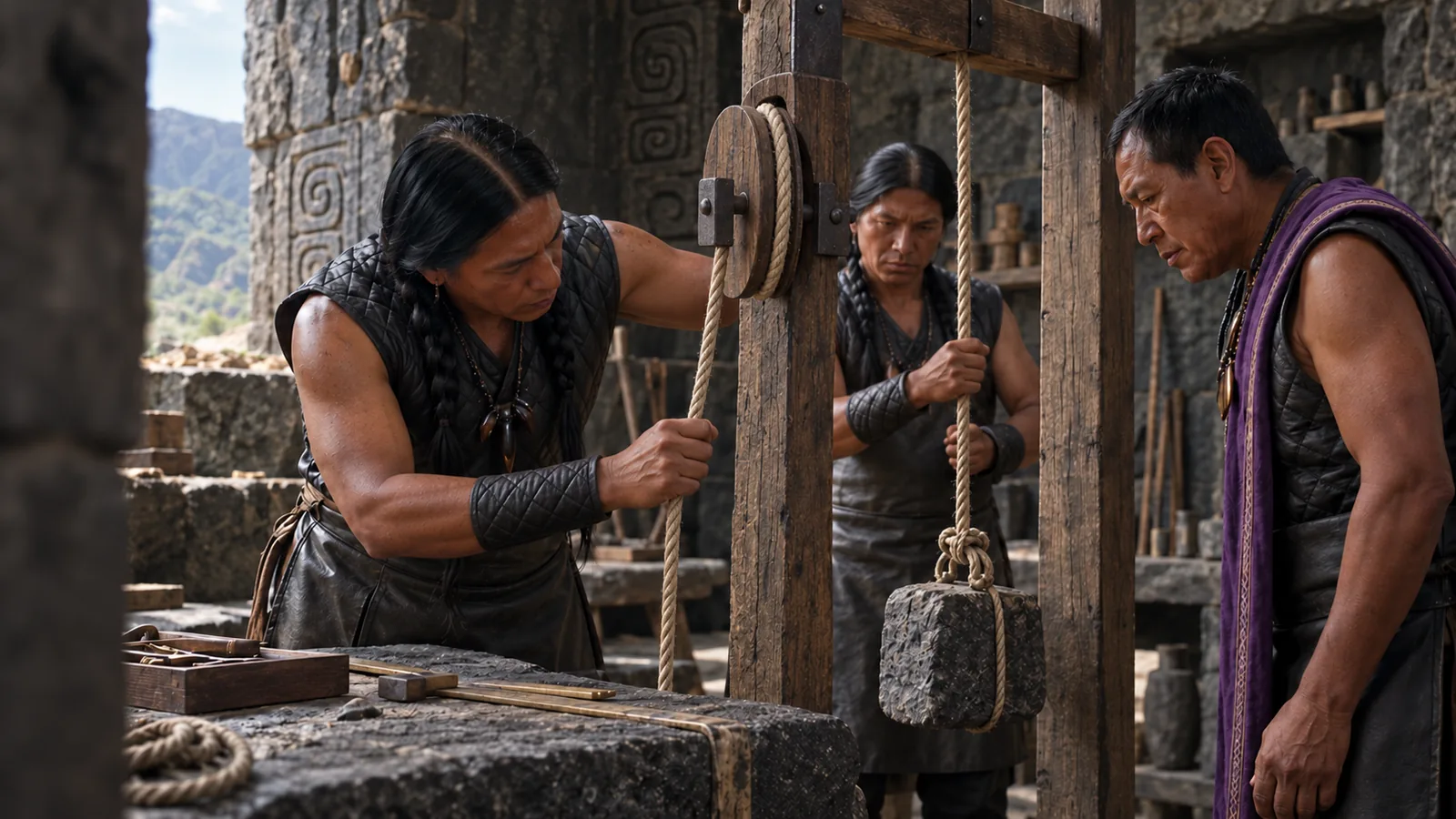
The chain master, collar riveter and armoured rigger work on assembly before an object appears as a finished piece. They check tension, closure, repair and holding under strain. Precision is not decoration: a poorly prepared join transfers weakness to everything depending on it. These actions add to the requirements of form, material and use; they do not replace them with a merely reputed craft.
Surveying and preparing corridors
Corridor geometers take measurements before a group enters a difficult passage. Trap setters and the recoil master examine points where a decision might no longer be correctable. This does not draw a complete military doctrine. It is threshold work: seeing the slope, exit, room for return and material constraint before force or speed impose their own answer.
Component marks, signature and responsibility
The bone engraver, trophy marker and patent master work at different moments, but all keep a part from becoming anonymous once it circulates. A mark can help distinguish a correction, provenance or manufacturing responsibility. It does not authorise use of human bone: human material remains outside all craft. An object thus keeps a material history without that history becoming permission to do anything.
Extraction and material preparation
A Korath part begins in extraction, rock sorting, transport and material preparation before it reaches the forge. Miners, carriers, heating crews and workshops depend on one another. Traction or protection animals change access to passes and how much material can move, but do not erase human work time. The final precision of a mechanism rests on an earlier chain of loads, stocks, tools and checked materials.
Specialisation creates dependencies
Concentration on mines, forges, ballistae and technical workshops makes Korath dependent on materials it does not always produce in sufficient quantity, notably food and some organic components. A supply break does not only block a market: it slows manufacture, reduces maintenance and forces workshops to choose which parts to finish. Technical power therefore has a material limit visible in stores, convoys and mountain passages.
Korath in figures
The average annual output of an inhabitant of Korath is estimated at between 82 and 92 Dracos. Industry and crafts make up 42% of it, the highest share among the nations that count in Draco; then come agriculture and fodder (15%), trade and finance (11%), the army (11%), animal husbandry (8%), elite rents (7%), administration and learning (6%).
Metals cost far less than the average rate there (0.78), but fodder and timber far more (1.25): prices reflect the country’s dependence on food imports.
What Korath sells the world
Korath rarely sells whole objects. Its exports are made of intermediate parts, the ones others need to make their own works hold together: hinges, tensioners, recoil mounts, pumps, gauges, locks, winches and transmissions. The calibrated rivets of its passes, with a stamped and standardised diameter, equip armouries all over the known world. Volonia’s shipyards buy its anchor chains and keel joints, even though Korath has no fleet, and Urnok imports its obsidian in large quantities.
To these goods are added very expensive services: days of engineers sent abroad, patent licences, certifications demanded by insurers and armies. In a way the country also sells graduates: foreign families pay to have their children trained, and these former pupils then recommend Korathi parts. Korath thus earns more from what enables others to make things than from what it makes itself.
Volonia finances, Urnok feeds, N’Goro heals
The pass merchants sum up the country’s position in a formula: Volonia finances, Urnok feeds, N’Goro heals. The Empire supplies grain, heavy sauropod tendons, leathers and wood; N’Goro the anti-rot resins, balms and antidotes; Volonia credit and insurance, its companies taking on the large risks that Korathi workshop mutuals cannot carry alone. Arkhan, despite an old hostility, sells its fine tendons, its bone and its salted meats.
This dependence has two faces. It makes Korath vulnerable to any cut in the roads, and it makes its neighbours dependent on its parts. Korathi know that a great Volonian hull, an imperial fort or an Arkhan battery can stop working for lack of a pin or a gauge from the mountain. Korathi trade is therefore a matter of balance, in which each side holds the other by what it lacks.
Living on licences
A large part of Korathi wealth cannot be seen. Families, workshops and banks live on annual licences, royalties, future shares and industrialisation contracts. A third-party workshop that wants to make a patented invention pays a fee each year to the author and backers; a pass toll is divided into negotiable shares, which also carry the upkeep of the garrison and the debt of the corridor. These titles are sold, lent and inherited.
Rights to the future patents of a funded inventor circulate almost like money, and Karûm-Brakh, which funds prototypes in exchange for such rights, holds a portfolio of thousands of fundamental techniques. The system rewards invention, but it also pushes fortunes to invest rather than make, and journeymen like to mock the houses that live on a signature they did not make.
The monopoly on heat
The state does not own the workshops, but it controls the heat. Lighting a furnace beyond a certain threshold requires an annual forge licence issued by the Forges, which keep heavy metallurgy and strategic alloys for themselves. Metal leaving the mining cities pays a forge duty, and the receipt travels with each load to its destination. It is the concrete form of a well-known formula: the citizen owns the signature, the workshop the licence, but the state controls the temperature and scale at which the idea becomes power.
This control gives the regime a lever over the whole economy. Political favour does not replace proof, but it often decides whether a patent stays a prototype or becomes national infrastructure. A workshop that loses its forge licence can go on inventing, drawing and repairing; it can no longer produce in quantity.
Paying without a mint
Korath has no mint of its own. Large contracts are reckoned in Dracos and settled in gold Scales, the Empire’s coin, which the country’s bankers hoard carefully. For small sums, custom has kept payments in metal: lots of calibrated rivets and copper bars stamped to the standards of the Forges, which pass from hand to hand in the markets of the warm city.
A journeyman’s wage, moreover, is only partly paid in money. Heated lodging, canteen meals, children’s schooling and insurance against accidents are part of the workshop contract, which is what makes leaving it so costly. The wealth of an ordinary Korathi is measured less by his purse than by the distance between his lodging and the Warm Vein.