

Creatures
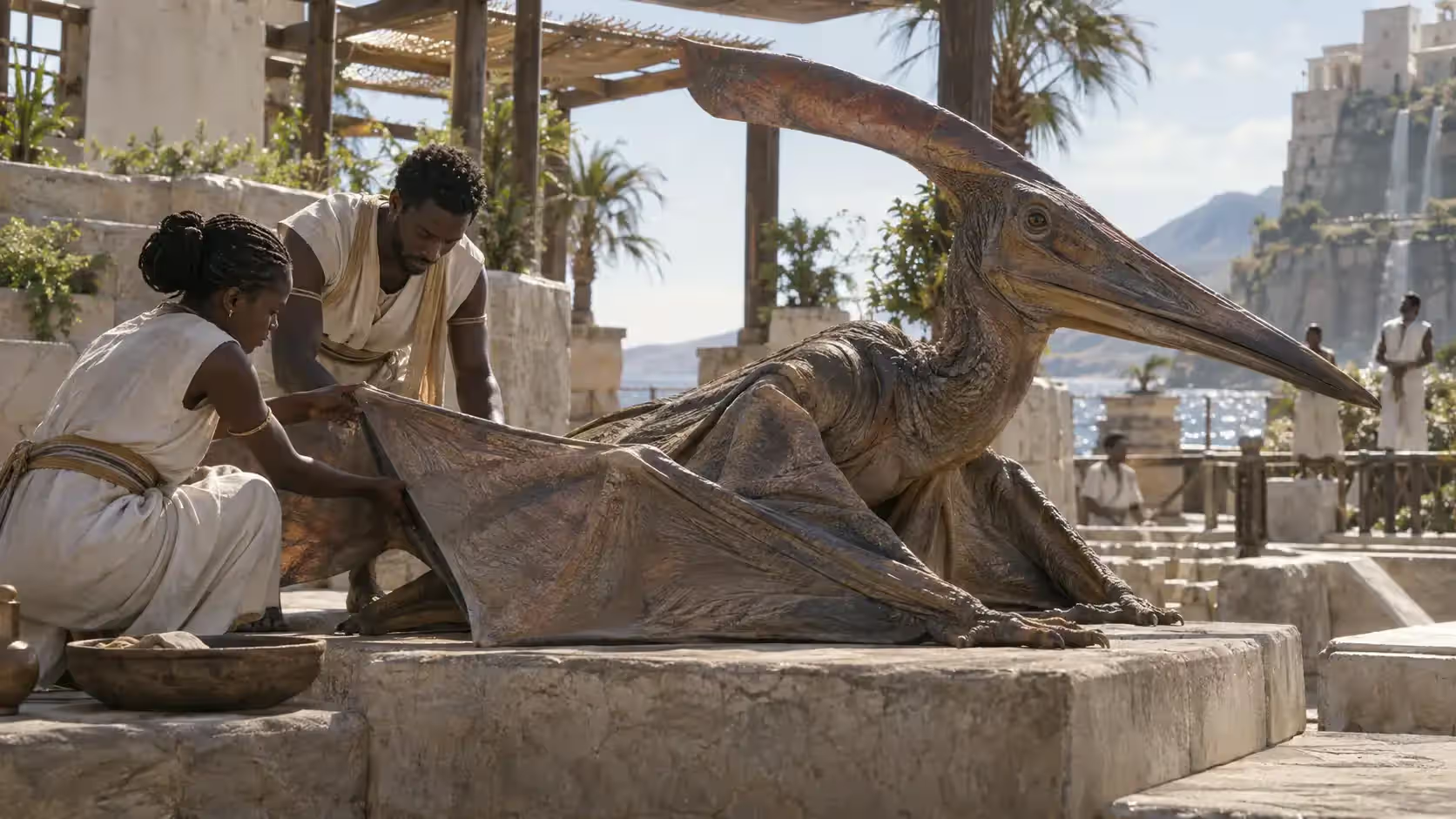
Pteranodons
Ishtir’s one hundred and twenty great living animals are giant combat pteranodons, twelve to eighteen metres in wingspan.
The hundred and twenty great living animals
Ishtir’s one hundred and twenty great living animals are giant combat pteranodons, twelve to eighteen metres in wingspan. They are strike animals: their claws are armoured, they seize individuals, strike and do not stay in place. Like the great lineages of other nations, they owe part of their size to breeding, which increases it by fifteen to thirty per cent.
They belong to the Gold, Ishtir’s sacred summit: all of them are placed under the responsibility of the Order of Gold and none has a private owner; Qer-Aton and the Couronne de Venthir hold their air command, perches, specialised care and flight preparation. The sacred ceratopsians are not among them.
Caring for membranes
Pteranodons need resting places, care, relays, harnesses and crews able to watch them fly. Membranes are inspected against the light; the cliffs and towers of Venthir require perches, care access, ramps and routes where nobody stands beneath the animals’ flight path. Their presence in a ceremony never does away with food, rest and medical follow-up.
A flying reptile
The pteranodon is a pterosaur, a flying reptile: neither bird, nor dragon, nor dinosaur. It has no feathers. Its wing is a membrane of living skin stretched between an enormous fourth finger, the flank and the hind leg, and laced with fibres and vessels that make it both supple and tough; three small clawed fingers stay free at the fold of the wing. Its bones are hollow and thin, so that a huge animal weighs surprisingly little.
Its head is the most recognisable in the known world: a long toothless beak made for seizing fish, and a bony crest swept back, larger in males, who use it for display. On the ground the pteranodon walks on all fours, wings folded, with a clumsy gait; to take off it springs on its forelimbs, or drops from a cliff and waits for the air to carry it. That is why it lives high up, and why Ishtir built its relays on rock faces.
From courier to great living animal
Ishtir breeds three kinds of pteranodon, told apart first by size. Signal pterosaurs, four to six metres in wingspan, weigh barely more than a slight man; fast and curious, they carry mail and signals by the thousand. The Silver Winds’ war pteranodons, seven to nine metres, carry a pilot, strike in dives and, four at a time, pull a nacelle. The temples’ solar pteranodon, the Hel-Aile, with its great crest and white-and-gold harness, belongs to this middle size and serves for relays, watch and rites.
Above them all stand the hundred and twenty great living animals, twelve to eighteen metres in wingspan. No wild animal reaches that size: it is the fruit of centuries of selection in the eyries of the Couronne de Venthir, which have increased it by fifteen to thirty per cent. Even the largest weighs only a few hundred kilos, less than a young ceratops; but with wings spread it covers a cohort courtyard.
From egg to first flight
Pteranodons nest in colonies, on ledges where wind and sun keep predators away. The female lays one to three thin-shelled eggs, barely three hundred grams for a war animal, in a hollow of sand or dry guano, and incubation lasts about three months. The young hatch with their eyes open, already clad in their adult skin, and demand fish from the first day.
They grow fast. Their membranes firm up during the first year, and the first flight comes from a jump a little longer than the others, without warning. A war pteranodon is adult at about three and lives some twenty years; the great living animals, slower to grow, serve for several decades, and the oldest of the core have seen several riders come and go.
Deep-sea fishers
The pteranodon is a fish-eater. In the wild it ranges dozens of leagues from the coast, glides for hours over the sea and snatches its prey as it skims the surface, without diving. It swallows fish whole, head first, and can carry some back to its young in the depths of its throat.
Ishtir has had to feed these fishers far from the sea. A war pteranodon eats about three kilos of fish a day, a great living animal as much as a boat brings in, and the Pêcheries des Perchoirs in the Îles du Soleil Levant work largely for them. The fish arrives fresh in live wells, dried in bundles or salted in jars. Breeders know that an animal fed too long on salt fish loses the sheen of its membranes, and keep fresh fish for the young and the sick.
Harnessing a great living animal
A great living animal’s harness is the finest in Ishtir, and the plainest. Its straps are of braided white linen, as broad as a hand, lined with signed leather where they take the load; its buckles and rings are bronze; matt gold appears only in thin lines on the crest straps and as a ray painted on the crest itself. The claws of its feet are shod with bronze talons, which make them a weapon able to seize a man and carry him off.
The Gold rider sits at the base of the neck on a low saddle, tied on by four lines that are checked twice before every flight. Harnessing a great living animal takes a whole crew and nearly an hour: the wings must be unfolded, the straps laid without pinching the membrane, the talons adjusted and the animal walked along the terrace to see that nothing rubs. No piece of this harness is put on a great living animal without first having been tried on a service animal.
Wild pteranodons
Outside Ishtir, pteranodons live free. Wild colonies nest on the cliffs of coasts nobody claims, in the vast regions of Pangaea that stretch beyond the known world, and Volonia’s sailors meet whole flights of them on the high seas. These animals are smaller than Ishtir’s, wary, and rarely let anyone near.
No other nation has managed to train the great ones. Volonia, Arkhan and Urnok use small pterosaurs for their messages, and Urnok hires signal strains from Ishtir for its relays; but only the Ishtiri ride war pteranodons, and only they breed animals the size of the hundred and twenty. The temple tales say the first great pteranodons ever tamed lived wild on the cliffs of Venthir, and that the whole of Ishtir’s sky descends from that colony.
Part of this article covers events of season 1. Turn spoilers on in the menu to read it.