

Creatures
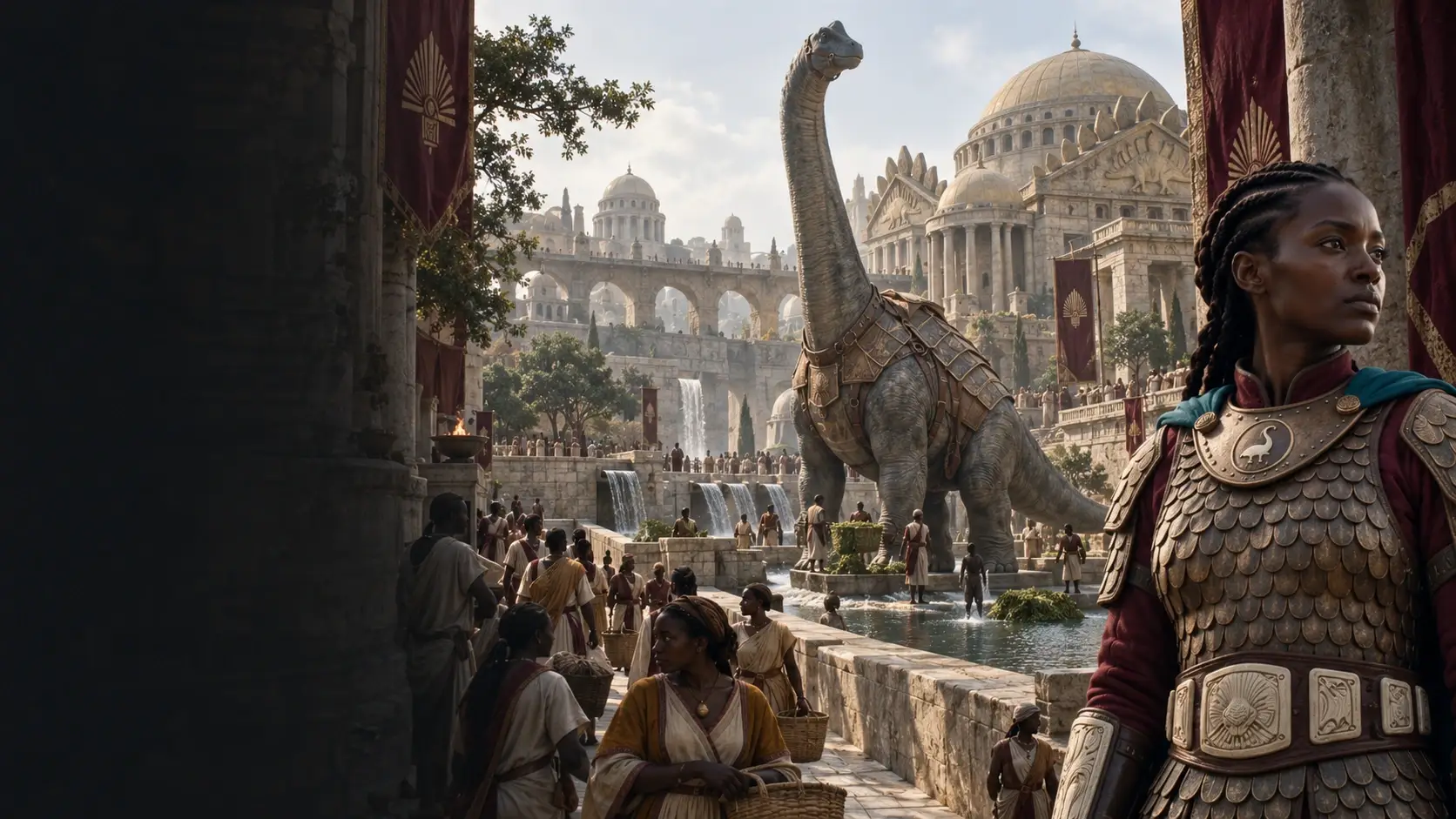
The imperial Ultrasaur
The sauropod lineage of the Crown of Urnok: animals of total combat, kept as an existential weapon.
The Crown’s animal
The imperial Ultrasaur stands for the Crown of Urnok. Its lineage is that of House Vael-Orûn; Azhor le Porte-Cendre, Orûs III’s mount, is its largest individual. Like all military titans, these animals legally belong to the Crown.
The Corps Royal des Titans keeps the rare colossi of the imperial lineages. They are not manoeuvre units but existential weapons, whose mere existence weighs on diplomacy; sending them out depends on the Sceau Noir and the throne’s decision. The Imperial Order of Orûs, a heavy guard distinct from the Order of the Diplodocus, handles Azhor’s breakthroughs and protection.
An animal of total combat
The imperial Ultrasaurs carry neither tower nor archers. Ultra-armoured, they are kept in reserve to change the course of a battle. At the Three Waves, five of them went in with the last fresh corps; Orgaï concentrated batteries, palisades and fire on specific individuals and managed to stop some, but the time each kill required worked against him.
Old age and retirement
An Ultrasaur can serve for generations. Or-Valem was withdrawn from combat after about eighty years of war service: old age and retirement are part of these animals’ lives, though no common lifespan can be drawn from it for every lineage.
The Crown’s silhouette
The imperial Ultrasaur looks like a more massive brachiosaur: a long neck carried high, shoulders higher than the croup, powerful forelimbs, a heavy tail. An ordinary adult measures thirty-five to forty metres and weighs about forty tonnes; Azhor, at fifty metres, remains an exception no one has equalled. The Crown lineages have been selected for centuries for chest, thickness of hide and calm under noise rather than for height, and an ultrasaur is recognised by the breadth of its chest before it is recognised by its neck.
Its hide is slate grey, mottled with darker patches, and veterans carry the scars of their campaigns on their flanks. It walks more slowly than a diplodocus but stops badly: once under way its momentum carries off palisades and batteries, and it is this mass in motion, more than its speed, that makes it an animal of total combat. An ultrasaur reaches adulthood at about twenty and then serves for generations; Or-Valem only left combat after eighty years of service, and the stable masters reckon that a well-tended ultrasaur lives past a hundred.
A lineage held by the Crown
Only the Crown breeds ultrasaurs. The birth of a very large animal is everywhere the privilege of a great licensed house; for this lineage the privilege is entire and has never been delegated. The breeding animals live in the imperial stables and on a few Crown estates, in the care of stable masters who keep genealogies spanning several centuries. A female lays only every three or four years, three to six eggs, brooded for nearly a year in the heated nests of the imperial hatchery.
An ultrasaur egg is not merchandise: it enters the register as a title of the Crown, and the law treats it as State property that no one may sell or pledge. To steal one is to steal from the Empire; to break one is to commit the worst of ovoclasms. The young grow up in the stables’ growing pens alongside their elders, and ultrasaurs are never counted in hundreds: a few dozen at most are serving or resting at any one time, which explains the care the Empire takes not to lose them.
Twenty years to make a war ultrasaur
An ultrasaur does not go into battle before spending two decades preparing for it. The first years are spent accustoming it to people, empty harness, ramps and pools. Then come the noises of war: drums, horns, crowd noise in the manoeuvre circles, and then the smell of fire, blood and great predators, brought in on hides and bedding. At about fifteen it wears its first pieces of cuirass, lightened at first, then complete; at about twenty it learns to walk on ground strewn with debris and stakes without seeking footing on them.
Combat training proper is built on pushing. An ultrasaur learns to engage its chest against a training palisade, to hold its course under missiles and to stop on the signal, which is the hardest part. Colossus whisperers follow it all its life, note its fears and habits, and pass their notebooks on to those who replace them. An animal that has seen its first battle is never quite the one that was trained: veterans change, and the stables learn to read them anew after every campaign.
Ultra-armoured
To soldiers, the very name of the ultrasaur calls up its cuirass. It is made of plates of bone and sauropod leather sewn onto thick linings, of overlapping lamellae on the neck and of bronze-rimmed chest shields. The Living Armouries, which work under State contract with Velmor’s black stone and parts bought from Korath, make it to measure for each animal; a full cuirass weighs several tonnes, and the animal wears it only for war and for trials.
The cuirass has no howdah: a combat ultrasaur carries neither tower, nor archers, nor platform. Its rider sits at the withers, protected by a high guard of leather and bone, and the Imperial Order of Orûs marches at its feet. This restraint is deliberate. An animal loaded with marksmen becomes a tower that has to be protected; an unloaded animal remains a weapon to be launched. Imperial officers sum up in this way the difference between the Carrying Towers, which serve the battle, and the ultrasaurs, which decide it.
Under the Ultrasaur’s shadow
The Ultrasaur is the animal of the Crown and of Calaron. It appears on the shields of the Crown Legion, on the banners of the great ceremonies and on the pediments of imperial buildings, and its statues stand at the capital’s crossroads beside those of brachiosaurs and diplodocus. Legionaries swear “under the Ultrasaur’s shadow”, a formula taken from an old saying of the capital: to march beneath it is to march beneath the Empire itself.
Retired veterans end their days in the imperial stables with their teams. They go out at dawn into the manoeuvre yards, receive the same care as animals in service and are never sold or slaughtered for meat; at their death their bones, tendons and plates return to the Crown with everything else. In everyday speech, “to bring out the ultrasaur” means to commit everything one has, in a family quarrel as in a negotiation, and people speak no better of it than they do of war.