

Families and social ties
House Eralis
The ducal House of Bralnor, the duchy of quarries. It holds the heavy stone of bridges, ramparts and great works.
The House of stone
House Eralis holds Bralnor, the duchy of quarries, blocks, heavy stone and highlands. Hadrav Eralis holds the ducal office; he is nicknamed the “Mountain Cutter”. The duchy’s quarries supply massive stone, noble stone, marble and limestone.
Its history goes back about four thousand six hundred years. Very old without being a founding house, it owes its legitimacy to its mastery of roads, blocks and counterweights rather than to an origin. It is the House of quarries and heavy standardisation; its schools have outlived the changes of its borders.
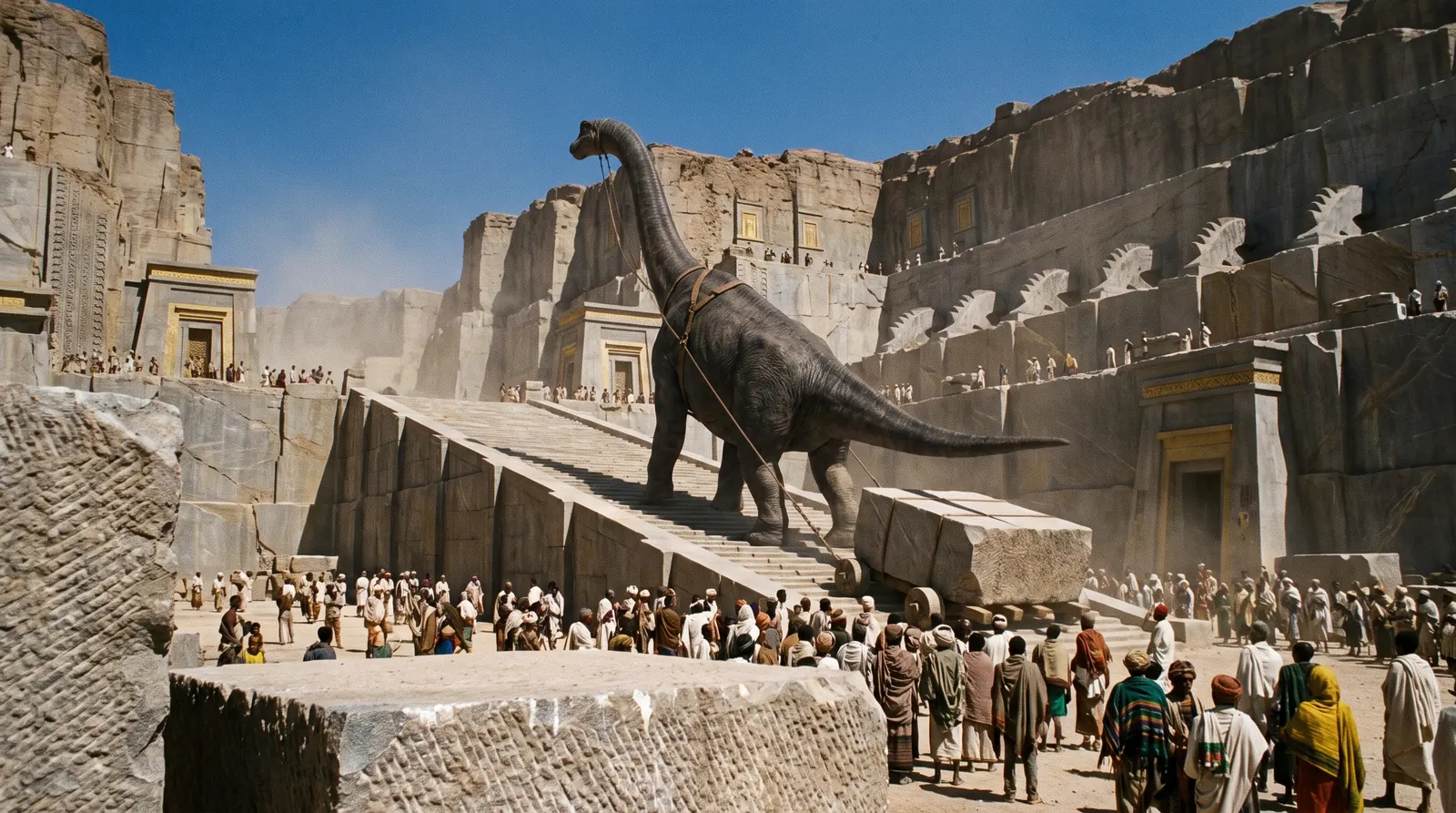
The name Eralis carries the mineral layer of Bralnor: R and L sounds, endings in -is and -or, a hardness of articulation that matches the hardness of the trade. The duchy’s emblem is the quarry brachiosaur.
Chains without family names
The register of Bralnor counts High Lines for quarrying, counterweights, winches, heavy haulage and cutting dust. These chains are known, but not yet the families that hold them.
The chain runs from extraction to the finished work. Quarry workers prepare the material; specialists in counterweights, winches and heavy haulage organise its movement to the building sites. Quarry brachiosaurs work there with their drivers and with the crews who check the load-bearing capacity of the roads. A block well cut in the quarry can still halt a building site if it cannot find its route.
Stone holds with leather and grain
Bralnor supplies the physical matter of the Empire, but depends on supplies from elsewhere: ropes and turned parts from the forest chains, leather and harnesses from Velmor, tannins from Orlantis, fodder and grain from Sarnor. A sauropod of Bralnor wears a black Velmor harness, tanned thanks to Orlantis bark, to haul the stone of a work paid for in Sarnor grain.
Karûm-Brakh is a major client for Eralis stone; the great works bind the House to the enterprise that runs through the six duchies. The House gives the Empire the material weight of war — bridges, ramparts, sieges, great building sites — and knows the real cost of every breakthrough.
The ducal family
Around Hadrav, the House counts Daran Eralis, the heir, who is drawn to Karûm-Brakh, and Mara Eralis, the technical voice of the quarries. The duke speaks in tonnes and quarry faces; he readily weighs up a person the way he weighs up a quarry.
Nahla Eralis
Hadrav Eralis is married to Nahla Eralis, a jurist of concessions.
Roche du Nord and the great quarries
The House sits at Roche du Nord, the duchy’s capital, in the Lands of the North and the High Plains: rocky ridges, hills and peaks to the north and east, gentler plains to the west. Winters there are hard. The duchy works two great quarries, which supply the noble limestone of the silo-cathedrals and the veined marble of the capital’s statues and façades, as well as the basalt quarries of the north-east, which yield counterweights, paving and millstones.
The town reads in the direction the stone goes down: the quarry face and the lifting ground of the brachiosaurs, then the sawing and cutting yards, set downwind because of the dust, the counterweight hall, the winch workshops, and finally the wagon park at the start of the road. The brachiosaur enclosures are outside the walls, between the quarries and the load-bearing road.
The quarry road
The stone of Bralnor leaves the duchy by the quarry road, a load-bearing road running down to Calaron and Sarnor. It is paved with slabs designed not to crush under the weight of the brachiosaurs harnessed to the wagons, and the High Chancellery of the Living Roads oversees its upkeep together with Karûm-Brakh, the quarries’ main customer. Its dangers are well known: the collapse of a section, the tribes of the northern wild lands, and winter.
A quarry brachiosaur weighs about forty tonnes, eats close to a tonne of fodder a day, mostly araucaria branches, and drinks more than two thousand litres of water. Water therefore limits the size of works as much as stone does. On building sites across the Empire, these animals are hired as living cranes, for about sixty-five Dracos a day.
The Eralis schools
The House’s prestige rests as much on its schools as on its quarries. They train quarrymen, stonecutters, counterweight weighers and the engineers who calculate the bearing capacity of a bridge or the load of a crane. These schools have outlived the changes in the duchy’s borders, and their former pupils run building sites all over the Empire. Their examinations are thought to be almost as hard as those of the Synod of Living Measures.
Bralnor also supplies the Corps of Masses, the imperial corps of siege engineers, which builds counterweight towers, rams and siege platforms. In wartime its crews and engineers can be called into the Empire’s service. The House thus gives the army the material weight of war, and knows its exact price, reckoned in blocks, animals and men.
Part of this article covers events of season 1. Turn spoilers on in the menu to read it.