

Places and landscapes
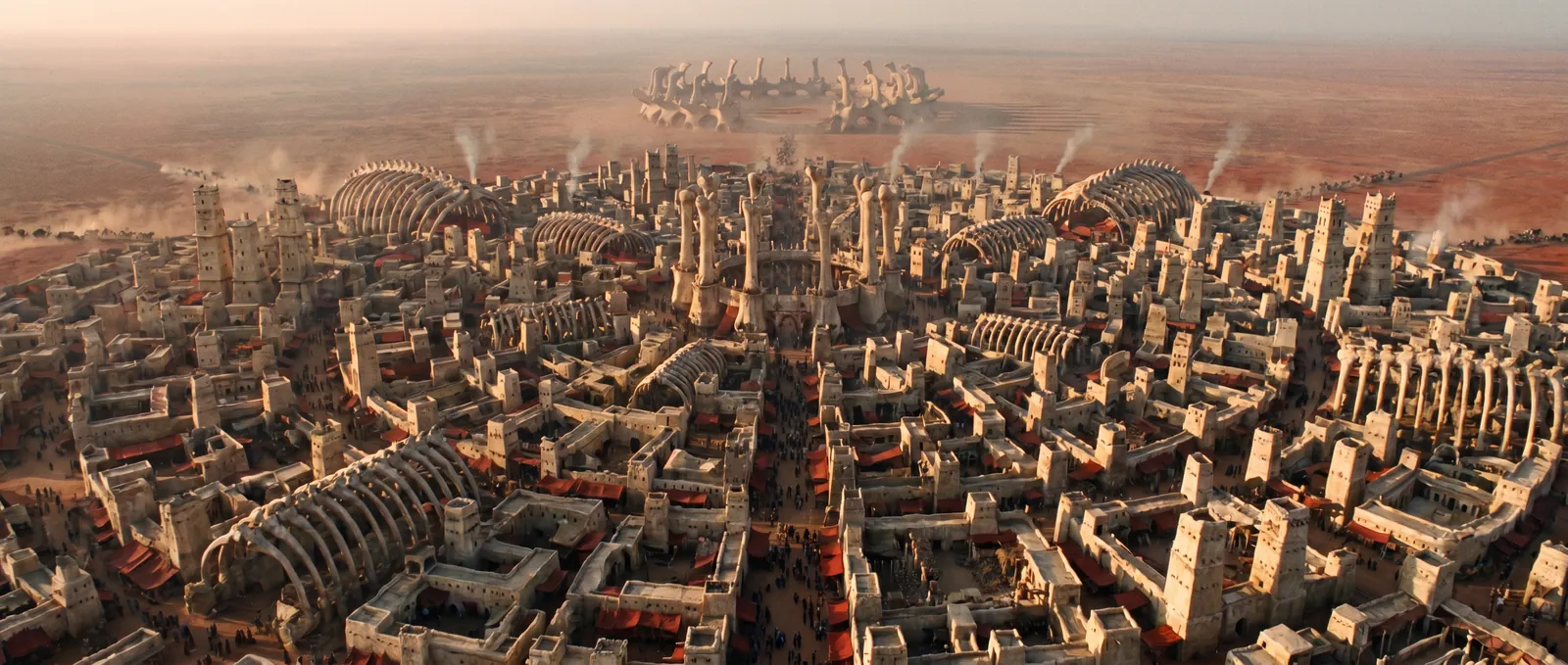
Arkhan Qor-Zaï: the Bone City
The centre of the Seven Tracks gathers memories, passages and monumental bone forms.
A name borne by two territories
Arkhan Qor-Zaï is the bone metropolis at the centre of the Seven Tracks. Its imperial namesake belongs to Urnok: the two places have distinct functions and affiliations. On a route crossing several powers, specifying “Arkhan” identifies the Bone City without sending correspondence towards the imperial march.
Bone becomes a public threshold
The great gate, ossuary threshold and certification halls can carry the Jaw-Fortress grammar. Fossil bone and Ancestor cement accompany weighing tables, notched bones, tokens and witness benches. The monument frames the sorting and recognition of spoils; large strategic animals remain outside ordinary circulation.
Two networks for crossing
Some raptor districts have a fast track for animals and riders and a slower human route. Turning landings, one-way movement and sandy fall zones give this distinction a local form. An injured person, a child or a visitor discovers the city along a different path from the mounted messenger crossing above the rooftops.
The capital that does not moult
Qor-Zaï arkhan is the capital of the Confederation and the centre of the Seven Tracks. The Conseil des Pistes, the treasury and the archives stay there during the Grande Mue: this permanence sets it apart from the shell cities, whose ruling peoples change with the cycle.
The supreme khan, however, must leave. During the Mue, the Tour des Sept Pistes takes him away for months to attend the handovers, confirm the khans, arbitrate and inspect the cities, while the Guardians of the Empty Saddle watch over his throne. The rule fits in one sentence: Qor-Zaï belongs to the supreme khan for as long as he remains able to leave it.
The city the first Urnokians left
Arkhan is a track civilisation some thirty thousand years old, without a continuous state. About ten thousand years ago, starving Arkhans stopped in the fertile plains of the centre and settled there: they became the first Urnokians. By giving their first march the name of the capital they had left, they created the double Qor Zaï.
The shared name thus carries ten thousand years of mourning. Qor Zaï impérial, an Urnok march duchy held by House Drakeris, and Qor-Zaï arkhan, the bone metropolis, remain two separate places under two separate sovereignties.
A city of animal bone
The Bone City is made of structural animal bone, bone cement, local stone, wood, hide and tendon. No human bone goes into it: the Arkhan taboo is absolute, and any human remains are removed from the material trades.
Several grammars coexist there. The great arena of Qor-Zaï combines earth-and-bone stands, restraint gates, sacrificial barriers, veterinary pits, carcass winches and separate exits for the public, the beasts and their masters. Watchtowers and cliff nests belong to the relays, never to the capital’s skyline.
Places and place names
The lands of Arkhan Qor-Zaï count two other named places: the Ossuaire du Khan Suprême and Selle-de-Lune.
A city of dead titans
Qor-Zaï is built from the remains of very-great beasts. The ribs of dead colossi serve as the ribs of its great halls and arches, whole vertebrae as plinths, long bones as beams. Between them, the Ancestor Cement binds and fills: a paste of bone lime, bone powder and stone mortar, which requires very-great bone for every batch. The lime comes from the kilns of the Long-Bones and from the Crown Lime Kilns in the Sharvor massif; the titan bones come from the carcasses of dead Apex, which the city always awaits more than it receives.
The colour of the city follows from this: an ochre ivory, powdery, which whitens in the sun and takes on the hue of embers at sunset. Its banners are racks of vertebrae. “The city is made of its dead and its hunts,” says the proverb; those dead are beasts, and one would not find a human bone in a single one of its walls.
Arriving at Qor-Zaï
One arrives at Qor-Zaï by one of the Seven Trails, and smells it before seeing it: the odour of the lime kilns carries far into the steppe, along with the white dust they leave on the scrub. The great gate, built like a jaw, opens onto a weighing court where caravans unload. Everything sold in bone, teeth or claws first passes through the Bone Tribunal, which certifies origin and quality; a tooth without a seal finds a taker only among receivers of stolen goods.
Beyond, the city is divided between the Butin-Kar’s hall, where prizes are weighed, the great market and its goldsmiths, the clan districts and the cement yards, always open. The carcass convoys use streets of their own, heading for the tyrants’ pens and the flaying yards. A foreigner may move about the markets and the weighing courts; the ossuaries, the Altar of the Ancestors and the approaches to the pens remain closed to him without a safe-conduct.
The core of the Apex
Qor-Zaï keeps the core of the Confederation’s Apex: some fifty great living ones out of the two hundred that Arkhan counts, almost all of them tyrants. The Tyrant of Qor-Zaï is the emblem of the Trails’ sovereignty, and Morg-Khaï, which has carried the Supreme Khan since his youth, is the best known of them. These beasts do not live in the streets: they occupy the pens of the Sharvor massif, where a meat tribute owed by the clans feeds them, and where the order of the Sovereign Fangs decides who may approach them.
Their teeth are almost never sold. An intact tyrant tooth serves the tribunal, the throne and the rite: oaths are sworn on it, judgments are given before it, and losing one would shame the whole city. The tyrants cross the city only on rare occasions, when the Supreme Khan leaves for the Tour or returns from it, and on that day the districts close their shutters.
The only city that stays
Qor-Zaï is the only great city of Arkhan that never changes people. The Première Piste stays there along with the trades the capital cannot let go: cement masters, certifiers of the Bone Tribunal, keepers of the archives and the treasury, and the Bone Guards, that heavy infantry with bone plates set in resin which protects the ossuaries and which the Horde almost never uses on campaign.
The peoples who shed their cities look on this stillness with affectionate irony. They call the capital’s people “those who do not move”, and like to point out that their master, for his part, must leave: “Qor-Zaï never goes away; its Supreme Khan always does.” The city thus lives by a strange balance, that of a fixed centre whose master is legitimate only if he knows how to leave it.
Gallery2 images
Qor-Zaï, the City of Bones.