

Families and social ties
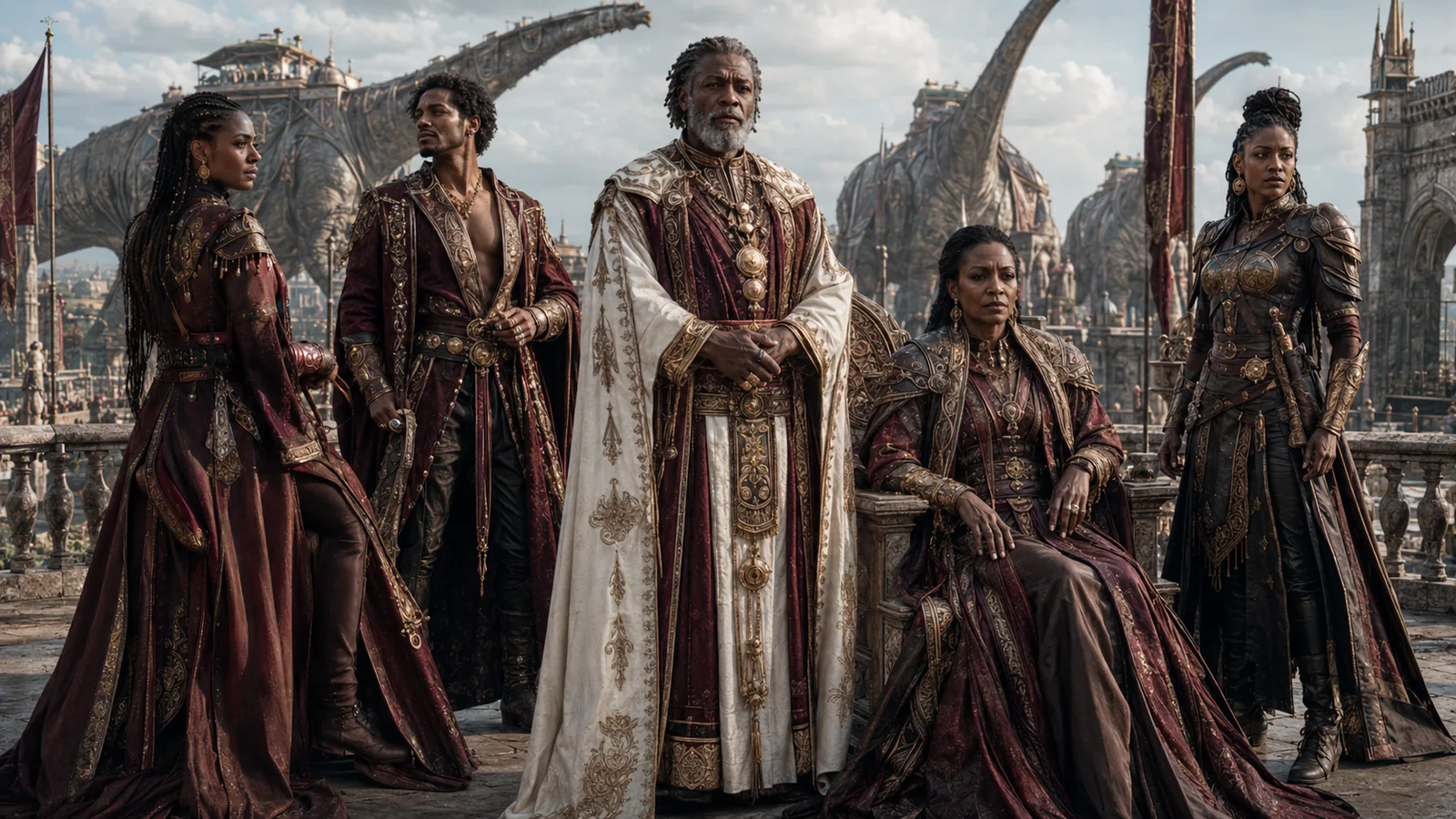
House Vael-Orûn
The imperial House of Urnok. It has carried the Crown for three generations, sits in Urnok and governs an empire several millennia older than itself.
A recent House on an ancient throne
House Vael-Orûn carries the imperial Crown of Urnok. Its family history goes back about two thousand four hundred years, yet it has held the throne for only three generations. The Empire is far older: its tradition reaches back to a famine some ten thousand years ago, and several warrior dynasties reigned before the Vael-Orûn.
The House is a very distant cadet branch of the Orlenox of Sarnor, the ancient House of reserves and granaries. It conquered or received the throne after those warrior dynasties. Its legitimacy is therefore younger than that of several Houses it governs: the Orlenox count at least eight thousand years, and the House of Qor Zaï claims descent from the first Urnokians.
Since the time of Orûs III’s grandfather, the Vael-Orûn have imposed a hegemonic peace. It is not pacifism: Urnok remains an ancient, military and heavily armed empire. The peace holds because the Crown can arbitrate between the dukes, mobilise resources and make a revolt costly.
The seat and the Houses of the centre
The House’s seat is Urnok, the capital, in the historic duchy of Calaron. Calaron is the centre from which unification set out; the other duchies are former Crowns that were absorbed while keeping part of their institutions, resources and rank.
The Crown does not hold the functions of the centre alone. They are shared among several Imperial Houses: Calaris holds protocol, arenas and seals, Tewolde-Baran civil records, Qoré-Mirhan the chancery. The Grand Imperial College brings together the dukes, the great orders and the major institutions; it confirms the heir and steps in during constitutional crises. Industrial families can be summoned there for their material role without receiving the full voice of a ducal house.
Below these Houses, the register of Calaron provides for High Lines of scribes, seals, arenas, heavy road maintenance and the schools of the Road; their names are not yet known. Curena Ulc, Commissioner for Heavy Waste, stands at the head of the heavy road chain. The duchy’s signature material is egg paper, ink and the register.
A living patrimony
The House’s power combines law, roads and the means of the state with a living patrimony. Azhor le Porte-Cendre, Orûs’s imperial ultrasaur, is the largest living animal of the imperial lineage. The Imperial Order belongs to the emperor himself; it is distinct from the Order of the Diplodocus, which Marjory founded.
The military titans assigned to the duchies and orders remain the legal property of the Crown, as do their remains. A duchy therefore uses these great animals without owning them.
The imperial Ultrasaurus is the sovereign emblem of Calaron and of the Crown. Imperial statuary raises ultrasaurs and brachiosaurs at crossroads: Urnok honours its great animals as living infrastructure.
The imperial family
Orûs III exercises sovereignty: supreme justice, the decision of war, arbitration between the dukes. His wife Marjory was born into Vael-Senn, the archducal branch of House Senn-Zarnith. The natural heir of Velmor in her youth, she renounced that succession when she married him. She became empress, commander and one of the great authorities of the imperial stewardship.
Their elder child, Sahina, is the heir. She holds the High Stewardship: the Living Ways, logistical crises and the sensitive projects that involve roads, supplies and great animals. Her mount is Nahara, a young Diplodocus. Their younger son, Maivar, frequents the court and the salons of Volonia; he is close to Andrea Vornëa.
Maivar et sa sœur Sahina, de la Maison Vael-Orûn.
Maivar et sa sœur Sahina, de la Maison Vael-Orûn.
The House also counts Ilmara Vael-Orûn, keeper of the funeral rites. Through Marjory, the imperial family is related to the Senn-Zarnith: Sahina and Maivar are first cousins of the children of Maelyra, Archduchess of Velmor.
Inheriting in a great House
In the great Houses of Urnok, sex sets no general ceiling: the principal office and the continuity of the House come first. An heiress can keep the House through a matrilineal union; a cadet branch can take up a name; an adoption can maintain the institution. Women inherit, command and hold high office.
The Vael-Orûn show how far this rule reaches. A distant branch of a House of Sarnor could carry the Crown, and a House’s name can outlive the extinction of a branch. Continuity of office counts as much as continuity of blood.
A Crown that depends on the duchies
The Crown depends on what it governs. Its decisions presuppose the granaries of Sarnor, the stone of Bralnor, the timber and resins of Orlantis, the harnesses of Velmor, the march roads of Qor Zaï and the crews who maintain the ways. Roads must bear the load, the Bank must allow credit and the reserves must feed the forces committed.
This dependence is also what makes the whole solid. The Empire never rests on a single family: it cannot be brought down at one stroke, nor reformed at one stroke.
Conquered or received
How the Vael-Orûn took the throne is still debated, and the debate is part of their history. The Calaris coronation archives record a reception: after several warlike dynasties, the Crown is said to have passed to this distant branch of the Orlenox by way of the forms, confirmed by the Houses and the Grand College. Another tradition, more widespread in the duchies, speaks of conquest and points out that nobody receives a throne without first showing they could take it.
The two accounts do not wholly exclude each other, and the House does not try to settle the matter. It draws its legitimacy less from its origin than from what it has made of power: three generations of administered peace, maintained roads, dukes arbitrated rather than crushed.
The peace of three generations
Orûs III’s grandfather turned imperial hegemony into administered peace. Before him, quarrels between duchies were often settled by arms, with the Crown stepping in only afterwards. Under the Vael-Orûn they come first before the emperor: a dispute over a road, a silo or a boundary is argued by the Houses’ agents, and the judgment shares out responsibility between them and the Crown.
This peace has nothing of disarmament. The legions stay in garrison, the Crown’s great animals stay ready, Velmor keeps its privilege of private war and the march of Qor Zaï never lowers its guard. What has changed is the cost of revolt: a House that took up arms against an imperial decision would face at once the army, the Bank, the Chancellery and the other duchies, whose roads and markets depend on the common order.
The gold of full silos
The House wears the Empire’s colours: a dull gold laid on an earth brown, the gold of full silos rather than that of riches. Its banners are heavy, its harnesses of oiled leather, and the Crown’s animals go out caparisoned in matt gold, never in shining gold. The imperial Ultrasaur is painted on the shields of the Crown Legion and on the banners of the great ceremonies.
The motto, “We carry what endures”, can be read on the pediments of imperial buildings and on the engraved milestones of the great roads. It states the House’s programme better than a long speech: to carry, as a sauropod carries a load, what earlier generations built, and hand it on in good order. The House’s court is sober for an imperial court; people there talk of roads, reserves and accounts more than of splendour.
The House’s rites
Ilmara Vael-Orûn is the keeper of the House’s funeral rites. In Urnok, a member of the imperial family receives a low state pyre, and the eulogy spoken before it is about their office rather than their titles: a few sentences on what they held, corrected or carried. Then a Counter closes their name in the register, reads out the charges they leave and transfers them.
The ashes do not rest in a tomb. Like those of any Urnokian, they may be poured onto the squares of grass that line the roads, in an empire that remembers the famine and wastes nothing, not even its dead. For the imperial family the rite remains that of any Urnokian, raised to the scale of the State: the same closing of the name in the register, before a larger crowd.
Part of this article covers events of season 1. Turn spoilers on in the menu to read it.
Gallery1 image
Orûs III in ceremonial dress.