
The great trade flows between nations
Grain, timber, stone, tendons, glues, metal and contracts move between six rival powers that cannot do without one another.
To specialise is to depend
None of the six powers produces on its own what it needs to live and fight. The world rests on a material division: living creatures provide tension, compression, bone, horn, tendon, tooth and traction; metal keeps the cutting edges, the rivets and the mechanisms. A weapon, a hull or a harness therefore almost always combines materials from several countries.
These exchanges also bind rivals. Korath despises Arkhan, yet its precision ballistae depend on the fine tendons of the Arkhan tracks. The Draco is the unit of account of great trade; contracts, insurance and registers settle who answers for a cargo, its condition and its loss.
Grain, timber and stone
Sarnor is the Empire’s granary: silos, reserves, grain and farming basins. Its fodder feeds the animals of every duchy and the markers along the roads; House Sarnor Trois-Saisons, which holds fodder, private silos and rations, can save or starve a campaign without loosing an arrow. Korath, by contrast, lacks food depth: its engineered valleys cannot replace the great plains, and imported grain remains indispensable to it. It sometimes takes payment for its training in grain, fish, oils or medicines.
The forests of Orlantis supply timber, resins, ropes, varnishes and fibres. These goods go to Volonia, whose hulls, quays and marine harnesses consume them; the Velasar shipyards even keep carpentry traditions that came from Orlantis. Pearls, fabrics and luxury goods travel the other way, and Orlantis resells them throughout the Empire. The Îles Brisées act as intermediaries for part of this trade. Arkhan bow workshops also depend on rare glues from Orlantis or N’Goro.
Bralnor supplies the Empire’s physical matter: massive stone, marble and limestone, of which Karûm-Brakh is the main client. Velmor adds its black stone, which travels to Calaron and to Korath by a mountain road.
Tendons, bone, glues and anti-rot
Urnok sends Korath heavy sauropod tendons, which become cables, heavy ballistae and forge bridges; fine tendons from raptors and theropods, coming from the Arkhan tracks and Port de Sable, go into precision ballistae and lashings. Within Arkhan itself, the long bones and bone lime of the tracks feed the cement of the Cité des Os, and the Stone Teeth work teeth, blades, saws and maps of the passes.
N’Goro supplies Arkhan, Korath, Volonia and Urnok with glues, enzymes and preparations against rot. These products stabilise tendons, leathers and cements: they are scarce, but indispensable far beyond the place where they are made. N’Goro exports anti-rot as a finished product, in marked batches, and keeps its formula secret. Venoms, antidotes, filters, fibres, spores and living wood concentrate high value in small volumes; their passage comes with inspections, quarantines and sometimes sanitary refusals. The League of Master Carriers, the hidden ports and the Houses of Black Milk run protected, taxed routes there.
Korath’s metal and parts
Korath’s nationalised Imperial Forges hold heavy metallurgy and strategic alloys. But Korath’s presence abroad mostly takes the form of intermediate parts: hinges, tensioners, recoil systems, pumps, gauges, locks, winches and transmissions. A great hull can keep its Volonian shape and its Orlantine timber while resting on Korathi joints and safety devices. Korathi engineers work at Velasar.
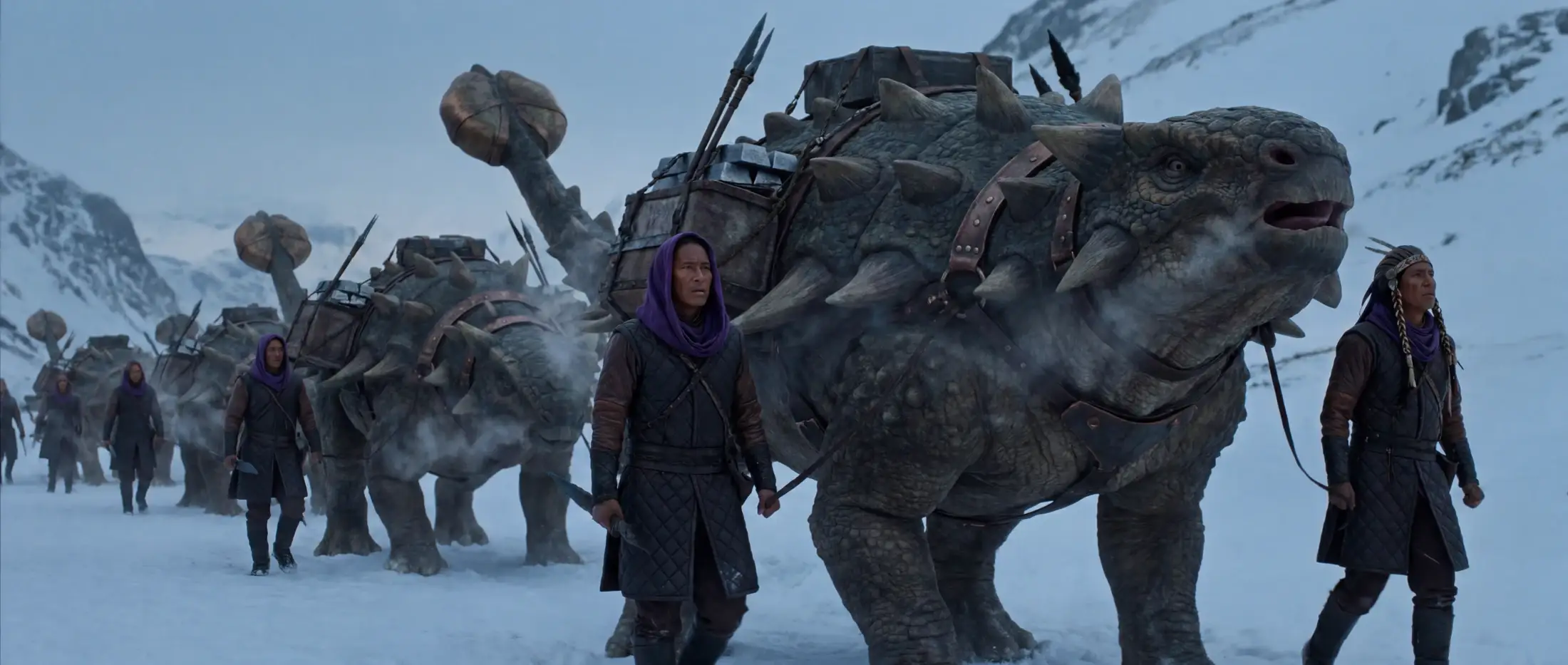
Urnok receives from Korath parts and manufacturing know-how needed for its military equipment. The Route noire links Velmor, Korath and Calaron: black stone, rivets, chains and unique parts travel on ankylosaurs and in armoured convoys. The Living Armouries depend on it: Korath forges the rare part, Urnok invents the doctrine. Karûm-Brakh, for its part, funds Korathi prototypes in exchange for future rights.
The sea, insurance and contracts
Volonia is the only great power that regularly works the Great Ocean. It therefore controls fish, oils, bones, pearls, shells and biological materials that other nations can reach only through it. Its finance was born of these flows: the fleet generated enough movement to make credit, insurance and securities unavoidable.
The Grand Comptoir handles exchange, clearing, debts and settlement between houses; the Cour des Marchands rules on bills of exchange, losses and cargo rights. An expedition can be funded through campaign shares that entitle holders to its returns, while bets are placed on its outcome, duration or losses. With Arkhan, Volonia trades ports, credit, insurance and charts; at Port de Sable, Arkhan spoils — beasts, cages, venoms, captives — become Volonian assets.
Ishtir: trading without a domestic market
Ishtir trades abroad without circulating wealth at home. Its orders and ports use barter, contracts, units of account or foreign currencies. The animals Urnok imports from Ishtir arrive with their trainers’ knowledge: the animal, its care, its feeding and the training it needs travel together.
The routes themselves
The trade of the known world follows a few great roads. The Empire’s great river, the Ur, carries grain, fodder and heavy goods on its living barges, for about half a Draco per tonne per day, quay tolls included; it runs down to the marshes of N’Goro, where the threshold post of Gwami inspects everything that enters. Towing canals link Sarnor to Calaron. The Black Road runs from Velmor to Calaron by way of Korath, and its armoured convoys carry black stone, rivets, chains and unique parts.
On land, caravan freight costs nearly two Dracos per tonne per day, and the passes of Korath are crossed landing by landing, by winch and chain. In the north, the High Moors road passes through the March of Braknor; in the south, Port de Sable opens the Arkhan coast to Volonian ships every season. At sea, the presence of the great marine reptiles imposes coasting from shelter to shelter, and only Volonia regularly works the Great Ocean.
Distances are counted in weeks. A relay courier covers forty to sixty leagues a day; a heavy convoy far fewer, and between two powers one must often cross weeks of land that no one holds.
When war passes through
War does not stop trade: it diverts it. When a road is cut, goods look for another passage, longer and dearer, and the small powers that hold that passage grow rich. Neutral ports fill up, insurance premiums rise, and the fences of the grey ports see cargoes arrive whose origin no one asks about.
Armies themselves are great customers. A campaign absorbs the fodder of several provinces, the tendons and glues of the workshops, the rivets and parts of Korath, the remedies of N’Goro; the workshops that supply them run at full capacity, and their prices follow. The merchants of every nation know it, and some sell to both sides at once, through different intermediaries.
Peace, finally, is also settled in goods. Treaties set reparations in grain, in Dracos, in animals or in the carcasses of great beasts, reopen roads and ports, restore licences. A treaty that forgets trade often prepares the next war.
Those who keep things moving
Behind every flow there are people whose trade it is. The Volonian houses charter the ships, insure the cargoes and hold the contracts; Karûm-Brakh finances the great works and delivers fodder on credit in the six duchies of the Empire. In the marches of Varek and Qor Zaï, frontier brokers place cargoes between Urnok merchants, Korath forges and Arkhan clans, guarantee the contract and speak all three languages.
Arkhan takes its share from the passage. Its clans levy a movement tax on whatever crosses the steppe, escort the caravans that pay it and plunder those that do not. In the south, the League of the Maîtres-Porteurs of N’Goro holds the barges, the guides and the hidden ports of the low waters, and nothing moves there without it.
All these intermediaries speak the Route-Cant, count in Draco and know one another, even when their nations are at war. On the quays it is said that a merchant always has a friend among the enemy.