

Armies
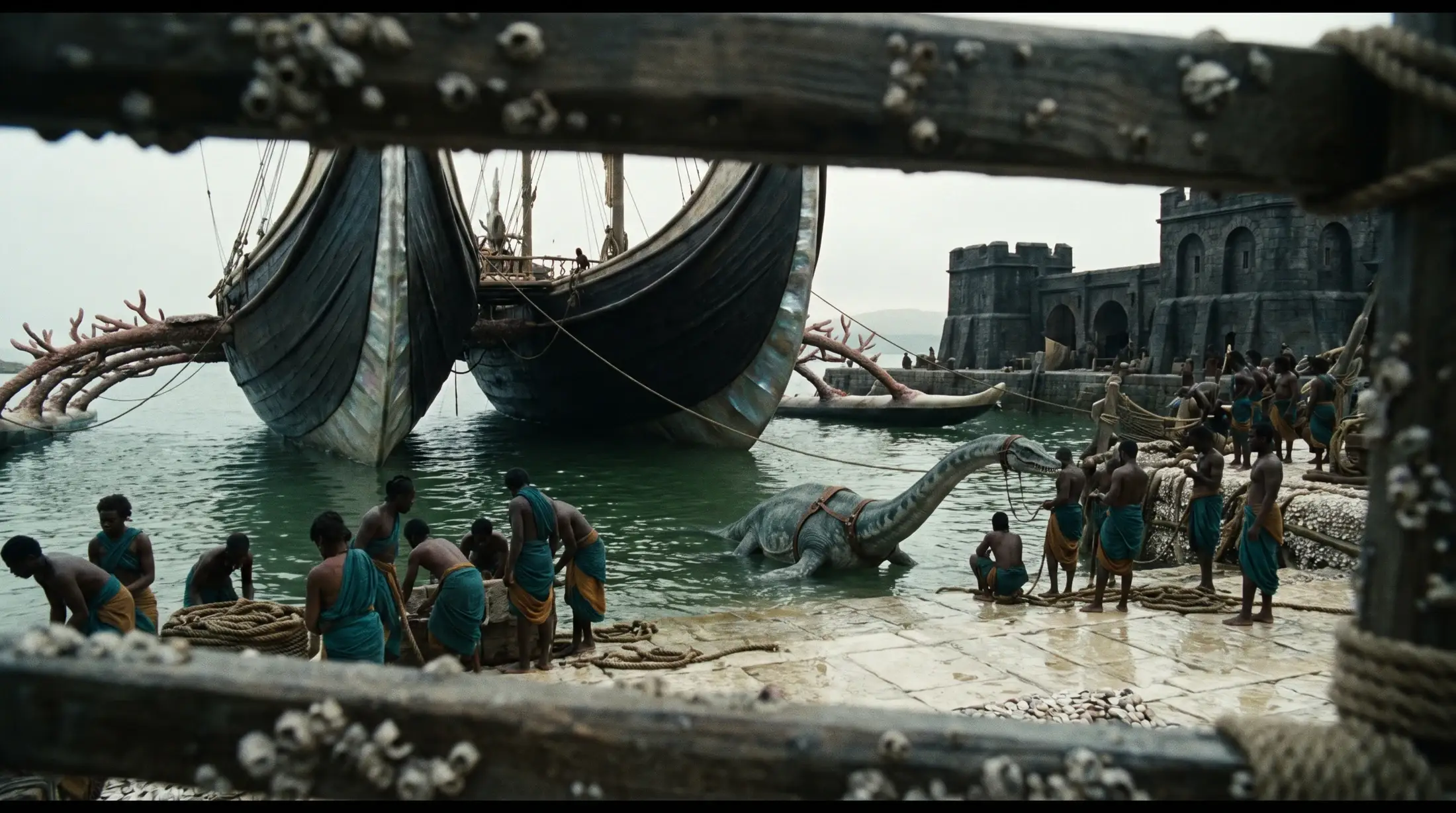
The Souverain des Marées
Volonia’s capital ship (“Sovereign of the Tides”): the largest vessel of the fleet, which carries the admiral and commands artillery, naval aviation and landings.
A ship that commands the others
The Souverain des Marées is not merely a very large galley. The register makes it the fleet’s sole capital ship, the one that carries the admiral, and a platform able to command several kinds of units at once: artillery, naval aviation and landings. It commands an air and underwater group.
At about one hundred and fifty metres, it is the largest Volonian ship. Neither the list of its named hulls nor their dates of commissioning are known.
What the flagship model can carry
The flagship model can combine two to three keels, articulated sections, watertight compartments and Korathi reinforcements; sails, oars and twelve to eighteen towing plesiosaurs; a group of pterosaurs, sea riders, landing barges, a hospital, workshops and animal reserves.
Its size does not abolish the constraints of the sea. A ship of this scale depends on the passes it can clear, the ports that resupply it and the means that repair it; that is why it sails with the fleet’s support ships.
A town of two thousand souls
Two thousand to two thousand eight hundred people live aboard a Souverain des Marées on campaign, the population of a large lagoon township. Rowers and topmen form the largest group; then come the crews of the forty ballistae and the catapults, the sea crossbowmen, the contract boarding companies, the masters of traction and their keepers, the Porte-Aile of the pterosaur group, carpenters, caulkers, cooks, surgeons and clerks. The admiral’s staff, with its clerks, signal copyists and pilots, takes up a good part of the stern by itself.
The ship is organized like a district. Each deck has its passageways, its mealtimes and its bells; the lower deck serves as the rowers’ dormitory, where they sleep by watches in hammocks slung above their benches. A ship’s chapel, a chart room, an infirmary, workshops and stores bedded in sand follow one another from bow to stern. Sailors say one can serve a whole season on a Souverain without seeing every corner of it, and that it is easier to get lost there than in the alleys of Port Volon.
Twelve to eighteen beasts in rotation
The Souverain never harnesses all its beasts at once. Its twelve to eighteen draught plesiosaurs work in teams: some pull, strapped into the lateral harnesses to port and starboard, while the others swim astern on slack leads or rest beside one of the squadron’s Maisons des Plésiosaures. Reliefs take place at fixed hours, at the master of traction’s signal, and call for a precise manoeuvre: a team is only unharnessed once the next is in place, so that the ship does not lose way.
The rotation governs everything else. A fresh team gives the Souverain the pace of a Grande-Coque de Ligne; an exhausted one leaves it as slow as a merchantman. Its beasts eat between one and one and a half tonnes of fish a day, brought by the Greniers du Large and handed out by the feeders from baskets lowered along the hull. Before a battle, the master of traction keeps his strongest animals for the moment of contact and has the others pull during the approach; it is often he who tells the admiral at what hour the fleet will be able to fight.
The Souverain’s court
A Souverain never sails alone. Around it forms a group that sailors simply call “the court”: one or two Nids d’Alizé and a Tour des Ciels for the sky, Grandes-Coques de Ligne and Frégates d’Écume on its flanks, Harponneurs and Coupe-Courant against sea beasts and, further astern, the Maisons des Plésiosaures, the Greniers du Large, a Hôpital des Marées and an Atelier des Coques. Below the surface, foam riders and Cloches d’Abîme complete the arrangement.
It is this whole that is meant when the Souverain is said to command an air and underwater group. The flagship receives the reports of the pterosaurs, the riders and the pilots, and sends back its orders by flags, bronze mirrors and written slips. Its raised afterdeck carries the post of the master of signals and perches for the mast Sénelles that carry dispatches from one ship to another. Admiralty officers say a Souverain is worth less for its ballistae than for what it sees and what it makes known.
Building a Souverain
Only the yards of Velasar know how to build a Souverain des Marées, and only the arsenal’s great dry dock, some hundred and fifty metres long, can take one. The multiple keel is assembled there over three seasons; then come the steam-bent, numbered frames, the planking of Orlantis timber, the copper sheathing below the waterline, the watertight bulkheads that divide the hull into compartments, and the single-trunk araucaria masts, chosen standing years in advance. The deck ballistae receive Korathi recoil dampers, fitted and tuned by engineers who come from Korath.
The cost of such a ship exceeds what any house will risk alone. A Souverain is therefore owned in shares, divided between the Velasar Trust, several great houses and the League’s common fund, and registered as such in the Register of Hulls and Routes. The rule forbidding an admiral to board a hull of his own house applies here in its own way: the admiral of a campaign may not belong to a house holding the majority of the shares in the Souverain he commands. Each launching, under the bells of Velasar, draws a crowd from every port.
A ship one does not risk
Its value is also the reason for its caution. The Admiralty commits the Souverain only to a decisive battle, when a victory can end a campaign; the rest of the time it commands from the rear, out of reach of enemy engines. Its size also limits its movements: its draught bars it from most estuaries and narrow passes, few ports can berth it at a quay, and it must often anchor offshore while boats ply back and forth.
Abroad, the Souverain is the very image of Volonian power. Urnok merchants and Ishtiri captains who have seen it pass speak of it as a moving island, and the maritime theatres of Port Volon stage it in their mock sea battles, shrunk to a model towed by Flèches-mer. The insurers of Marévant speak of it differently: no single policy covers a Souverain, and its loss would strike insurance chambers in every great port of the republic.