

Culture
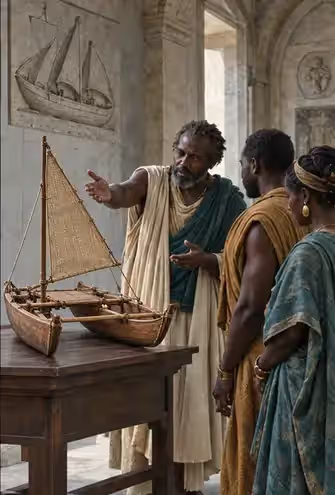
The Museum of the Great Crossings
The Museum of the Great Crossings keeps the memory of the ships, explorations, migrations and animals that served Volonia’s routes, along with trophies from distant expeditions.
The memory of the routes
The Museum of the Great Crossings gathers the memory of the ships, explorations, migrations and animals that served the sea routes. It also displays trophies brought back from distant expeditions. In fixing these memories, it also fixes the story the republic tells itself about its own daring.
Museums belong to Volonia’s popular pastimes, alongside floating markets, neighbourhood festivals and water shows; the greatest fortunes even keep private museums in their homes beneath the sea. Deep blue, turquoise, warm gold, mother-of-pearl, coral, copper and coloured glass recur in decorations and prestige objects.
The museum and its halls
The Museum of the Great Crossings occupies former warehouses in Port Volon, on the edge of the Navigators’ quarter, where the cartographers work. Its halls open onto a basin where the oldest hulls the republic has preserved lie afloat, among them a large double canoe from the earliest times, of the kind the ancestors who came from the Broken Isles used to pass from one island to another. Visitors look at it from wooden galleries, at deck height.
Inside, the collections follow the order of a crossing. The hall of hulls displays models numbered as in the Register, rudders, stems and sections of Great Hulls that show their watertight bulkheads. The gallery of animals exhibits skeletons of working plesiosaurs, harnesses from every period and the first transport cages. The hall of charts gathers maps engraved on nacre, old tide tables and copies of ancient portolans that can now be shown without danger. The hall of migrations, finally, brings together the objects left by the peoples who came to settle in the ports: tools, amulets, chests and clothing, each accompanied by the name of the quay where its owners landed.
Trophies from far away
An old rule requires every expedition financed by campaign shares to leave an object at the museum on its return. The hall of trophies is therefore the fullest: teeth of great wild reptiles from the Great Ocean, as long as a forearm, giant shells, sea amber holding insects, spices and seeds brought back from the Far Souths, prows of pirate ships taken in the south-west, flags of defeated squadrons. Each object carries a label naming the expedition, its house, its captain and the amount of the shares that financed it.
Not all these trophies are peaceful. The Broken Isles have long demanded certain pieces taken from their ancestors, and the museum answers that they were acquired according to the customs of their time. The houses, for their part, fight over the placing of their objects: a dais at the centre of the hall is worth an advertisement for a whole generation, and the great families pay for the upkeep of the halls where their name stands first.
The museum and the city
The museum is one of the busiest places in the capital. Neighbourhood schools bring children there before their first embarkation, and entry is free on the day after the Reckoning of the Tides. The guides are almost all former sailors or former pilots, who tell of the crossings as if they had taken part, and sometimes they did. Foreign visitors come too: for many merchants from Urnok or Korath, it is the first time they see a plesiosaur skeleton or a chart of the Great Ocean up close, even an old one.
The museum also serves the republic. Fleet homecomings are celebrated there, the most spectacular prizes are displayed, and the Admiralty sometimes consults its old charts and models to rediscover a forgotten passage. What one does not see there matters just as much: there is almost nothing about lost ships, whose memory belongs to the chapels of the drowned, and little about defeats. Volonians know it and joke about it: at the museum, every crossing arrives.
Keeping what the sea damages
Preserving marine objects in a sea city is a daily struggle. Salt eats metals, damp swells wood, shipworms attack the hulls in the basin, and the leather of old harnesses cracks if it dries too much. The museum therefore employs its own craftsmen, often carpenters, caulkers and harness-makers retired from the yards, who oil the leathers, recaulk the hulls, clean the nacre plates and remake parts of the models.
Its collections grow mostly through families. Many captains bequeath to the museum their oldest chart, their ship’s bell or their logbook, and the heirs insist that the donor’s name be written beneath the object. The League pays for the upkeep of the buildings; the houses pay for the rest.