

Armies
Volonia — Arsenaux et matières du vivant
De l’atelier au terrain d’exercice, les os, les tendons, les cuirs et les cornes deviennent des pièces choisies pour une fonction précise.
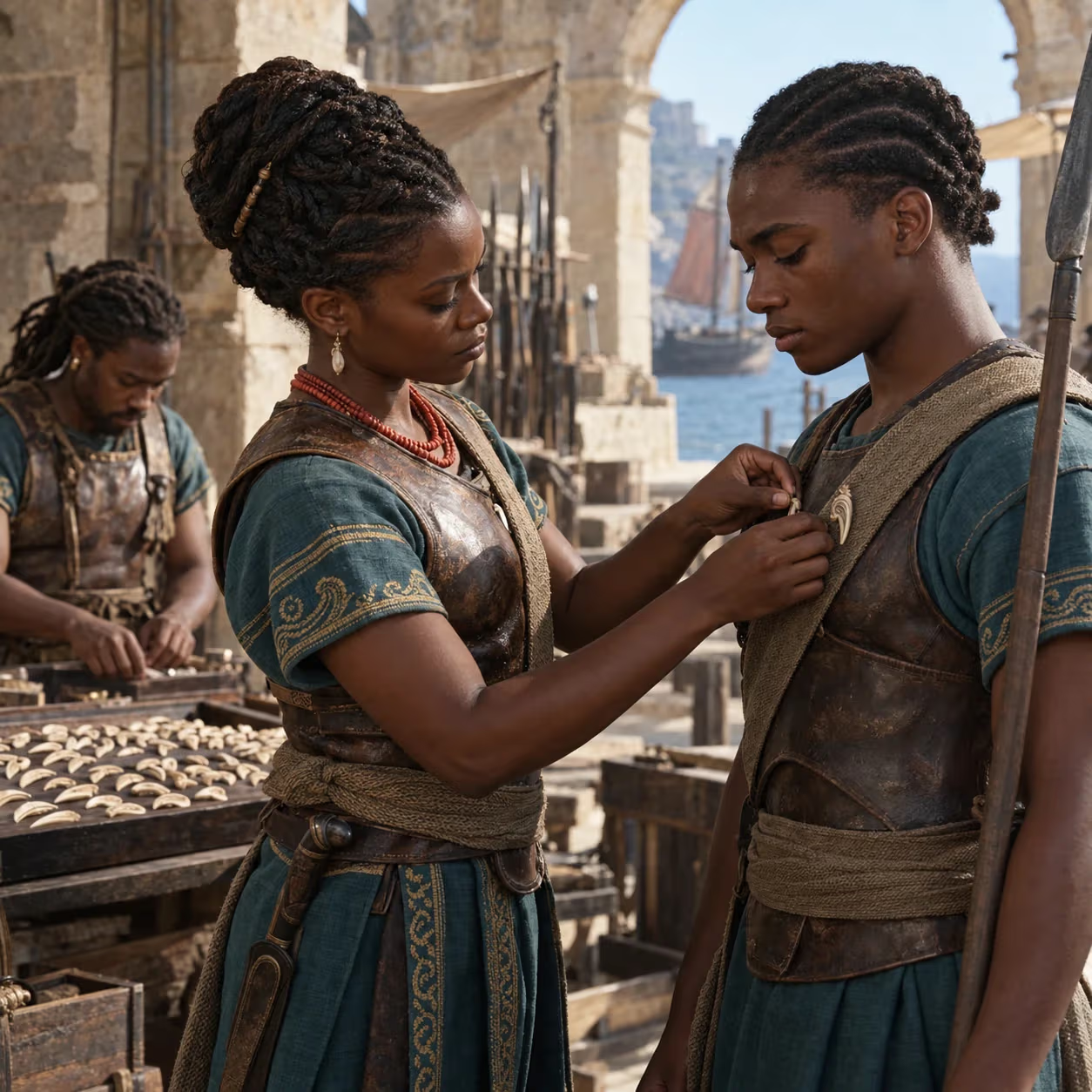
Choisir, assembler, réparer
This extended reading is currently available in French.
Les chantiers de Velasar et les métiers des calfats donnent aux équipements maritimes une place dans le travail du port. Le harpon de Calystrëa appartient à cet ensemble d’objets dont la fonction dépend des équipes, des embarcations et des conditions d’usage. Une flotte ne se maintient pas par ses armes seules. Les réparations, les matières et les engagements économiques rendent possible la continuité du service entre deux sorties.
Les matières biologiques ne rendent pas toute arme supérieure au métal. Une doublure doit rester souple, une protection laisser respirer et une pièce usée pouvoir être remplacée. Les plaques dorsales décoratives se distinguent des pointes adultes destinées à l’armement.
Éprouver le matériel
Inspection, manipulation et entraînement révèlent la place de ces équipements dans une formation. Les gaines de griffes et les couronnes d’Apex restent des prototypes ; les équipements scellés gardent le secret de leur fabrication.
A productive naval power
Velasar is the great naval House-trust: Great Hulls, arsenals, ocean fishing, plesiosaur breeding and foreign orders. The chain brings together Korath engineers and Orlantis traditions. Vornëa’s reputation and luxury do not make it the leading naval complex: productive functions remain distinct.
A hull begins far from the sea
Flows connect Orlantis timber, resins and cordage to Volonia’s hulls and marine harnesses. The shipyards add hides, sinew and metals. This network explains the dock’s dependence on several land-based and animal-material workshops.
The shipyard works with an animal
The plesiosaur works in construction and towing. Its channels are distinct from human routes and boats; floating docks, passages, refuges and moorings belong to the port vocabulary. The animal does not replace the shipyard: people, harness, hull and water work together.
A trade between the pieces
Hull carpenters and caulkers work at different stages of shipbuilding. Sealants, oakum and marine resins join timber, frames and planking. A joint is worked material rather than a gap the carpenter forgot. Between construction and repair, watertightness has its own supplies and the hands that install them.
Rope lives in salt
Marine ropes, storm sails and rigging form a chain distinct from the hull. Salt-exposed rope, shrouds and pulleys serve mooring and navigation. Work does not end with braiding: rope exposed to salt and moisture enters an upkeep economy where replacing a part matters as much as making the first assembly.
Workshops accompany the fleet
In Volonia, docks and great hulls opened ocean access before financial expansion. The flagship model may include workshops and watertight compartments. These workplaces aboard allow tools and trades to keep working after departure from the shipyard.
The sea becomes a workshop
The Calystrëa Harpoon combines a marine tooth, timber, treated sinew and a metal point. Its making belongs to the quay supply chain: a hunting or escort tool depends on hull, line, treatments and people who know how to work on water.
A material of port and company
The object is a sign of Volonian maritime economy, where commerce, escort and hunting may overlap. No company holds a monopoly over it.
Ownership and command
In ordinary times, houses own fleets, animals, officers and doctrines. Once a major war is recognised, the Meeting of Flags places participating forces under the Admiralty of the United Fleets. Houses retain ownership while operational orders pass to naval command.
Sky, surface, depth
Fleets combine great hulls, plesiosaurs and marine riders mounted on common beasts. Small pterosaurs provide coverage, signals and reconnaissance. These groups perform different functions above water, on the surface and beneath hulls, using animals suited to each environment.
Basins are part of the fleet
Plesiosaurs also tow, transport and rescue. Ports separate different waters and animal basins; hanging harnesses, ramps and service quays make work possible. Great strategic reptiles serve primarily deterrence and vital defence.
Volonia: the sea produces flows
The fleet before finance
Plesiosaur selection, quays and large hulls enable regular exploitation of the Great Ocean. Deep fishing and mass transport circulate fish, oils, bones, pearls and biological materials. Insurance and credit develop around these material flows. The port therefore remains a place of animal work, construction and handling as much as a financial market.
Volonia: the sea produces flows
The Fifteenth
The universal fifteen-percent tax applies to income, profits and realised gains, including betting winnings. Individuals, houses, companies and trusts are subject to it without major-house exemptions. A separate, modest wealth levy accompanies this tax. Declared wealth must pay its duties before taking part in power.
Volonia: the sea produces flows
A cargo keeps its risk
At the quay, a sensitive cargo does not become ordinary because it enters a hull. The sensitive-cargo inspector describes what requires care; the rare-living evaluator assesses transport conditions; the marine cage master watches the container and its relation to the sea’s movement. Their work does not promise the absence of accident. It makes visible what must be checked before departure and what must be explained if the journey fails.
Volonia: the sea produces flows
A guarantee requires precise reading
The guarantee weaver, claims broker, caravan insurer and maritime-clause jurist work where a risk must become understandable before it can be shared. They read exclusions, delays, the nature of the cargo and opposed accounts of the same event. A guarantee erases neither loss nor mourning; it determines what can be claimed and by whom. Precision of language is part of port work.
Volonia: the sea produces flows
The quay has thresholds
The Vaesh quarantainer maintains a distance between an arrival and the bodies, basins or animals that could suffer its consequences. Their action is followed by inspection, sometimes by ransom negotiation when waiting turns a crossing into crisis. No trade has the power to make the sea safe. Their presence recalls that a port organises thresholds: what may touch land now, what must wait, and what must leave again.
Volonia: the sea produces flows
The port is a place of production
Volonian quays are used to land, sort, repair, feed, measure and redistribute. Deep fishing and sea transport require holding pools, hulls, crews, handlers, carers and workshops able to repair a damaged part before the next departure. Insurers and banks work after or around these actions, but do not replace them. Port wealth first rests on working bodies, monitored animals and maintained vessels.
Volonia: the sea produces flows
A fleet also depends on land
Shipyards do not live on the sea alone. Hulls, quays, props, repairs and some containers require timber, fibres, ropes and resins. Deliveries from Orlantis are therefore a material condition of Volonian circulation. A supply delay can immobilise a hull before any contract is discussed. This dependence explains why the port also follows land routes, timber orders and the quality of parts delivered.