

Places and landscapes
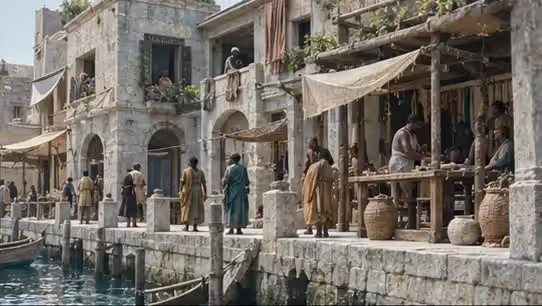
The lagoon terraces
The everyday face of Volonian cities, the lagoon terraces mix homes, workshops, markets, hotels, theatres and basins along raised streets and service canals. They house the middle classes.
The ordinary form of the cities
The lagoon terraces are Volonia’s dominant urban form, the popular city where markets, hotels, races, theatres and breeding pens come together. They are the ordinary face of Port Volon, Séloris or Girvane: middle-income housing, workshops, theatres, markets and basins. The middle classes live there around the markets, canals, theatres and workshops.
Streets run along the terraces, doubled by service canals. Ramps, high or lifting bridges and tide stairs make it possible to change level without blocking the passage of boats and animals; drained floors, awnings and suspended harnesses complete the equipment.
Five waters that do not mix
Fresh water, brackish water, salt water, waste water and the animals’ basins must stay apart. Furniture follows the movement of the water and the lack of space: tables with lockable legs, fixed benches, watertight chests, lockers, hooks, baskets that stop jars from rolling, washable fabrics, low lamps, tide markers, stoppers and valves. Before a move or bad weather, every object must be able to be lashed down.
Landings and pontoons
In Port Volon, the lagoon terrace becomes a landing: tiers surround deep basins, ramps run down to the water and pontoons serve for rites. Trade, festivals and sea traction meet there; plesiosaurs are part of the everyday scene, the mosasaur far less so.
A day on the terraces
The day begins before dawn, with the water carriers. Fresh water arrives from the cisterns and aqueducts in jars or through terracotta pipes, and every household fills its reserves before the canals come to life. Then come the market boats, laden with fish from Marévant, vegetables from the islands and bread, and then the workshops opening their awnings onto the upper street.
At midday the service canals belong to work: delivery boats, lagoon plesiosaurs guiding barges, cleaning crews steering waste water towards the settling basins. In the evening the upper street becomes the place for meals, music and conversation, and on Fridays whole families set off together for the nearest maritime theatre. The terraces never quite sleep: the night tide still brings boats, and the sluice watchmen pass by to adjust the levels.
How a terrace holds up
A lagoon terrace rests on piles driven into the lagoon bed and on caissons filled with a lime that sets under water. Above, walls of coral and stone hold up the drained floors, sloping slightly towards gutters that lead each water to its own circuit. Sluices of wood and bronze, stoppers and tide markers regulate the levels; a badly closed sluice can mix the fresh and salt water of a whole block.
Upkeep is the neighbourhood’s business. Every terrace has its canal association, which raises a contribution from the households, pays the sluice watchmen and the dredging, and decides on repairs. The best-kept terraces are also the most expensive: the rent of a house depends on the cleanliness of its canal as much as on its view of the sea.
The world of the middle classes
The terraces are the land of Volonia’s middle classes: artisans, clerks, brokers, small merchants, pilots, masters of traction, healers, schoolteachers. Many own a share in a ship rather than a ship: merchant double-hulls are sold in twenty-fourths to captains’ families, and a terrace family can live partly on the returns of a hull it sees only once a year.
These families carry weight in political life when they unite. A canal association, a guild or a district can pool its stakes in the Chambers and swing a vote against a great house. It is also on the terraces that the Volonian promise plays out: a docker’s child who became a pilot often buys a first house there, and a bankruptcy sends a family back down to the stilts.
Neighbourhood festivals
Every terrace has its festivals. During the Festival of Music, the upper streets are covered with stages and musicians’ barges travel up the service canals; canal associations organize banquets to which each household brings a dish, and swimming contests between blocks pit the district’s young people against each other. Neighbourhood theatres, smaller than the great maritime theatres, put on comedies there that mock the great houses, the collectors and the neighbours.