

Armies
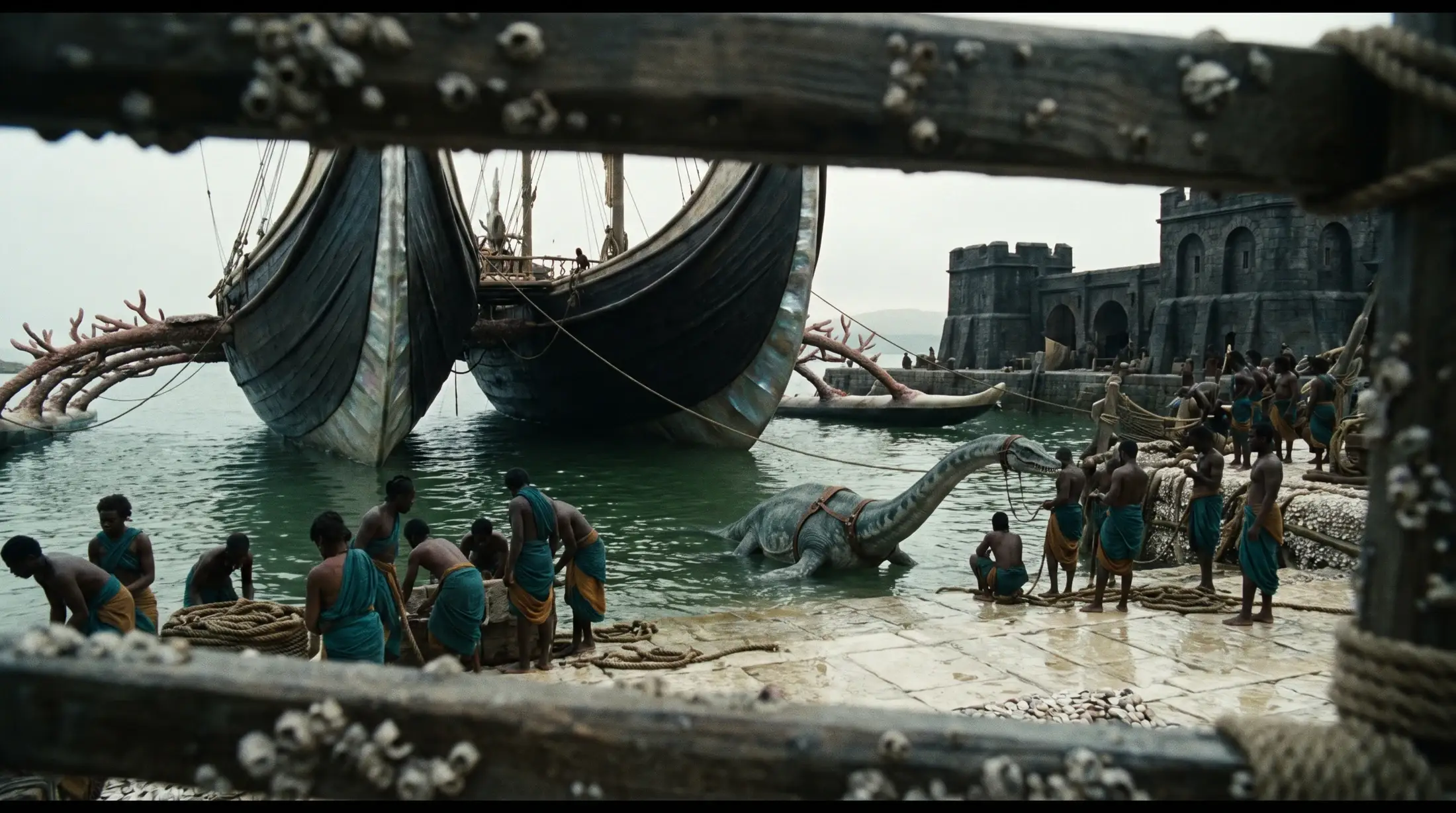
The Grande-Coque de Ligne
The capital ship of the line of battle (“Great Hull of the Line”), armed with heavy ballistae and catapults.
Holding the line
The Grande-Coque de Ligne is the register’s other capital class, alongside the Souverain des Marées. It is built for the line of battle: heavy ballistae and medium catapults, on a hull of ninety to one hundred and twenty-five metres served by one thousand to eighteen hundred people.
It moves under sail and oar, with eight to fourteen plesiosaurs. Like the other Great Hulls, it comes from yards that design articulated hulls, multiple keels and watertight compartments, and its war machines may receive Korathi recoil parts.
A hull made for the line
The Grande-Coque de Ligne is the building block of Volonia’s war fleets. Its hull of ninety to a hundred and twenty-five metres rests on two parallel keels joined by shared frames, which gives it a broad seat and good steadiness when all its ballistae fire together. Along each flank run the bronze-reinforced fastening points of the lateral harnesses, where the salt-tendon traces of its eight to fourteen plesiosaurs are made fast. A hinged rudder, with bronze pivots and pulley tackle, lets two men steer a ship of this size.
Its war engines are carefully placed. The heavy ballistae occupy the upper deck on turning mounts; the medium catapults, bulkier, sit amidships, where the roll is least. The rowers work on the lower deck, sheltered from bolts. Below the waterline, copper sheathing protects the timber from shipworm, and watertight bulkheads keep the ship afloat even if an enemy beast tears open a compartment.
How a line battle is fought
A line battle is prepared long before contact. The Great Hulls form abreast, a few lengths apart: this is the harness interval, the space that lets each plesiosaur team swim without tangling its traces with its neighbour’s. Too tight a line loses its beasts in confusion; too loose a line lets the enemy through. Captains set the interval by the signals of the Tour des Ciels and the flagship.
Combat opens with an exchange of bolts. The heavy ballistae aim at decks, masts and above all the enemy’s teams, for a hull whose beasts are wounded or cut loose can no longer manoeuvre. Then come the chained harpoon bolts, which hook the enemy ship and keep it from breaking away, and then the boarding, led by the contract companies and the deck sailors. Meanwhile the Double-Fins, plesiosaurs carrying archers’ platforms, guard the flanks of the line against swimmers, small craft and enemy riders.
A thousand to eighteen hundred people
A Great Hull’s crew mixes trades that rarely meet ashore. Rowers make up a large share; they are free men hired by the season, paid and covered by a micro-insurance against drowning and injury. Topmen work the sails, gun crews the war engines, sea crossbowmen the tops and the deck. The masters of traction and their keepers live as close as possible to the beasts, in posts open to the sea, forward.
A contract boarding company, often supplied by Calystrëa, embarks for the campaign; it obeys the captain in matters of discipline and its own chief in battle. A physician, carpenters, caulkers and, when the ship carries Korathi-fitted ballistae, a Korathi recoil engineer complete the complement. The captain remains a man of his house, but his officers have often served under other flags: a Volonian sea career passes from house to house as contracts come and go.
Between wars
A Grande-Coque de Ligne is costly to keep, and no house leaves one idle for long. In peacetime it escorts the most valuable convoys, shows its house’s flag in foreign ports and serves as a showcase for the yards that built it. Some houses hire theirs out to the Admiralty to police the routes; others halve the crew and keep the ship at anchor behind a ring-bastion until the next Gathering of the Flags.
Great Hulls live long. A well-kept hull serves several generations of captains, returns regularly to the Velasar refit docks and changes masts, planking and war engines several times over. The Register of Hulls and Routes records each repair in its hull book. On the quays an old Great Hull is recognized by the uneven colour of its timber: sailors say it wears its campaigns on its skin.