
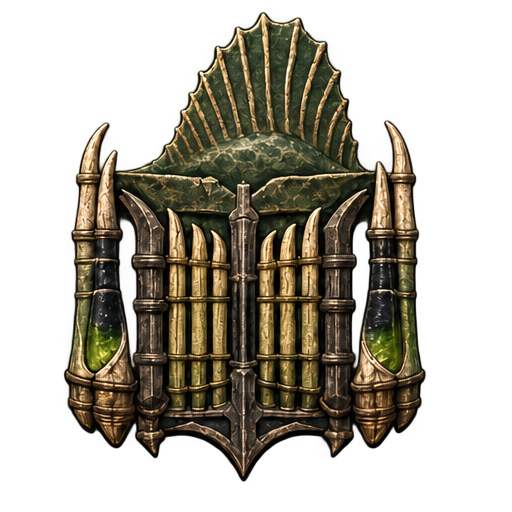
Creatures
Giant crocodilians
The great crocodilians of N’Goro’s marshes: guardians of the waters, the canals and the quarantine basins.
The marsh sarcosaur
N’Goro’s marshes shelter great crocodilians, reptiles that are not dinosaurs. The largest is the marsh sarcosaur, which N’Goro calls Sarko-Brume: a giant, silent crocodilian, an ambush predator of the Living Mirror and the Terres Englouties.
It denies the waters it holds and controls the canals; it is regarded as a taboo of the waters. Its teeth, hide and fat are recovered. It belongs to a country where water, air, soil, plants and animals can all become predators without any human intent.
The basin Deinosuchus
The basin Deinosuchus, massive and motionless, guards the Bassins de Contrôle, N’Goro’s sanitary zone. It protects the quarantines, takes part in managing the basins and deters crossings: a living quarantine, a sanitary guardian more than a beast of war.
The Mâche-brume
The Mâche-brume, a deep-marsh crocodilian with green eyes and black skin, belongs to N’Goro’s toxic fauna. Territorial, it is a threat as much as a resource: it provides defence, medicine and hide.
Mère-Sous-La-Vase
N’Goro’s tales speak of a giant wild crocodilian, Mère-Sous-La-Vase, that no one has ever seen whole. Canal pilots divert three channels for her, and the Synod classes her as a zone, not a beast. Like all the legendary wild Apex, she cannot be trained.
The tusked crocodilian
Not every crocodilian in N’Goro is a wild terror. The tusked crocodilian, named for the protruding fangs that show beyond its closed jaws, is a beast of about a tonne and a half, slow and clumsy on the bank but sure and powerful in deep water. It is the only one of these species the Ngoro train for riding. Riders on its back, armed with forked spears, cross with it the waters where infantry cannot stand; its dwarf lines, smaller and handier, guard the reed beds and carry the spear teams of the ford militias.
Training is the business of clans specialised in amphibious beasts, such as Échine-Boue. The young are taken at hatching, raised in basins and accustomed to the smell of their riders. Sturdy and stubborn, the tusked crocodilian obeys badly anyone who has not fed it, and its riders like to compare it to a barge with teeth: reliable so long as it is not asked to leave the water.
Living near the great crocodilians
N’Goro’s villages share their waters with the great crocodilians and have learned how. The beasts are fed in the same places, far from pontoons and playgrounds, so that they grow used to coming there rather than elsewhere; piles are built high enough that none can reach a floor; neither fish nor linen is washed at the water’s edge at nightfall. Children learn to recognise the trails of bubbles and slow swirls that betray a submerged beast.
Watching for these reptiles is a trade. Œil-Boue, a brotherhood of lookouts, keeps watch over amphibious reptiles along the fords and channels and warns the villages when a great beast settles into an inhabited water. The most dangerous season is laying time, at low water, when the females guard their nests on the banks and attack anything that comes near. The lookouts then plant red poles around the nests, and paths are rerouted.
What is taken, what is not
The Ngoro do not treat all crocodilians alike. The Sarko-Brume is taboo: no one hunts it, and its teeth, hide and fat are taken only from a beast that has died a natural death or been killed in self-defence. Its teeth, as big as a hand, become insignia and harpoon points; its hide, thick and plated, makes shields that do not rot; its rendered fat goes into ointments against burns and chapping. The Deinosuchus of the basins, guardian of the quarantines, is never touched.
The Mâche-brume, on the other hand, is hunted. Territorial and dangerous, it settles near villages and quays, and the hunters of the house of Saek track it through the deep marshes with several barges, harpoons and weighted nets. From it come a much-prized black hide and remedies prepared from its glands and bile; its flesh, which keeps a sharp taste, is eaten only after long soaking and smoking, and many refuse it.
Crocodilians in the defence
No one leads the great crocodilians into battle, but they are part of the country’s defence. The Sarcosuchus that haunts the passes of the Bay of Roots, able to wait for days before striking very fast, guards the hidden ports better than a garrison: the pilots know where it lies, foreigners do not. In the canals of the Control Basins, the Deinosuchus discourage any escape. And wherever a foreign army ventures into a channel, its draught beasts and wading soldiers draw whatever lives beneath.
The defenders have no need to unleash them: it is enough to let the enemy into their waters, close the passes behind him and stay on the mats and roots themselves. The riders of tusked crocodilians, for their part, fight in earnest. They surge from deep water beneath enemy rafts and barges, overturn the craft with their forked spears and are gone before the archers have found them.