

Trades
The caulker and marine rope
Oakum, sealants and ropes maintain what lets a hull return to sea.
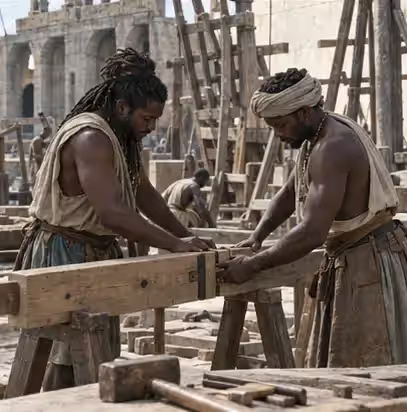
A trade between the pieces
Hull carpenters and caulkers work at different stages of shipbuilding. Sealants, oakum and marine resins join timber, frames and planking. A joint is worked material rather than a gap the carpenter forgot. Between construction and repair, watertightness has its own supplies and the hands that install them.
Rope lives in salt
Marine ropes, storm sails and rigging form a chain distinct from the hull. Salt-exposed rope, shrouds and pulleys serve mooring and navigation. Work does not end with braiding: rope exposed to salt and moisture enters an upkeep economy where replacing a part matters as much as making the first assembly.
Workshops accompany the fleet
In Volonia, docks and great hulls opened ocean access before financial expansion. The flagship model may include workshops and watertight compartments. These workplaces aboard allow tools and trades to keep working after departure from the shipyard.
The caulker’s gestures
The caulker works with few tools: caulking irons of various widths, a hardwood mallet and a kettle where the pitch heats. He first drives oakum, fibres twisted into a cord, into the seam between two planks, packing it down with regular mallet blows. He then applies a resin caulk, a mixture of oakum, tar and resin, and covers the whole with hot pitch. A well-made seam stays watertight for years; a botched seam gives way in the first heavy weather.
The yards ring with this work, and harbour folk recognise an active yard by the song of its mallets. Below the waterline of the great hulls, caulkers also nail copper sheets that protect the wood from shipworms and shellfish, and they replace them at every careening. In the refit docks, once the water has been pumped out, they scrape the hull, find the tired seams and redo what needs redoing.
The ropewalk
Ropes are made in long narrow buildings, the ropewalks, where ropemakers twist the fibres while walking backwards along the whole length of a cable. The fibres come partly from Orlantis, whose ropemaking families supply the rigging of a large part of the fleets, and partly from the islands. For the hardest uses, Volonia employs salted tendon: a sea tendon brined and coated in resin, which does not rot at sea and is used for harpoon lines, crossbow strings and plesiosaur harnesses.
A fifty-metre merchant ship needs a full rig of shrouds, stays, halyards and tackles, which the ropewalk delivers in a single lot. This rigging wears fast: salt, sun and the rubbing of the pulleys mean part of the ropes must be replaced every season, and boatswains keep count of the age of each cable.
At sea and under fire
The great ships take their caulkers to sea. During a campaign, it is they who go down into the hold, lamp in hand, to stop a leak after a storm, a strike on a reef or a ramming. In battle, a team of caulkers waits below deck with plugs of oakum, planks and pitch, ready to seal a breach opened by a projectile or by the jaws of a great reptile. Fire is their obsession: hot pitch is handled on board only far from the oil stores, and a careless caulker can set a ship ablaze more surely than an enemy.
The trade is passed on by apprenticeship, in the guild of the craftsmen of the sea at Port Volon and in the yards. An apprentice begins by preparing oakum and tending the kettle, and it is said that it takes ten years to make a caulker who can be trusted with the hull of a Great Hull.
The sail loft
Beside the caulkers and ropemakers work the sailmakers, who cut and sew sails in large lofts with clear floors. The heavy sails of the Great Hulls, doubled and bolt-roped for the winds of the Great Ocean, take weeks of sewing; the silk sails of the racing sailers come from Séloris and are mended with a tailor’s care. Each sail carries the mark of its loft, and a house recognises its own canvas from afar.