

Armies
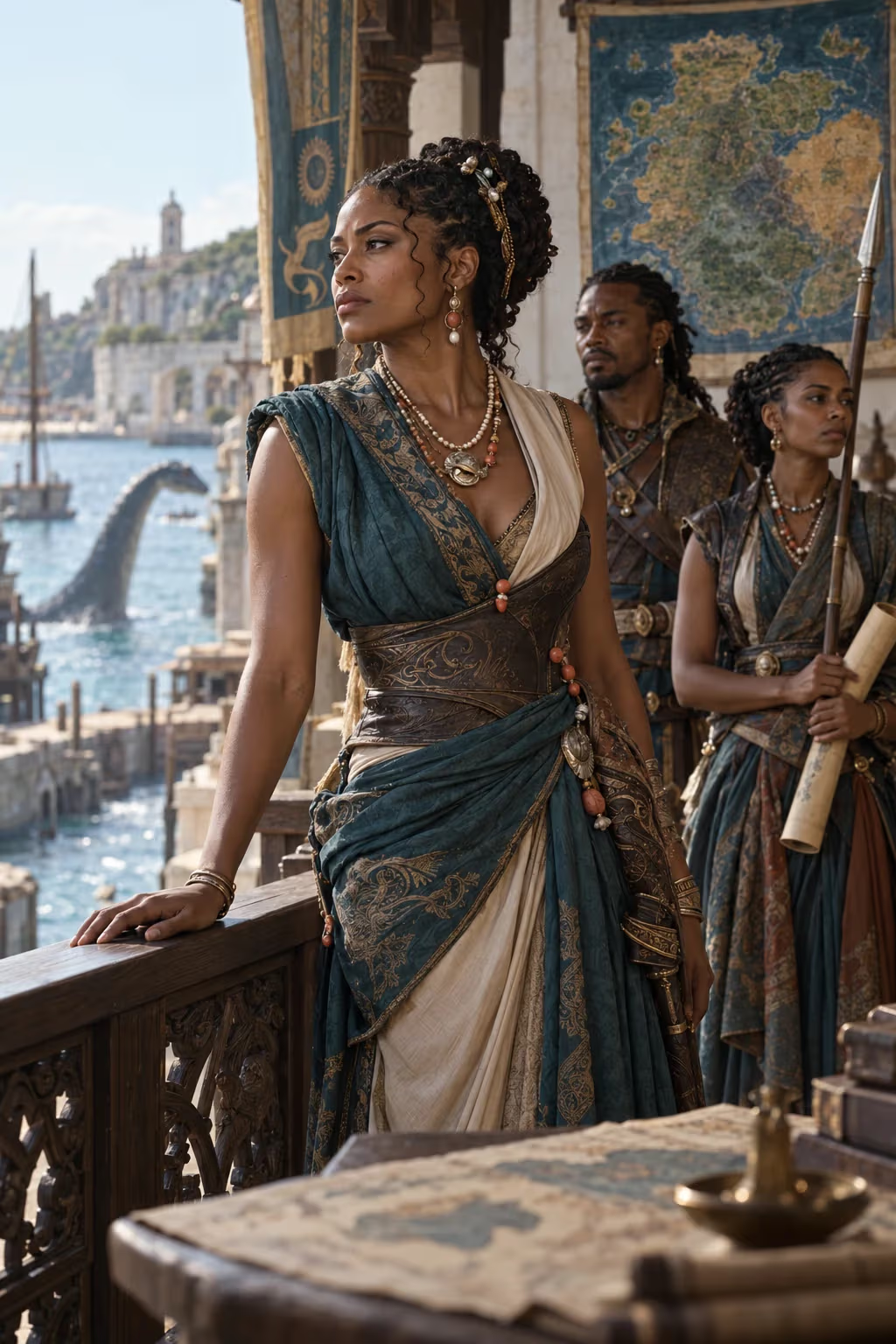
The fleets of Volonia
Private flags, shared naval command and three dimensions of warfare.
Ownership and command
In ordinary times, houses own fleets, animals, officers and doctrines. Once a major war is recognised, the Meeting of Flags places participating forces under the Admiralty of the United Fleets. Houses retain ownership while operational orders pass to naval command.
Sky, surface, depth
Fleets combine great hulls, plesiosaurs and marine riders mounted on common beasts. Small pterosaurs provide coverage, signals and reconnaissance. These groups perform different functions above water, on the surface and beneath hulls, using animals suited to each environment.
Basins are part of the fleet
Plesiosaurs also tow, transport and rescue. Ports separate different waters and animal basins; hanging harnesses, ramps and service quays make work possible. Great strategic reptiles serve primarily deterrence and vital defence.
Making war pay before waging it
Volonia makes war pay before waging it. Fleets, companies, insurance and privateers are its means; the sea, commercial intelligence and indirect war, its strengths; nested contracts and plausible deniability, its organisation. Battle begins in a clause. Several houses can be enemies while Volonia remains neutral, and a privateer captain’s charter can be disowned by its backer.
Its weakness is land: little depth on land, dependence on ports and the fragmentation of the houses limit its reach beyond the sea.
Thirty great living animals
Volonia has thirty great living animals. Twenty-one belong to Vaesh, a private order under public charter: its twenty-one elders are the riders of the twenty-one mosasaurs. Vaesh almost never projects its great animals beyond Volonia; its last operation abroad dates back about four centuries, and when it strikes at home, the twenty-one move together. The Great Hulls, up to about a hundred and fifty metres long, carry the heavy artillery; below the surface, mosasaurs and pliosaurs are keel-breakers.
The land forces
Volonia fights first on the water, but it is not without a land army. Its land forces are mostly human and almost all under contract. The Calystrëa companies form the heavy infantry, armoured in salt leather and plates, renowned for holding the centre of a line. The Koraleth pikemen, drilled in their quay-city, plant their long pikes against the great land beasts of the other powers. The sea crossbowmen, used to shooting from a rolling deck, wear the enemy down before contact, and the anti-pterosaur net teams guard the sky with sheets weighted with lead and sea teeth.
The deck sailors, recruited on the pontoons of Marévant and Velasar, provide numerous, cheap light infantry. Harpooners mounted on fast coastal draught beasts harry the flanks, and the shark-headed landing rams break open harbour gates. The Lamier de Velasar, a great scythe-clawed beast raised in the arsenal’s pens, is the only great land beast Volonia has agreed to train for war: set in a corridor, it holds the passage. But against the colossi of Urnok or the great predators of Arkhan, these forces remain made to defend a coast, not to conquer a plain.
Who serves, and how
Volonia has no conscription. Its crews are hired by contract, for a season, a voyage or a campaign. Rowers are free men, paid and covered against drowning, bites and falls by the quay micro-insurance; officers and specialists, pilots, masters of traction, recoil engineers, negotiate individual contracts. Infantry companies are hired by the day, under enforceable seal, with their weapons and their chiefs.
Pay is topped up with shares. A war sailor receives a share of the prizes judged by the Merchants’ Court, the crews of Chasseurs de Pirates and Harponneurs receive bounties from the insurance chambers, and widows are entitled to a share set in the contracts. The system draws sailors from every port of the known world: a gathered fleet hears a dozen languages spoken, and Route-Cant serves as the common tongue on its decks.
The nine giants outside Vaesh
Of Volonia’s thirty great living beasts, nine do not belong to Vaesh. They are mostly mosasaurs and pliosaurs, shared among the great houses, the ports and the fleets. The quays know roughly where they are: a few guard the passes of Port Volon on the Admiralty’s behalf; others protect the arsenals of Velasar, where the Kron-Mer, a massive-headed pliosaur, serves as a living ram; Marévant guards the pass of its insurers, Girvane has its risk routes escorted, and Séloris keeps a great show reptile that is displayed only once a generation.
These beasts are a weapon of last resort. They are almost never committed to an ordinary battle, because their loss would be irreparable and their mere presence is enough to close a roadstead. Their riders, their basins and the kitchens that prepare their ration of cast-off fish, fat and salt cost considerable sums every season, and the houses that keep them draw from them a prestige nothing else gives in Volonia.
What the fleet buys
The most powerful fleet in the known world depends on materials it does not produce. Timber, resins, tar and ropes come from Orlantis, by the resin route and the Broken Isles; iron, chains, anchors and harpoon heads from Korath, a dozen days’ sailing away; anti-rot glues and divers’ remedies from N’Goro; grain and part of the rations from Sarnor. Without these flows, a Great Hull could be neither built, nor armed, nor repaired.
Volonians work these materials in their own shops. The common fleet’s arsenal at Velasar produces the Korathi-recoil ballistae, the Double-Fin platforms and the pass barriers; the Calystrëa workshops forge the hull-mounted harpoons; other houses make sea crossbows from imported metal. But every supplier keeps a lever: in war, Korath can suspend its licences, parts and engineers, and Orlantis slow its felling. Volonia’s diplomacy watches over these routes as closely as over those of its convoys.
What is said of Volonia’s fleets
Abroad, Volonia’s fleets have a double reputation. They are admired for their Great Hulls, their plesiosaur teams and their ability to hold the Great Ocean; they are mocked for their contracts, their insurers and their war accounts. Urnok officers say a Volonian fleet weighs anchor only after selling off its risks, and Ishtiri captains that it fights very well as long as the battle pays.
Volonians see nothing offensive in this. For them, a war not paid for in advance is a war badly prepared, and a fleet that knows what each of its hulls costs also knows not to waste them. Old sailors answer the mockery with a quay saying: “No one sinks what he has insured himself.”
From rumour to sea
Between the first rumour of war and the departure of a gathered fleet, rarely more than a few weeks go by. War premiums rise first at Marévant, with every report of blockade or raid; the Chambers of Stakes then open the measure of Gathering on the Great Board, and the houses post there the hulls they pledge. Meanwhile the arsenals of Velasar work night and day, the contract companies raise their rates and the breeding grounds prepare the teams.
On the day of departure, the squadrons gather in the Baie des Mille Mâts or off Port Volon. Families fill the quays, the chapels bless the hulls and the crowd reads on the masts the colours of each house beneath the League’s flag. The bookmakers, for their part, have already opened their odds on the length of the campaign.