
Creatures
Spinosaurids
The great theropods of N’Goro’s shallow waters, called Siirmuu when allied or domesticated.
An animal of N’Goro
Spinosaurs belong to N’Goro, and to N’Goro alone: Arkhan has none. Native to marshes and rivers, the great spinosaurids are the colossi of defence, fishing, estuaries, rescue and the Foam Marches. N’Goro has one hundred and twenty of them.
Siirmuu is the N’Goro working term for great allied or domesticated Spinosaurus. It names a category of work and relationship, not an animal’s own name. The fisher-trainers of the Foam Marches live and work with them.
Ecological training
Trainers prepare scent, territory, food, rhythm and potions; they never steer the animal mechanically. Stress, pain, hunger, sleep and territory can be modulated, never fully controlled, and doses vary with the body and the exposure. On dry, open ground, most of the advantages of this amphibious relationship and its environment disappear.
Sous un ponton, un baryonyx à demi immergé saisit un poisson ; un gardien observe de loin depuis la plateforme.
The last threshold
N’Goro does not wage war by fielding its great animals first. Its defenders close the roads and let waters, spores, insects and canals wear down the invader; the great spinosaurids only come in afterwards, against a force the other thresholds have already weakened. From Muu-Shanga, Sûma mobilises the Sapkeepers, the fisher-trainers and the ports.
Baryonyx and Long-Museau
N’Goro also uses lighter spinosaurids. The mist baryonyx, armed with a fishing claw, fishes and guards the marshes of the Foam Marches; it is also used for boarding. The Long-Museau, a suchomimus with a crocodilian snout, escorts the banks and protects the quays.
A theropod built for water
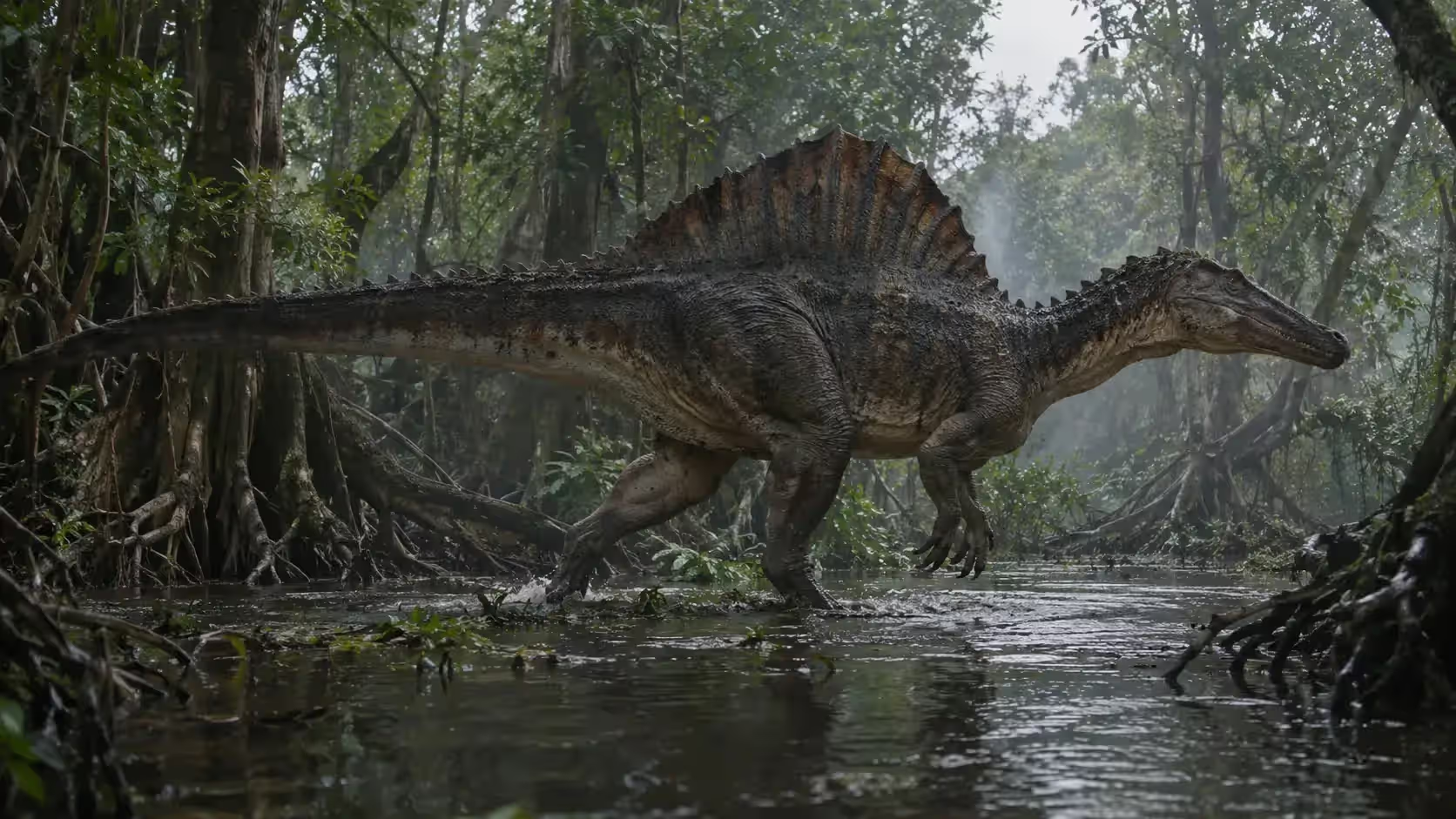
The great spinosaurid of N’Goro is one of the largest predators of the known world. An adult commonly measures some fifteen metres and weighs seven tonnes or more, but it looks lower and longer than the great theropods of firm ground: its hind legs are short, its body elongated, and its tall, flattened tail, like a paddle, drives it through the water. Its narrow snout, like a crocodilian’s, carries conical teeth made for holding slippery fish rather than for slicing, and its nostrils, set far back, let it breathe with its snout half under water. Its powerful arms carry great hooked claws.
Its dorsal sail, a tall crest of bony spines covered with skin, is its most striking feature. It changes colour when the animal grows heated or irritated, gathers algae and leeches in calm waters and can be seen from afar above the reeds. Trainers read it like a face: a sail that reddens announces anger, a dull sail illness.
Growth and laying
Great spinosaurids live long. A young one reaches adult size at about sixteen, and the oldest pass seventy, so that teams of trainers often follow one another over several generations beside the same animal. The female lays at low water, on a sandbank or a raised mound of mud at the far end of a dead arm, two to six eggs of several kilos each, which she guards through nearly five months of incubation. The hatchlings, barely an arm’s length long, make for the water at once; most are eaten in their first year by crocodilians, large fish and other spinosaurids.
Nesting sites are among the best-protected places in the country. No one may take a spinosaur egg out of the marsh, and no living spinosaur leaves N’Goro. Fisher-trainers watch the mounds throughout the incubation, and a foreigner caught near a clutch is taken, at best, to the Control Basins.
What a great spinosaurid eats
The great spinosaurid is first of all a fisher. It hunts from ambush, standing still in water up to its belly, and seizes with a toss of the head the large fish that come within reach; it also searches the bottom with its claws, flushes fish out of the roots and does not scorn young crocodilians or the carcasses the floods carry down. An adult eats about a hundred kilos of fish a day, more at high water, when the shoals swim up the rivers.
The Ngoro have learned to live off this appetite. Herding fishing, in which a Siirmuu drives the shoals towards the nets, feeds whole villages; the Siirmuu ration, made of fish, salt and fragrant herbs, makes the animal more predictable without commanding it. Wild spinosaurids are costly neighbours: they raid nets, rip open fish traps and contest the best arms of water with the fishermen, and riverside villages drive them off with smoke and drums rather than fight them.
Wild ones and known individuals
The marsh holds far more spinosaurids than the hundred and twenty of the register. The great wild ones live in the Terres Englouties, the inner mires and the remote estuaries of the Overflows; shyer and less predictable than the Siirmuu, they keep away from the villages, and their sails are sometimes seen passing in the mist far off. Fishermen call them reed spinosaurs, and the trainers make no attempt to capture them.
A few individuals are known throughout the country. Mère-Boue, an old matriarch covered in a crust of peat and shells, lives in the waters of the Living Mirror, and the Sap-Keepers read her movements to learn the mood of the waters. Longue-Faim, a gaunt animal with jutting ribs and a tall, thin sail, follows the floods over leagues of black water and can endure long famines between two feasts. Sûma-lui-parle, the ritual animal of the Control Basins, is the most venerated of all, and Seuil, Sûma’s mount, the one most often seen.
Out of the water
The spinosaurid’s great weakness is dry land. Its short legs and its bulk make it a slow walker that tires quickly, copes badly with the heat of an open plain and loses most of its powers within a few hours. A Siirmuu pulled out of its water is no more than a winded beast, vulnerable to pikes and ballistas, and the Ngoro never commit one there. That is also why the Foam March, the great amphibious mobilisation of the spinosaurids, always goes by water, drawing the beasts together by scents, food and currents towards an enemy already weakened.
Other nations have learned this limit in their own way. The khans of Arkhan, who have no spinosaurs and to whom N’Goro has never given one, know that no one pursues a Ngoro into his water, but that his spinosaur need not be feared on a dry flat. The Volonians, who see the Siirmuu in the Foam Marches, admire them as fishers rather than warriors; Urnok’s officers count them in their calculations as a wall that does not move.
Gallery1 image
Stilt houses and fumigation towers in the green mist.