
Creatures
Giant centipedes
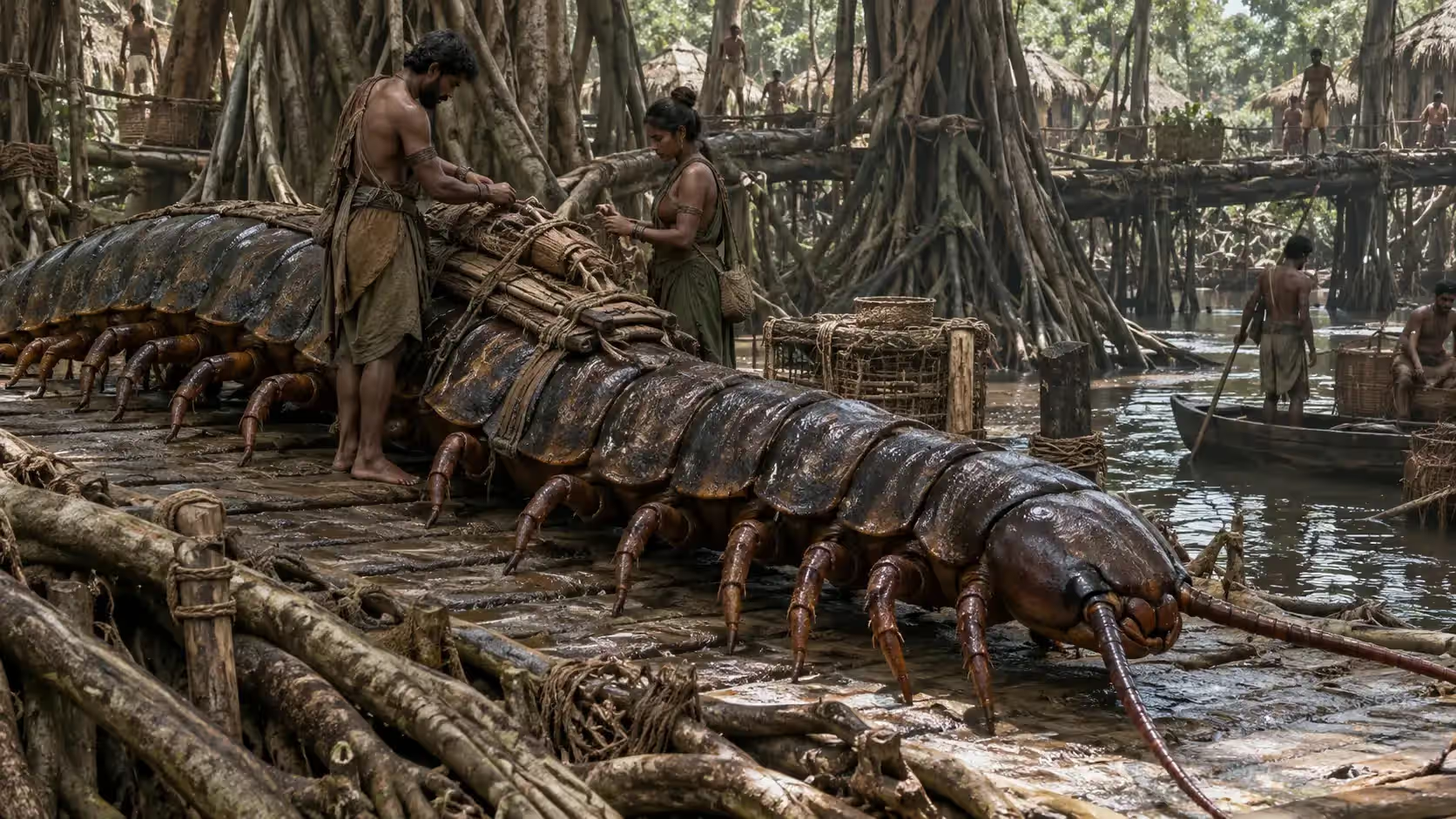
The mounts of N’Goro’s roots, walls and lower canopy, alongside the marsh arthropleurids.
Mounts of the roots
Giant centipedes serve as mounts among roots, on rock walls and in the lower canopy; they carry messages and take part in hunting and ambushes. Their mobility opens routes other than those of the barges and links terrain where humans move poorly.
The route is not indifferent to their presence: roots, vines and installations react to loads and vibrations, and the mounts must travel along suitable passages. A mount is not to be confused with the wild centipedes of the same environment; residents tell apart known behaviours, the dangers of exposure and the limits of a journey.
Marsh arthropods
N’Goro also has rarer native arthropods: arthropleurids four to eight metres long and royal centipedes of eight to ten metres, tied to marshes, medicine, venoms, slow transport and rites. These animals remain exceptional. At the Three Waves, the N’Goro contingent fielded mounted arthropods and low units able to slip into spaces where long pikes became clumsy.
Two kinds of many-legs
The Ngoro group under the same name of many-legs two very different beasts. The centipede is a hunter: its flat, segmented body carries one pair of legs per ring, its antennae are long and mobile, and its two front fangs, under the head, inject a burning venom that brings pain, paralysis and fever. Quick and nervous, it climbs everywhere and feeds on whatever it catches: large insects, amphibians, small reptiles. The arthropleurid, by contrast, is placid and almost never bites. Broad and low, covered with light dorsal plates, it feeds on rotting plants and debris, and serves the marsh as a scavenger.
Both beasts moult as they grow, change their shell several times in their lives and remain vulnerable for a few days after each moult. They are arthropods, like insects and crabs, and the N’Goro language classes them with the living of chitin, alongside armour and foreigners under arms.
The pack arthropleurid
The great eight-metre arthropleurids remain rare, but the breeders of the Silver Reeds and the Terres Englouties keep a smaller line, barely four metres long and a few hundred kilos in weight, trained to carry packs. It is not numerous: a few hundred beasts in the whole country. In the reed beds and deep marshes, where a heavy beast would sink and no barge can pass, the pack arthropleurid carries on its flat back bales of reeds, jars and baskets, spreading its weight over dozens of legs; it moves slowly, never sinking, and feeds on the way on whatever the marsh is rotting.
Its dorsal plates are precious. When an arthropleurid moults or dies, its broad, light chitin is recovered and made into shields, floats, armour that neither rusts nor holds water, and the raw material of glues and filters. The Mille-Pattes brotherhood, which makes chitin armour, is its main user. In war, arthropleurids are sometimes lined up across a passage like living dykes: they break no line, but nothing makes them give ground.
The royal centipedes
Royal centipedes, eight to ten metres long, are so rare that each one is known and followed by the clans who live near it. Their chitin, black with green glints, is the hardest in the marsh; armour of rank and black jewellery are made from it, but only from cast-off moults or dead beasts, for no one would dare kill one. Their segments are crowned with outgrowths that earned them their name, and their fangs carry enough venom to bring down a large beast.
They are reserved for the great rites and for decisive battles. The few royals that accept a rider are kept by old lineages that raise them from the egg and ride them only on rare occasions; a royal winding between the ranks of an enemy army, biting the largest opponents, is one of the images foreigners bring back from the marsh wars. A family that keeps one is said to have “a queen in the house”.
Raising centipedes
Riding centipedes are raised in chambers of living wood, under roots or in the hollows of great trunks, where the damp and the half-light they like prevail. The female lays some thirty to sixty eggs, coils round them and guards them until they hatch, then goes on protecting the young through their first weeks; that is the time when she must above all not be disturbed. The young are fed on fat larvae and farmed insects, then sorted by temperament: the calmest will become mounts, the others will be used for venom milking.
This milking is a licensed trade. Milkers press the beast’s fangs over a horn cup and collect a venom which, once purified in laboratories such as that of Tamis-Venin, serves as the base for medicinal distillates, anaesthetics and remedies against fevers. The centipede antidote, prepared from that same venom, never leaves the kits of breeders and riders.
Wild centipedes
Wild centipedes are everywhere in the roots, and on some nights the villages hear them go by. The smallest, one or two paces long, sometimes move in swarming sheets that cover a bank in an instant and ebb away as fast; the largest hunt alone in the low canopy. They rarely attack humans, but they bite when surprised, and their bite brings a fever lasting several days.
Villages protect themselves with simple habits. Piles are ringed with bands of bitter resin that many-legs dislike crossing, mats and clothes are shaken out every morning, and no one ever puts a hand into a hollow in the roots without first lighting it. Centipede riders, who know these beasts better than anyone, are often called to dislodge a wild one that has settled under a house, and they do it without killing it, luring it far away with scented pastes.