
Armies
The Frégate d’Écume
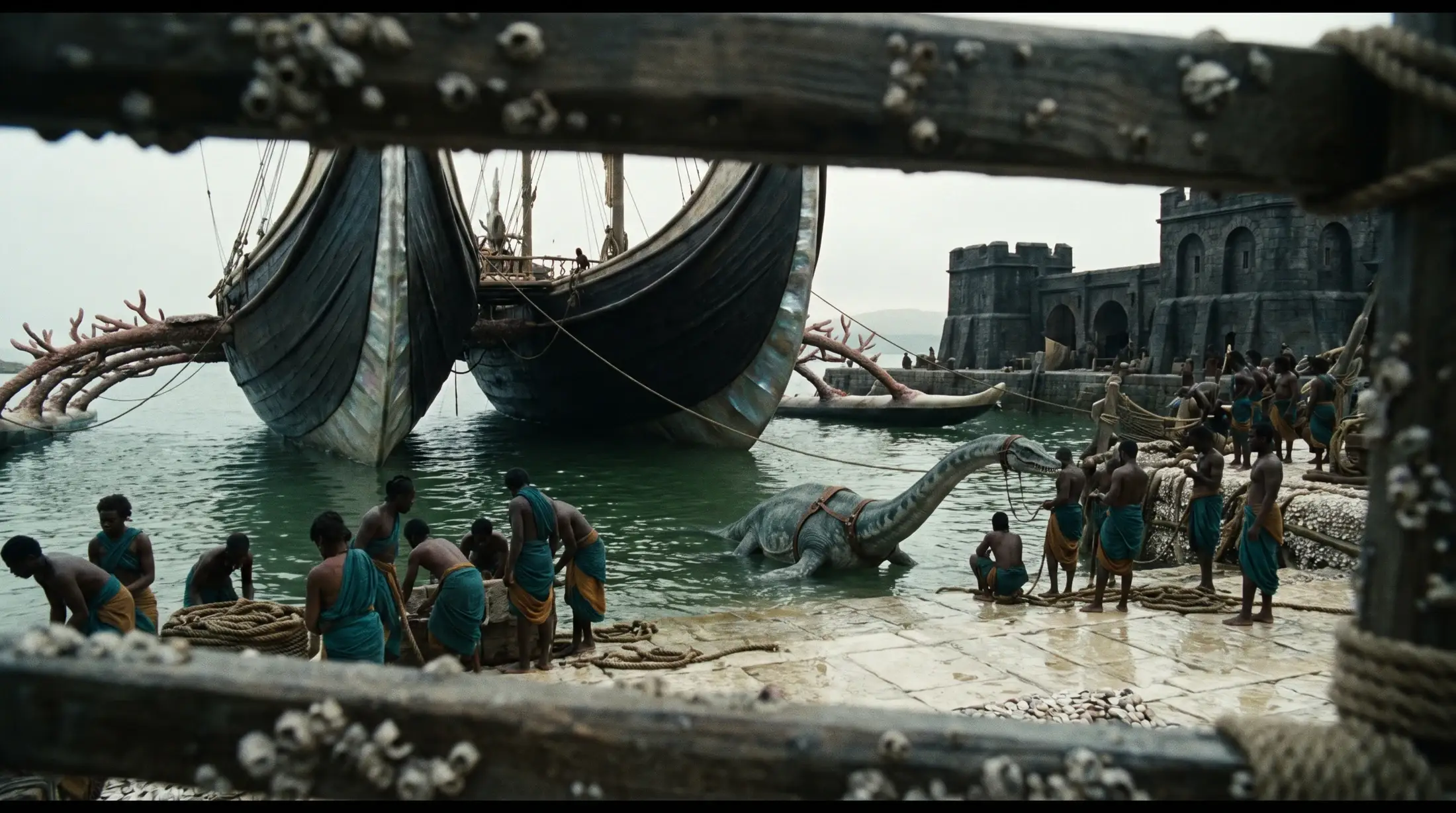
A close-escort ship (“Foam Frigate”), armed with bows, harpoons and light ballistae, which moves by sail and oar.
Protecting at close range
The Frégate d’Écume provides close escort. Its weapons are those of close combat: bows, harpoons and light ballistae. It is the only combat class in the register that moves by sail and oar without plesiosaurs.
Small, at thirty to fifty metres, it carries one hundred and forty to two hundred and eighty people. It protects a ship or a group at close range, while the Escorteur de Convoi defends trade routes.
Why the Frégate harnesses no beasts
The lack of plesiosaurs is not a saving: it is a choice of trade. A Frégate d’Écume must be able to slip right up against the ship it protects, between two hulls of a convoy or into a crowded channel, without harness traces fouling those of a neighbour. It must also be able to turn on the spot and pass over shallows where a team of beasts would run aground. Its oars give it that agility, and its sails carry it between fights.
The choice has its price. Without a team, the Frégate cannot keep pace with a plesiosaur-drawn fleet over a long crossing; it is then taken in tow, or kept for slow convoys. But at the moment of combat it is the only Volonian warship that nothing ties to a beast, and its captains see freedom in that: a Frégate never loses its engine to an enemy bolt.
The rowing bench
Most of the hundred and forty to two hundred and eighty people aboard are rowers, and these rowers are also the fighters. At the alarm they leave the oar for the bow or the harpoon, then take it up again when the ship must manoeuvre. A stroke master sets their pace with a drum, in rhythms the whole crew knows: the cruising stroke, the approach stroke, and the breakaway stroke, shorter and fiercer.
The training is hard. Young sailors entering the war fleet often begin on a Frégate, where in a single season they learn to row, to shoot from a rolling deck and to repel boarders. Many Great Hull officers made their first campaigns aboard one, and keep the habit of counting oar strokes without thinking.
At close quarters
On escort duty, the Frégate keeps within hailing distance of the ship it protects. It drives off whatever approaches by water: boarding boats, swimmers trying to cut traces or climb the hull, enemy riders on small sea beasts, fireships pushed by the current. Its archers also shoot skyward at pterosaurs swooping on the decks. Its light ballistae target boats, its harpoons small beasts.
In a line battle, Frégates cover the flanks and the intervals between the Great Hulls, intercept fireships and pick up men who have fallen overboard. They also accompany ships that their role pins in place: an anchored Brise-Port, a pair of Coupe-Courant stretching their barrier, a Fort de Marée at its post. The foam riders patrolling around the formation often use them as a resting base.
The neighbourhood warships
In peacetime, the Frégates d’Écume are the warships Volonians see most often. They patrol the lagoons and passes of the great ports, escort prestige barges and floating salons, and act as roadstead police for the harbour masters. The houses of Séloris and Port Volon hire them to escort their guests on festival nights, which earns the crews tips more generous than their pay.
Their small size also makes them ships for a first command. An officer given his first Frégate proves himself aboard before aspiring to a larger vessel, and the houses watch closely how he handles her. On the quays their crews are recognized by their broad shoulders and calloused hands, and it is said that a Frégate sailor still rows in his sleep.
The foam and its name
The class takes its name from its way of fighting. When a Frégate breaks into the breakaway stroke, its oars beat the water so fast that the hull almost vanishes in a band of white foam, and that is the image sailors kept. On the quays, “to make foam” means to leave all at once, without warning, and the phrase is used as readily for a fleeing debtor as for a hurried lover.
The name also links the Frégates with the foam riders, with whom they often work. The two trades are alike: small, fast, always in contact, and rarely named in accounts of battle, which mostly remember the Great Hulls.