
Armies
The Brise-Port
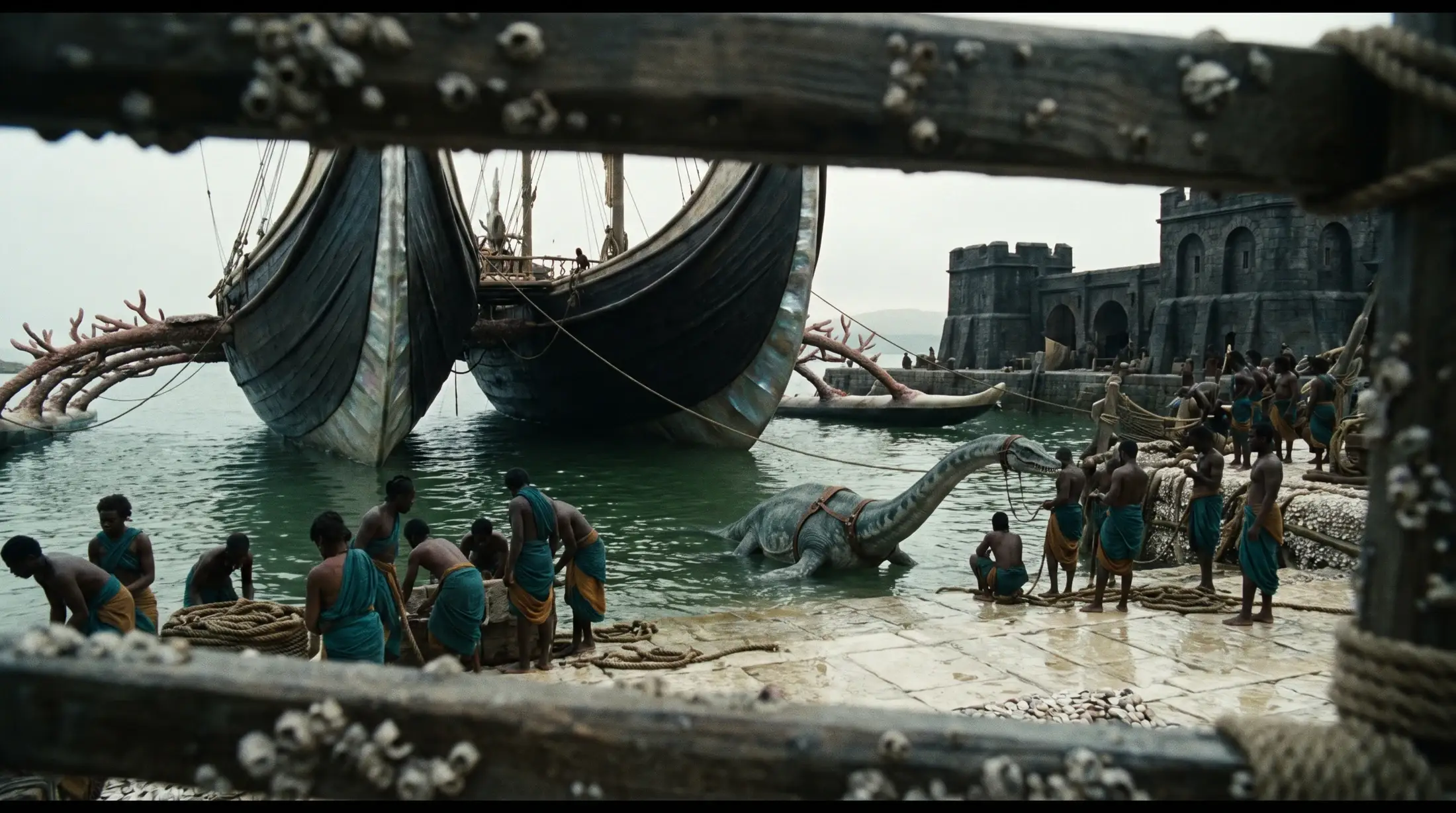
The coastal siege ship (“Port-Breaker”), armed with heavy catapults and demolition projectiles against ports, quays and walls.
Besieging from the sea
The Brise-Port is prepared for coastal siege. Its heavy catapults and demolition projectiles aim at ports, quays and walls. It measures eighty to one hundred and ten metres and carries nine hundred to fourteen hundred people.
It sails with the help of plesiosaurs. Its place in the fleet lies in its mission: where the Grande-Coque de Ligne engages other ships, the Brise-Port goes after the coast itself.
Engines made for stone
The Brise-Port is built around its heavy catapults. They take up almost the whole central deck, on reinforced platforms that spread their weight down to the keels; the largest throw iron-hooped stone balls, the demolition projectiles, able to breach a quay, bring down a watchtower or split a harbour wall. Lighter ballistae fore and aft cover the ship while it fires.
Part of the hold serves as a magazine. The balls are stowed there in wooden racks, sorted by weight, and the crews hoist them to the deck by winch. The ship also carries jars of sea fire, made from the oil of the Mists, which are hurled at warehouses and ships moored at the quay: this fire cannot be put out with water. They are kept in a separate compartment, bedded in sand, and no flame is allowed anywhere near.
Attacking a port
No one sends a Brise-Port alone against a fortified coast. The attack begins with the work of others: the Baliseurs de Courants sound the approaches, the Cloches d’Abîme cut the harbour chains by night, the Coupe-Courant close the water to the defender’s beasts. The Brise-Port then moves in, towed by its plesiosaurs to firing range, and anchors bow and stern to give its catapults a steady platform.
Its first targets are the defence’s engines: ballista towers, quay batteries, net-throwers. Next come the chains and pontoons, then the quays themselves, so that the Porte-Barges can approach. A Volonian coastal siege rarely lasts long; the aim is to open a port, not to starve it. Once the breach is made, the contract companies land with their shark-headed rams and their pikemen, and the Brise-Port stays at anchor to cover their withdrawal.
A slow target
The Brise-Port is slow, heavy and vulnerable once anchored, and defenders make it their first target. War engines set up ashore, steadier than its own, can reach it from afar; fireships released from the port on the current threaten a hull loaded with sea fire; swimmers try to cut its anchor cables and deliver it to the current. In ports that keep a great marine predator, the attack can also come from below.
To guard against this, the crew stretches weighted nets around the hull, keeps buckets of sand and wet hides all over the deck and posts sea crossbowmen in the tops. Frégates d’Écume stay within hailing distance, ready to intercept fireships, and a Harponneur keeps close by. The nine hundred to fourteen hundred men aboard draw a siege bonus; on the quays it is said they earn it, for they spend most of a battle motionless under fire.
Demolition in peacetime
Outside wartime, Brise-Ports find other work. The League hires them to demolish wrecks stranded in the passes, to smash the stakes and hull-breakers that pirates plant beneath the surface of channels, or to raze the small forts in the coves where the raiding flotillas of the south-west hide. Their mere presence before a grey port is sometimes enough to obtain the handing over of captured ships or prisoners.
They also serve the yards. Their catapults, used at low charge, help bring down old coastal fortifications when a house rebuilds a quay, and their crews are sought after by the coral and stone quarries of the islands. Few Brise-Ports stay permanently armed: their engines are expensive to maintain, and most wait at anchor in Velasar or behind a ring-bastion until a Gathering of the Flags calls them back.