

Families and social ties
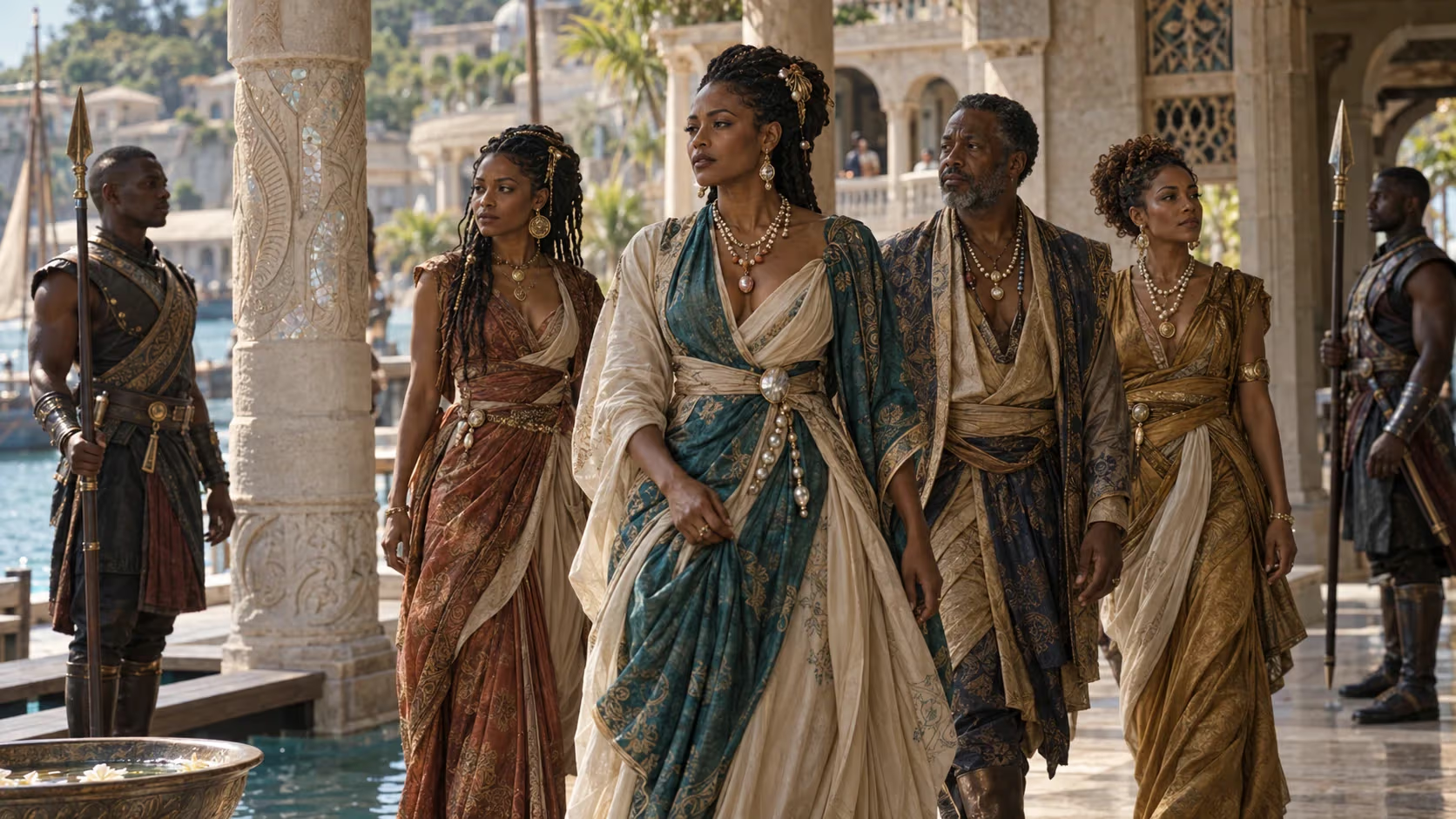
The great houses of Volonia
In Volonia, houses are at once families, companies and political forces; the republic has no individual sovereign and is led by the Council of the Five Families.
Families that are companies
Volonia is a maritime republic whose houses combine family, trade and political influence. A house owns activities that span generations: shipyards, fleets, trading posts, workshops, contracts. Some take the form of trusts, like Velasar, the great naval house-trust. The Pact of the Houses of Port-Volon placed these houses within a common organisation, beyond the interests of any single family.
Age brings prestige, but a house’s power also depends on the workshops, routes and partners it can still mobilise.
Four houses, four powers
Calystrëa is among the oldest houses of the Pact, at about 2,600 years; its power rests on route insurance and law. Velasar has at least 2,500 years of naval traditions inherited from Orlantis and dominates Great Hulls, arsenals and plesiosaur breeding. Vornëa, about 1,700 years old, is a house of mother-of-pearl, fashion, spectacle and reputation. Bellcor, born some 180 years ago from the measurement of risk, embodies new money.
Two poles structure the rivalry. Vornëa masters representation: it can turn an ordinary expedition into a public triumph and a financial event, but it does not own Velasar’s industrial apparatus. Velasar is the country’s leading private naval power and ranks among the five largest private companies in the known world.
Capital creates houses
Volonia does not close its door to new houses. Bellcor was born of statistical insurance rather than conquest: data, premiums and asset valuation were enough to found a house that now counts among the great. Its presence shows that a recent house can overtake thousand-year-old lineages.
Houses and power
The republic has no individual sovereign. Its executive summit is the Council of the Five Families, a collegial leadership seated at the Palais des Gouvernants. Houses defend their interests with their own means, but they do not govern alone: guilds, unions, artisans, districts and the middle classes can pool their stakes in the monetary vote, and a house can lose against such a coalition.
Houses are not above taxation. The Fifteenth applies to houses, companies and trusts like any other contributor, and the Vaesh quarantine, which is not a house, controls the cargoes, animals and beneficiaries that enter the ports.
The houses’ fleets
In ordinary times, houses own their fleets, animals, officers and doctrines. When a major war is recognised, the Meeting of Flags places the forces engaged under the Admiralty of the United Fleets: houses keep ownership but lose the right to give operational orders. Capital decides whether the war exists; expertise commands once the fleet is at sea.
Beyond the four
The four great houses do not sum up the landscape. Marévant, about two thousand one hundred years old, holds mass and luxury fishing, the live tanks and sensitive cargoes; it is the least prestigious house and the most indispensable. In Marévant, House Verdian holds the festivals, the decorative arsenals, the political carnival and the parade ships. The Belcour branch, an offshoot of Bellcor, has turned to law.
Below them come the segment houses, which dominate one critical link without holding the whole chain. The Two Keels Yards, for instance, have made a speciality of the hardest art of the sea: carrying living cargo. Vaesh, finally, is not a house: it is a private order under public charter, not hereditary, which controls and taxes all the others.
Being born, lasting, disappearing
A Volonian house exists when three things meet: a family, an activity that runs across generations and a seal the counting houses recognise. The seal matters as much as the blood. It lets a house endorse letters, sign at the Great Counting House and lodge a stake in its own name. A rich family whose seal is not recognised remains a fortune; a modest family whose seal is accepted on every quay becomes a house.
Lasting requires paying one’s dues: the Fifteenth, every house’s contribution to the Vaesh quarantine, the debts owed to the house’s dead. A house that can no longer honour its receipts rarely disappears by force. It marries, merges into another, sells its shares or changes its name. In Volonia, they say, you do not seize a house: you marry it. Old names then survive in the long form of surnames, like the trace of a balance sheet.
Every house has its foreigner
Each great house holds a frontier with the world. Calystrëa is present at Sand Harbour, where Arkhan’s takings become Volonian cargoes. Velasar depends on the timber, resins and ropes of Orlantis, and employs Korathi engineers. Marévant sells its catches to Urnok, to Orlantis and, under contract, to the Broken Isles. Vornëa circulates its reputation through foreign courts, up to the imperial family of Urnok. Bellcor insures other people’s wars.
These ties give Volonian diplomacy its particular shape: it runs through the houses as much as through the League. Relations with Arkhan are excellent, fed by trade, ports, credit and a shared hostility to Urnok’s hegemony. The republic’s deepest doctrine is to prevent a power already dominant on land from also gaining complete freedom at sea; the rights of call, pilotage, repair and finance that the houses grant or refuse then become weapons.