

Culture
Learning the maritime body
Swimming, diving and reading currents are childhood skills.
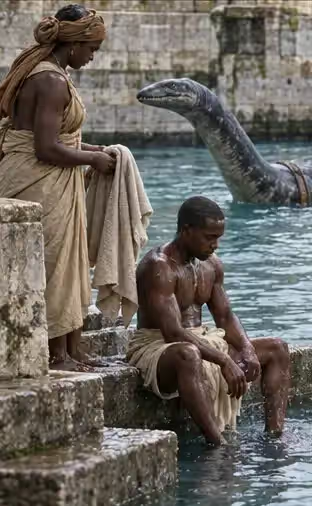
The current is part of learning
Volonians learn early to swim, dive and read currents. This training accompanies port life and work with marine animals. Moving through water means more than covering a distance: people must understand the environment through which their bodies move and recognise what may carry them away from their route.
A trained breath remains limited
Swimmers’ skill grants neither gills nor supernatural breathing. Trained breath-holding, breathing bladders, diving bells and caissons belong to the underwater travel repertoire. Deep journeys remain dangerous, short and costly. Learning the maritime body therefore also includes recognising limits and using suitable equipment.
Working with another body
Handling harnesses and working with animals belong to this aquatic culture. The plesiosaur serves towing, fishing, transport and rescue. A swimmer and an animal do not occupy water in the same way; human skill operates in the relationship between movement, equipment and the needs of a living co-worker.
The swimmer’s stages
Learning begins with the first bath, at four or five, in front of the district chapel. Then come stages every harbour child knows: floating on one’s back without moving, swimming the length of a quay, diving for a stone at a man’s depth, crossing a canal against the current, then learning to read a pass by throwing a float into it and following its drift. Parents, elder siblings and quay masters teach; in the poor districts it is the other children, and one learns faster by following the older ones.
Neighbourhood festivals hold swimming and breath-holding contests, and the best young swimmers catch the eye of the divers of Girvane, of captains or of racing stables. A saying of the terraces holds that a child who cannot swim does not play on the planks: until it can swim, it does not stray from the adults, and it is often the shame of being left out that drives the most fearful into the water. By twelve or thirteen, a harbour child can get out of a pass current, dive under a boat and climb up a hull by its chains.
What water does to the body
Volonian swimmers know their ailments. Pressure makes the ears of divers who descend too fast bleed; it is countered with a balm of seaweed and ichthyosaur oil, less effective than the pastes of N’Goro but much cheaper. The cold of deep water, cramps, pass currents, blade-sharks and the eddies of plesiosaur basins kill experienced swimmers every season. Hospital ships and harbour infirmaries care for the drowned who are brought back in time, as well as for the pressure sicknesses old divers know well, who often have aching joints and weakened hearing.
Simple rules follow. One never dives alone: a second stays on the surface, rope in hand. One does not swim in the harness lanes, and one waits until the plesiosaurs have left a basin before entering it. Dockers, haulers and divers pay a small quay insurance, a few coins a week, against drowning, bites and falls; the unions have long demanded that it be paid by the houses that employ them.
The swimmer at war
Knowing how to swim is a military advantage Volonia does not neglect. In a boarding action, a Volonian sailor who falls into the water often climbs back up on the other side, where a soldier from a land nation sinks with his shield. Crews train to swim armed with a knife, to cut the moorings of an enemy ship at anchor by night and to climb a hull by the anchor chains.
The best swimmers serve in separate units. Sabotage divers go down with the towed bells to place charges or cutting tools under enemy keels; rescue swimmers pull the wounded out during the fighting; scouts approach an enemy roadstead by night to count its ships. The Calystrëa contract companies train their men to swim in light armour of sea leather, and it is said on the quays that a good company soldier is known by the fact that he comes back soaked, but comes back.