

Institutions
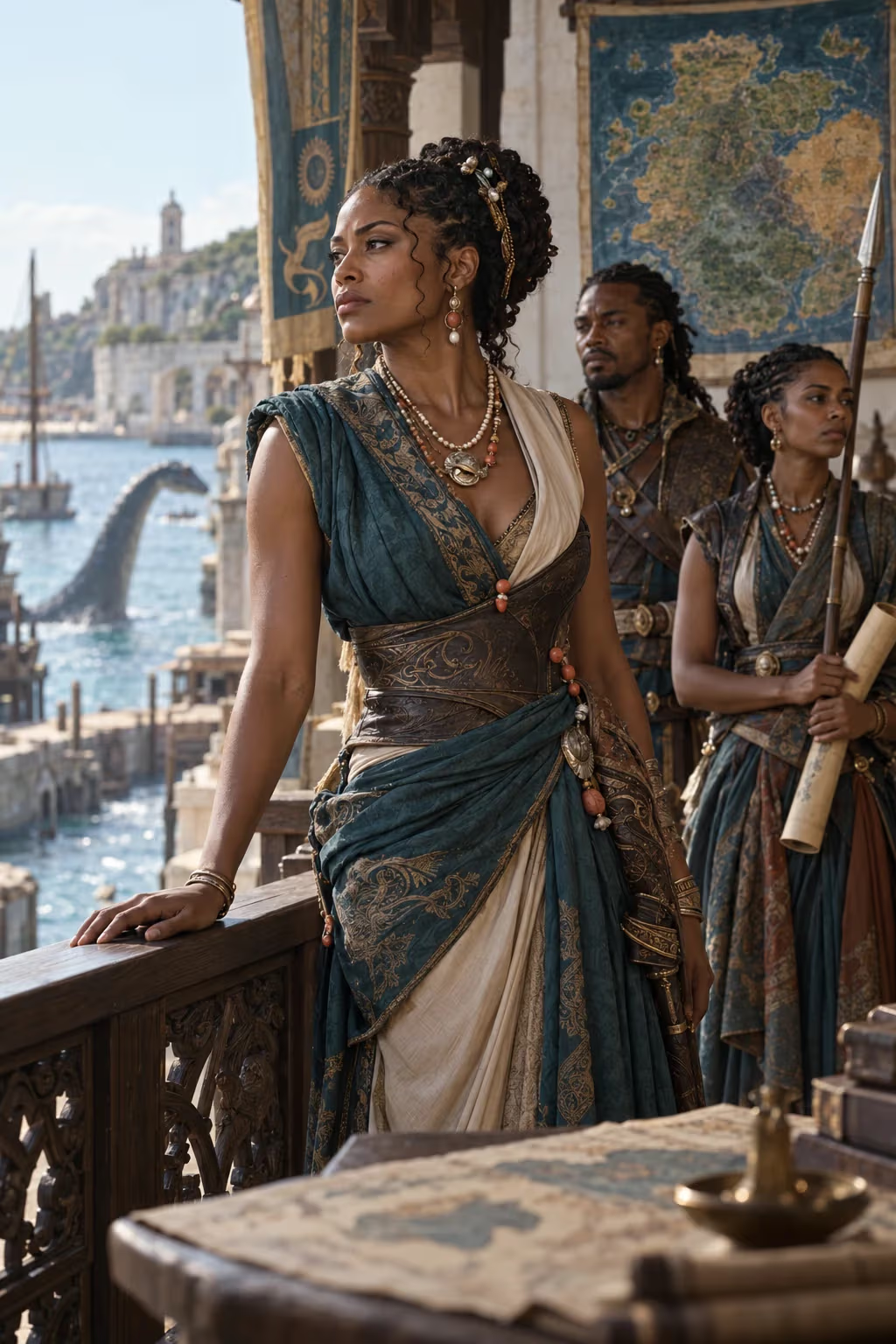
The Meeting of Flags
Volonia’s war mobilisation: the houses’ private fleets pass under a single command without changing owner.
Private fleets in ordinary times
In ordinary times, Volonian houses own their fleets, animals, officers and doctrines, and sail under their own flags. When a major war is recognised, the Meeting of Flags places the forces committed under the Admiralty of the United Fleets. Houses keep ownership of their means; they lose the right to give them operational orders.
Volonians sum up the rule this way: capital decides whether the war exists, expertise commands once the fleet is at sea.
Two separate functions
The arrangement separates funding the war from conducting it. Stakes make the expedition possible; naval expertise directs its movements once at sea. It allows ships and crews belonging to rival houses to be brought together without each owner altering the manoeuvre on its own. Volonia can thus fight a real naval war without owning a single state navy.
The political summit decides on mobilisation, and the Admiralty conducts operations within the powers entrusted to it. The Council of the Five Families and the great shipowners do not have to intervene in every manoeuvre of a battle.
Recognizing a major war
Not every act of violence at sea triggers the Gathering of the Flags. Hunting pirates in the south-west, escorting a convoy or answering a raid remain matters for the houses: they are settled by contract, with escorts the Admiralty hires out in peacetime and companies engaged for the season. The Gathering is reserved for a war the republic recognizes as its own: a port of the League attacked, a great route cut, a foreign fleet threatening the straits, or a power claiming to close the sea to Volonian convoys.
Recognition follows a public order. The Council of the Five Families brings the proposal before the Chambers of Stakes; the measure goes up on the Great Board with its estimated cost, its duration and the houses that pledge to supply hulls. War stakes are deposited like any others: a house, a guild or a district can back the mobilization, refuse it, or fund only part of the campaign. When the measure gathers the necessary weight, the act of Gathering is read aloud on the League Quay, in the Sealed mode, and the bells of the Great Counting House ring the tide of the levy.
The vote also sets a term. A Gathering is never pronounced without an end: it holds for a number of seasons written into the act, after which the Chambers must renew it by a new vote, or the flags are lowered.
What each house commits
Once the Gathering is pronounced, each house hands the Admiralty the roll of what it commits: its hulls by name and by number in the Register of Hulls and Routes, its plesiosaur teams, its officers, its contract companies, its stores of food and animal rations. The Register supplies the condition, guarantees and pilots of each vessel; the Admiralty may refuse a poorly kept hull or exhausted animals, and the house must then provide an equivalent or pay its share in money.
The ships keep their colours. The League’s flag goes up above the house’s flag, never in its place: in the gathered fleet, one can still tell at a glance who owns each hull. Captains remain those of their house and answer to it for upkeep, pay and everyday discipline; only the orders of movement, formation and battle now come from the Admiralty.
Recalling a gathered ship without the Admiralty’s consent is the gravest fault a house can commit during a campaign. The Merchants’ Court judges it as a breach of contract towards the whole republic: the house loses its campaign shares, pays for the losses its withdrawal caused, and may see its name struck from the Great Board for several seasons.
Who pays, who loses, who wins
The Gathering opens a war account at the Great Counting House. The stakes voted in the Chambers feed it, campaign shares are entered in it, and each house records there what it has committed, valued at the outset by the Register’s gaugers. A sunken hull, a lost plesiosaur team or a badly damaged Great Hull is compensated from this account according to its registered value, not according to what its owner claims afterwards.
Prizes follow the same path. Whatever a gathered fleet seizes — ships, cargoes, beasts, equipment — is judged by the Merchants’ Court before being sold, and the proceeds are divided between the war account, the crews and the houses according to the clauses of the act. Predictive wagers stay apart: they are settled on the outcome, the duration or the losses, without ever touching the Admiralty’s orders.
This division explains a feature often misunderstood abroad. A victorious campaign can ruin the house that lost its best hulls in it without insuring them highly enough, and enrich an entire district that had staked on a short war. In Volonia, a Gathering is said to be “settled”: peace is only complete once the war account is closed and read out at the Great Counting House.
Why the houses gave up command
The Gathering of the Flags is rooted in the constitutional history opened by the Pact of the Houses of Port-Volon. Before it, the houses allied case by case against the fleets of the old island powers, those from which the Broken Isles descend. Volonian annals keep the memory of battles lost for a simple reason: at the decisive moment, every shipowner pulled out his hulls to save them, and the line came apart of its own accord.
The rule that came out of it has not changed since: the house that owns does not command. It did not abolish rivalries. During a campaign, the houses go on quarrelling over supply contracts, places in the line and the honour of the first prizes. But those quarrels go through the Chambers, the Court and the accounts; they no longer go through the manoeuvre.
Volonians call their way of waging war the Armed Contract. The Gathering is its most solemn article: the one the whole republic signs, and in which the houses agree, for a time, that their most precious property should obey someone other than themselves.