

Institutions
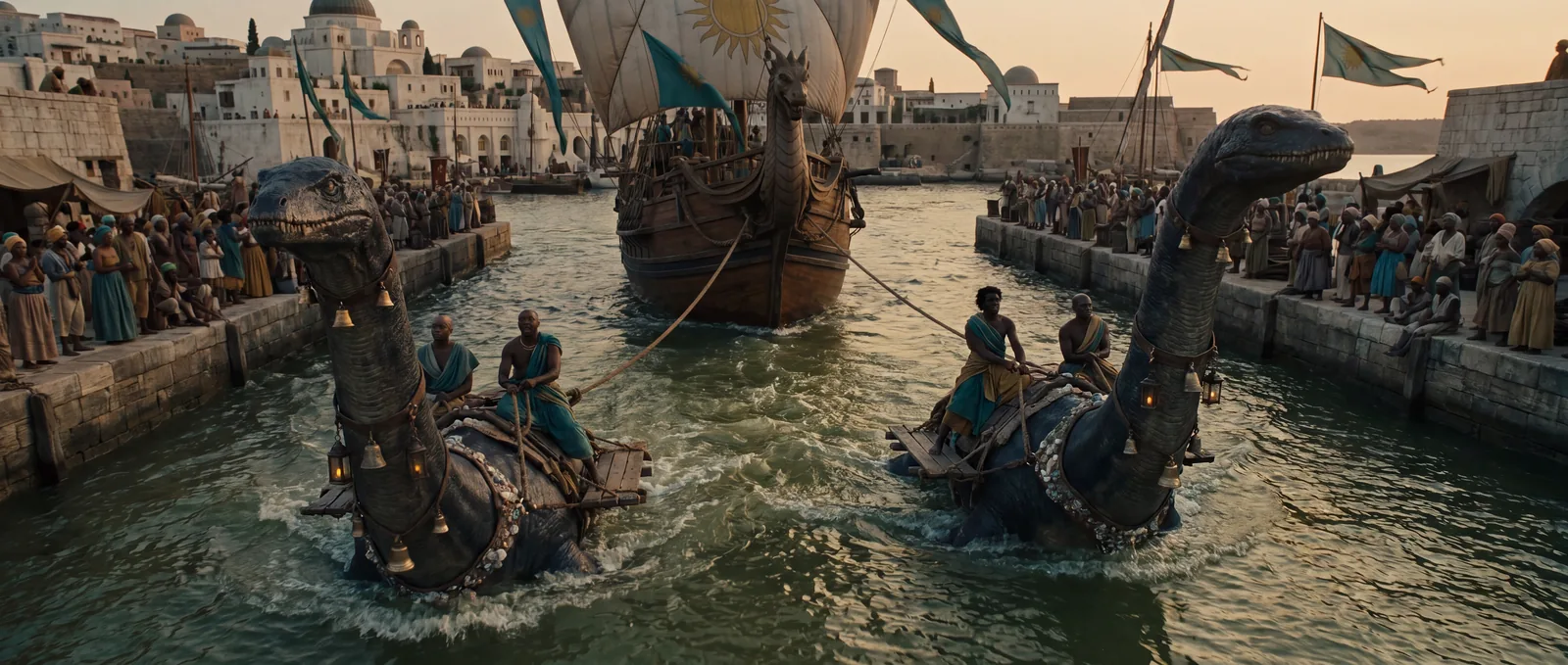
The League of Seas and Counting-Houses
Volonia’s network state: the League binds together the ports, routes, treaties and common fleet of a republic made of coasts and islands.
A state made of ports
The League of Seas and Counting-Houses is the framework that holds Volonia’s maritime republic together. It links its ports, routes, treaties and common fleet across a territory of coasts, archipelagos and counting-houses rather than a single landmass. The republic’s registers class it as a network state.
A republic without a sovereign
The League has no sovereign. Volonia’s executive summit is the Council of the Five Families, a collegial leadership that sits at the Palace of Governors. The houses keep their own interests and means; guilds, unions, artisans and the middle classes can form coalitions with them or against them.
Decisions pass through specialised institutions. The Stake Chambers receive the money committed to votes, the Grand Comptoir settles financial exchanges, the Merchants’ Court decides disputes. Governing means gathering enough means and support for a decision to become enforceable in each of these places.
Finance in the service of flows
Volonia’s power follows an order of causes. First come the domestication and breeding of plesiosaurs, then quays and great hulls, access to the Great Ocean, the monopoly of ultra-deep fishing and long-distance transport; insurance, credit, securities and offshore services only come afterwards. The League therefore organises material means first: hulls, animals, pilots and routes. Finance serves these flows; it did not create them.
A sea power
This organisation gives Volonia exceptional coastal defence and strong ocean projection, but little continental depth. The common fleet does not come from a standing state navy: when a major war is recognised, the Meeting of Flags places the houses’ fleets under the Admiralty of the United Fleets. The League holds the seas and coasts; a long conquest of inland territory suits it poorly.
Four millennia of routes
The League is the outcome of a history some four thousand years long. Volonians descend from the ancient peoples of the Broken Isles, themselves issued from Orlantis, with a heritage of high-sea sailors. For centuries the ports of this lineage were rival cities as much as kindred ones; it was the domestication of plesiosaurs, then the opening of the Great Ocean, that gave the most powerful among them the means to impose a common framework.
The Pact of the Houses of Port-Volon set that framework: the port houses accepted shared institutions in it, beyond the interests of any single family. The oldest Volonian houses claim more than two millennia of continuity; others, such as Bellcor, go back only a few generations. The League has never erased these gaps in age and prestige: it has placed them under the same rules.
Its historical rivals remained at its gates. The old island powers whose heirs are the Broken Isles were marginalized by Volonian taxation and trade rather than conquered, and their ports still seek routes that do not pass through the League’s trading posts.
A country of coasts and islands
The League’s territory covers some 450,000 km², made almost entirely of islands, peninsulas and coasts; laid end to end, its shores exceed twenty thousand kilometres. The republic holds no continental depth: its cities are spread among large wooded islands, relay archipelagos and peninsulas. Its six great cities each have their function — Port Volon the capital, Velasar the arsenal, Marévant insurance and fishing, Séloris silk and luxury, Girvane pearls and diving, Vaesh quarantine and salt — and the archipelagos of the Silver Wind, the High Isles and the Pilots bind the whole together.
Its ten million or so inhabitants live mostly near the water, and the capital’s region alone holds nearly a quarter of them. Work is divided in a way that surprises visitors from the continent: land, salt and vines still occupy nearly one worker in five, as many as port crafts and almost as many as trade; ports and navigation employ about one in six, finance, insurance and exchange one in ten. Maritime security, contract companies and lookouts occupy a smaller share, but one visible in every port.
What the League signs
A treaty of the League rarely concerns borders. It sets rights of call, access to pilots and repair yards, the terms of credit and insurance, quarantine tariffs and escort obligations. These clauses have a strategic reach the republic embraces: by opening or closing a port of call, by granting or refusing a pilot, it decides what a foreign fleet can actually reach.
The great partners each have their treaty. With Arkhan, relations are excellent, nourished by a shared hostility to Urnokian hegemony, and Sand Port serves as the interface between the two powers. With Urnok, the League trades a great deal — pearls, noble fish, insurance and credit against Orlantis timber, grain and fodder — while denying the Empire complete freedom at sea. Korath supplies metal, a dozen days away by sea; N’Goro its glues, filters and remedies, all of which pass through Vaesh.
The League never signs in perpetuity. Its treaties hold for a number of seasons and are renewed, which obliges every partner to come back and negotiate at the Great Counting House — and to learn there the state of its accounts.
What the League pays for
The League owns little of its own, but it maintains what no house would pay for alone. Lighthouses and signal towers, the breakwaters of the great passes, the College of Pilots’ buoyage, the Register of Hulls and Routes, the Merchants’ Court and the Admiralty’s permanent staff are financed from the revenues of the Fifteenth, levied by the collectors of Vaesh on all incomes, gains and profits. The quarantine itself is paid for by a special tax to which every house contributes.
This common budget remains modest compared with the republic’s private fortunes. Yet it is enough to hold the network together: a port of the League must be signalled, buoyed, inspected and judged by the same rules as any other, whether it belongs to a powerful house or to a coalition of small shipowners. Volonians sum up the idea by saying that a route is only Volonian if it is so from one end to the other.