

Trades
Les pilotes des routes voloniennes
Courants, migrations et fenêtres océaniques déterminent le passage d’un navire ou d’un convoi.
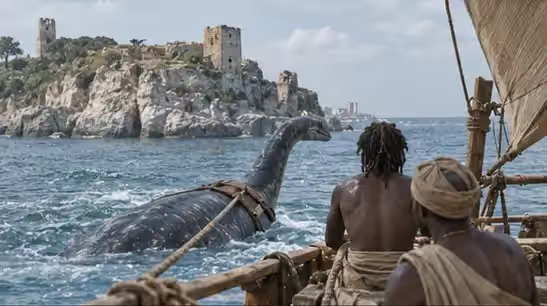
Apprendre les eaux dans les Îles des Pilotes
Les Îles des Pilotes accueillent la Maison des Pilotes et l’École des Routes. Courants et migrations sont des matières de formation, car une route maritime dépend de conditions qui ne restent pas immobiles. Le métier associe la connaissance des passages à celle du moment où ils peuvent être empruntés. L’archipel scolaire et technique réunit ces savoirs dans des lieux dédiés, distincts des chantiers qui construisent la coque et des ateliers qui entretiennent son équipement.
Choisir une route et un moment
Le Collège des Pilotes traite des routes, des courants, des migrations et des fenêtres océaniques. Une fenêtre de passage donne une dimension temporelle à l’itinéraire : savoir où aller ne suffit pas à décider quand partir. La distance se combine à la marée, à la profondeur et au courant. Ces conditions engagent le bâtiment, les animaux associés à son déplacement et les personnes embarquées, qui ne disposent pas tous de la même endurance ou du même accès.
Une route pour un ensemble précis
Les barques, les Grandes Coques, les plésiosaures, les nageurs et les animaux stratégiques ne partagent pas un chenal unique. Le pilote doit donc considérer ce qui se déplace, sa place dans le passage et les autres circulations. L’existence d’une route ne garantit pas qu’un autre bâtiment puisse l’emprunter à l’identique. Les chenaux séparés, les passes secondaires et les refuges hauts de certains ports-forts font partie de ce paysage de navigation.
Le pilote parmi les informations du bâtiment
Le Registre des Coques et Routes associe le pilote aux renseignements qui permettent d’engager un bâtiment : tonnage, propriété, état et garanties. La navigation est donc aussi une responsabilité reconnue dans la circulation des contrats. L’école fournit des savoirs ; le registre rattache des personnes et une coque à un voyage possible. Les ports et partenaires peuvent ainsi examiner un ensemble, plutôt qu’une promesse de passage détachée de l’état du bâtiment.
What the pilot carries
A pilot travels light, but his few objects are worth a great deal. He carries the season’s tide table, the almanac of tides, currents and passage windows the College publishes every year; a tide astrolabe, a bronze disc engraved with the stars and the spring tides; and his current charts, engraved on nacre plates that fear neither water nor salt. To these is added his notebook, in which for years he has noted the passes, landmarks and dangers he has seen for himself.
These charts are numbered and tracked. A captain or pilot who owns one may not resell it freely, and at his death it is bought back so as not to fall into the wrong hands. A pilot who loses his charts at sea must declare it as a lost cargo.
The pilot and the captain
The division of powers on board is fixed by custom. The captain commands the ship, its crew and its business; the pilot decides the route. In a pass his opinion prevails, and a captain who disobeys him loses his insurer’s cover: without a College pilot in the passes, insurance no longer covers the ship. Disputes arising during the voyage are taken on return before the Merchants’ Court, which hears both men and reads the logbook.
The pilot is paid by the passage or by the voyage, according to his rank, and his reputation precedes him in every port. Foreign ships entering the League’s waters must take a Volonian pilot, and many foreign captains end up hiring one for their whole voyage.
The Great Ocean pilot
At the summit of the trade stands the Great Ocean pilot. He alone can read the currents of the high seas, the migrations of the shoals and of the great wild reptiles, and the windows in which a fleet can leave and return. There are only a small number of them, and each receives particular attention: he is not allowed to travel on a foreign ship, nor to fall into enemy hands.
In war, his value becomes military. Capturing a Great Ocean pilot amounts to capturing routes, and Volonia’s enemies know it; the Admiralty places these pilots on the best guarded ships and makes them swear to destroy their charts before being taken. Pilots have their superstitions: they never name a bank until their ship has come back from it, and never whistle in a flat calm, for fear of calling up the storm.