

Armies
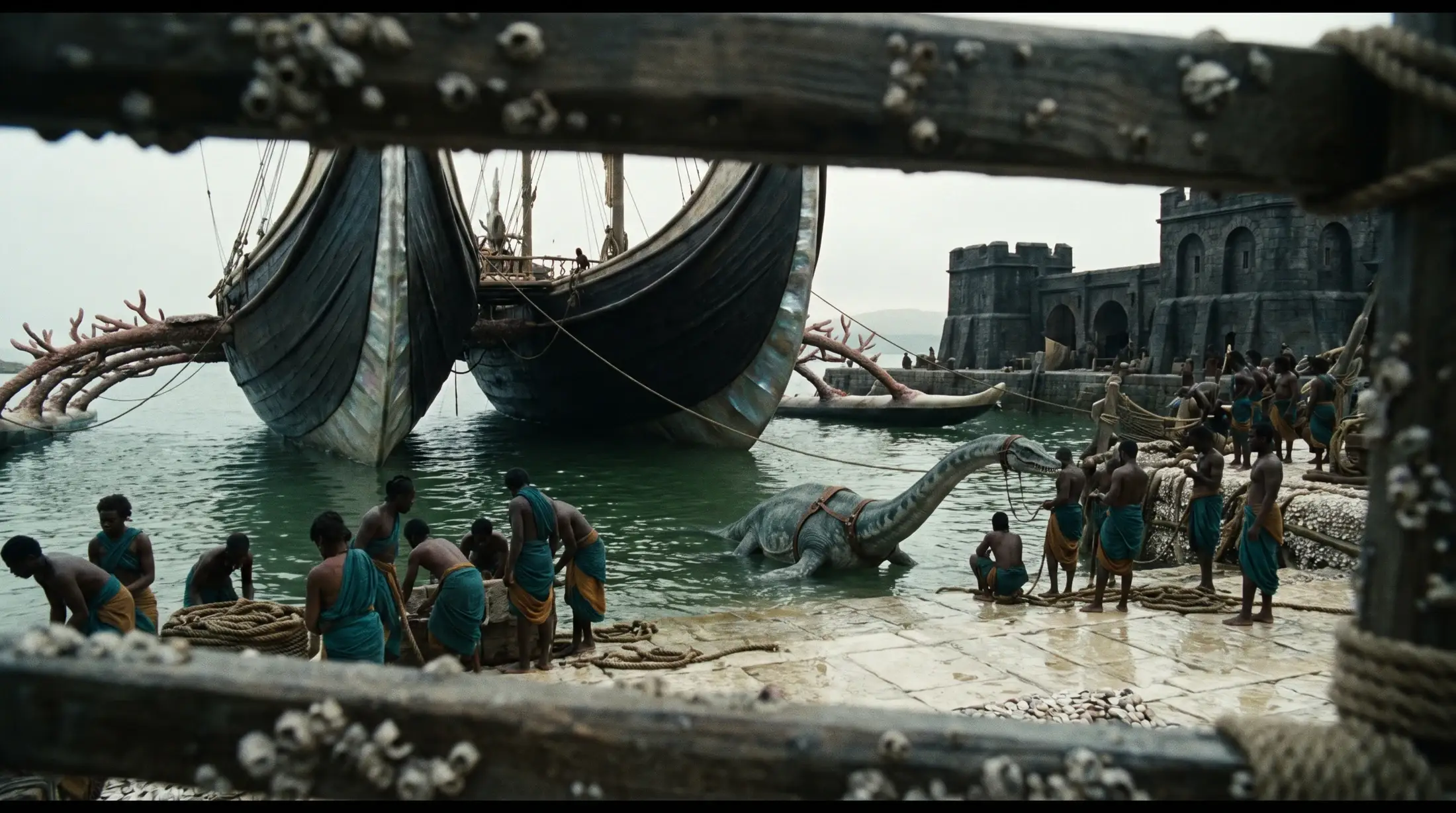
The Coupe-Courant
The interdiction ship (“Current-Cutter”): chains, nets and heavy harpoons to close a passage to enemy animals and formations.
Closing the water
The Coupe-Courant denies passages. Its chains, nets and heavy harpoons block the animals and formations trying to cross a channel. It moves by oar and with plesiosaurs, and carries five hundred to nine hundred people on a hull of fifty-five to eighty-five metres.
Together with the Harponneur class, it shows that the Volonian navy has a branch specialised against enemy animals: it knows the threat may come from an animal and not only from a ship.
The chain-net
The Coupe-Courant’s main weapon is not fired: it is stretched. Coupe-Courant work in pairs and stretch between their two hulls a chain-net, a barrier of Korathi iron chains held up by floating barrels, beneath which hangs a curtain of weighted nets reaching several fathoms down. Once in place, the barrier closes a pass to sea beasts and boats alike: an enemy plesiosaur that blunders into it fouls its flippers, a boat smashes its stem.
Laying it calls for a slow, precise manoeuvre. The two ships start side by side, pay out the chain from their capstans, then draw apart at the pace of their plesiosaurs until they span the width of the channel. Each hull then anchors with several heavy anchors. A well-laid barrier can hold for several days; it is raised within a tide, or abandoned and sunk if the fleet must leave in haste.
When a beast strikes the barrier
The most dangerous moment for a Coupe-Courant is when the barrier does its job. A great marine reptile caught in the net pulls with all its mass; if the chain does not give, the ship heels, and a badly anchored ship can capsize. The capstan crews must then “give slack” at the right moment, letting a few fathoms of chain run to absorb the shock, then take up the tension again as the animal tires.
This is where the heavy harpoons come in. Fired from deck ballistae, chained to the ship and barbed so as not to pull out, they do not kill the beast: they keep it from fleeing and from working itself free. The Harponneurs that often accompany the Coupe-Courant then finish the work. The five hundred to nine hundred people aboard therefore include an unusual share of haulers, chain smiths and capstan men.
Closing a strait
In battle, the Coupe-Courant act first. They close the passes through which enemy beasts might turn the Volonian formation, protect the anchorages where the teams rest and cut off the retreat of an enemy fleet caught in a channel. Together with the Forts de Marée they form the gates of the sea: the Fort holds the entrance, the Coupe-Courant shuts it.
Their weakness lies in their immobility. A stretched barrier also pins the two ships that carry it; if they are attacked by shore engines, fireships or swimmers sawing at their cables, they can only break free by sacrificing their chain. Coupe-Courant captains therefore choose their line with the pilots, out of range of the coast when possible, and always ask for an escort of Frégates d’Écume.
Barriers for the ports
In peacetime, the Coupe-Courant guard ports as much as straits. When a great wild predator follows a shoal of fish up a pass, the League calls in a pair of these ships to close the entrance for a few tides and protect the traction basins. During a quarantine, they stretch their barriers before a closed port so that no ship forces the sanitary blockade of Vaesh.
They also serve for capture. The Velasar breeding grounds and some houses hire them to trap great wild marine reptiles alive, destined for the herds and the show basins. The trade has no glamour and pays poorly in ordinary times; but Coupe-Courant crews are reputed the calmest in the fleet, and it is said none of them panics when the water starts to pull.
A weapon born in the passes
The chain barrier is older than the ship that carries it. Island ports already closed their passes at night with chains held up by barrels, stretched from shore to shore, and the Broken Isles still use them: their Brise-courant, squat ships fitted with winches and davits, still lay such chains and throw weighted nets before sea beasts. The yards of Velasar took up the idea and made it mobile. By placing the barrier between two harnessed hulls, they turned it into a gate the fleet carries with it and can shut wherever the enemy does not expect it.
Old island sailors speak of it with a touch of bitterness: Volonia, they say, took the chain from them just as it took their routes.