
Creatures
Mosasaurs and pliosaurs
Volonia’s great marine predators: deterrence, vital defence and naval destruction.
Volonia’s strategic predators
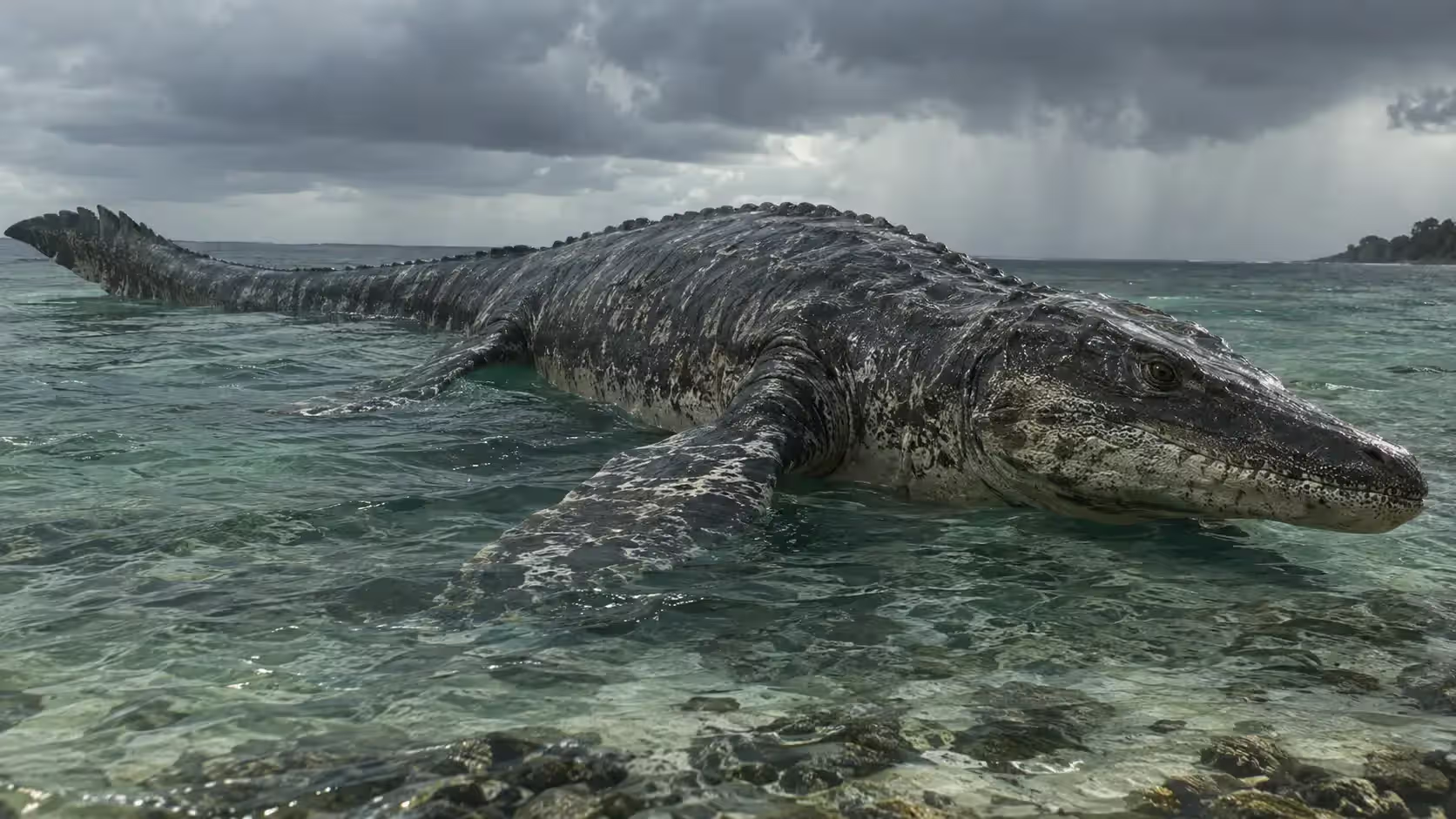
Mosasaurs are Volonia’s most famous predators. With a few great pliosaurs, they make up its thirty very-large animals, twenty-one of which belong to Vaesh. Their power serves for deterrence, vital defence, naval destruction and execution; great pliosaurs can attack keels from the depths. They are not used for ordinary towing.
They are marine reptiles, distinct from dinosaurs: they remain bound to water and cannot follow an army across a dry plain. Their presence changes how ships pass, how escorts are formed and how a port’s risks are judged; harpooners, nets, chains and enemy firing machines are the threats they face.
Riders and limits
Preparing them takes specialised riders, tactile signals, basins and suitable support. The diver or rider remains bound by the limits of breath and equipment, and an attack beneath a ship requires coordination with the rest of the fleet. The animal does not become a machine whose endurance or need for rest disappears on command.
The White Mosasaur of Vaesh
The White Mosasaur is the emblem of Vaesh. This marine force belongs to Volonia’s deterrence and strategic protection.
Zeko-Mar and the Houses’ lines
Volonia calls the deep-sea mosasaur Zeko-Mar, rare and political: a brute force that attacks from below, breaks hulls and serves as deterrence. The great Houses keep marine lines of their own.
The Bellcor keep the Tylor Noir, a black-swimming tylosaur that blocks channels and hunts ships on the blockade routes: a quieter terror of the trading posts. The Kron-Mer, a pliosaur with a massive head and short jaw, guards the arsenals of Doryan as a living, hull-breaking ram. The Calystrëa keep broad-jawed guard pliosaurs, marked with their colours, which escort living cargoes on the high seas along the Sand Port route.
Two kinds of giant
Mosasaurs and pliosaurs look alike from afar and differ up close. The mosasaur is a very large sea lizard: a long, supple body of some fifteen tonnes, four flippers, a powerful tail ending in a paddle, a hinged jaw that opens very wide and a second row of teeth on the palate that holds the prey. It hunts by bursting up from the depths, strikes from the side or from below, and can open a hull with one bite. The tylosaur, with its spur-like snout, is one of its forms, and the Bellcor keep the Tylor Noir line of it.
The pliosaur is a short-necked plesiosaur: stockier, about twelve tonnes, it carries an enormous head with outsized jaws on a compact body, and swims with four great paddle flippers. Slower in pursuit, it is more fearsome in ambush and readily attacks rudders and keels from the depths. The Kron-Mer is the form kept at Velasar; the Lio-Roi, a basin liopleurodon, is shown only once a generation.
Basins and rations
A giant does not live in an ordinary harbour. It needs a deep basin closed by walls, gratings and chains, opening to the sea through a pass that is raised only on orders. Those of Vaesh form the Black Basin, set apart from all other water circuits; the nine giants that do not belong to Vaesh have similar basins at Port Volon, Velasar, Marévant, Girvane and Séloris. A kitchen of their own prepares their ration: trash fish, fat and salt, by the cartload.
A mosasaur sheds and replaces its teeth all its life. The moulted teeth gathered from the bottom of the sealed basins sell at a very high price, and the trade in them is discreet: nobody admits to selling them, and teeth without a seal of origin are seized. A giant leaves its basin only for exercise, escort or war; every outing is prepared by its riders and announced to the pilots, because no ship must be in its path.
The riders of the giants
The giants are ridden. A rider, strapped into a low saddle fixed behind the head, steers the animal with tactile signals: pressure of the knees, taps on the neck, pulls on a line passed around the jaw. He dives with it, holds his breath when the animal goes down, and surfaces to breathe only with it; that is why attacks beneath hulls are short and carefully prepared. Riders are few, trained for years beside a single animal, and are among the most respected and best-paid people in Volonia.
A team works around them: keepers, basin wardens, Calystrëa harpooners who lead the outings the way one leads a pack, and, in war, the fleet officers who decide when and where the animal is released. The rider has the last word on one point: he can refuse to send an exhausted or wounded animal down. Sailors say you do not command a mosasaur; you persuade it.
The wild ones of the open sea
Volonia’s giants are only a handful beside those that live free. In the Great Ocean, wild mosasaurs and pliosaurs follow the fish shoals and the bands of plesiosaurs; a fishing ship that crosses their path can lose its nets, its animals and sometimes its hull in a few moments. Pilots learn to recognise their signs, captains to steer clear, and insurers take them into account in the price of campaigns.
The Traqueurs de Dents hunt medium-sized wild sea reptiles for their teeth, leather and oil, and dread above all meeting a pliosaur bigger than their prey. No house deliberately hunts an adult giant: the risk is too great, and an animal captured alive would cost years of training before it was worth anything. Velasar’s watertight bulkheads, which let a gutted hull stay afloat, owe much to that fear.
What the ports say
The mosasaur is Volonia’s most feared and most famous animal, and foreigners often confuse it with the nation itself. Volonians gladly correct them: the mosasaur protects Volonia, the plesiosaur made it possible. Yet they do not escape its fascination. Theatres replay its hunts in their naumachiae, children on the quays play at being mosasaurs in the canals, and the houses that keep one draw from it a prestige nothing else gives.
The White Mosasaur of Vaesh holds a place apart. To see it rise from the depths is taken, in every port, as the sign of a sanction: a contaminated cargo drowned, a ship that forced the quarantine sent to the bottom. People speak of it only in low voices, and foreign sailors who glimpse it for the first time at the mouth of a roadstead keep a memory of it that Volonians make no effort to soften. The Northern Pirates, with their three black mosasaurs, are the only people to answer that fear with an equal fear.