

Institutions
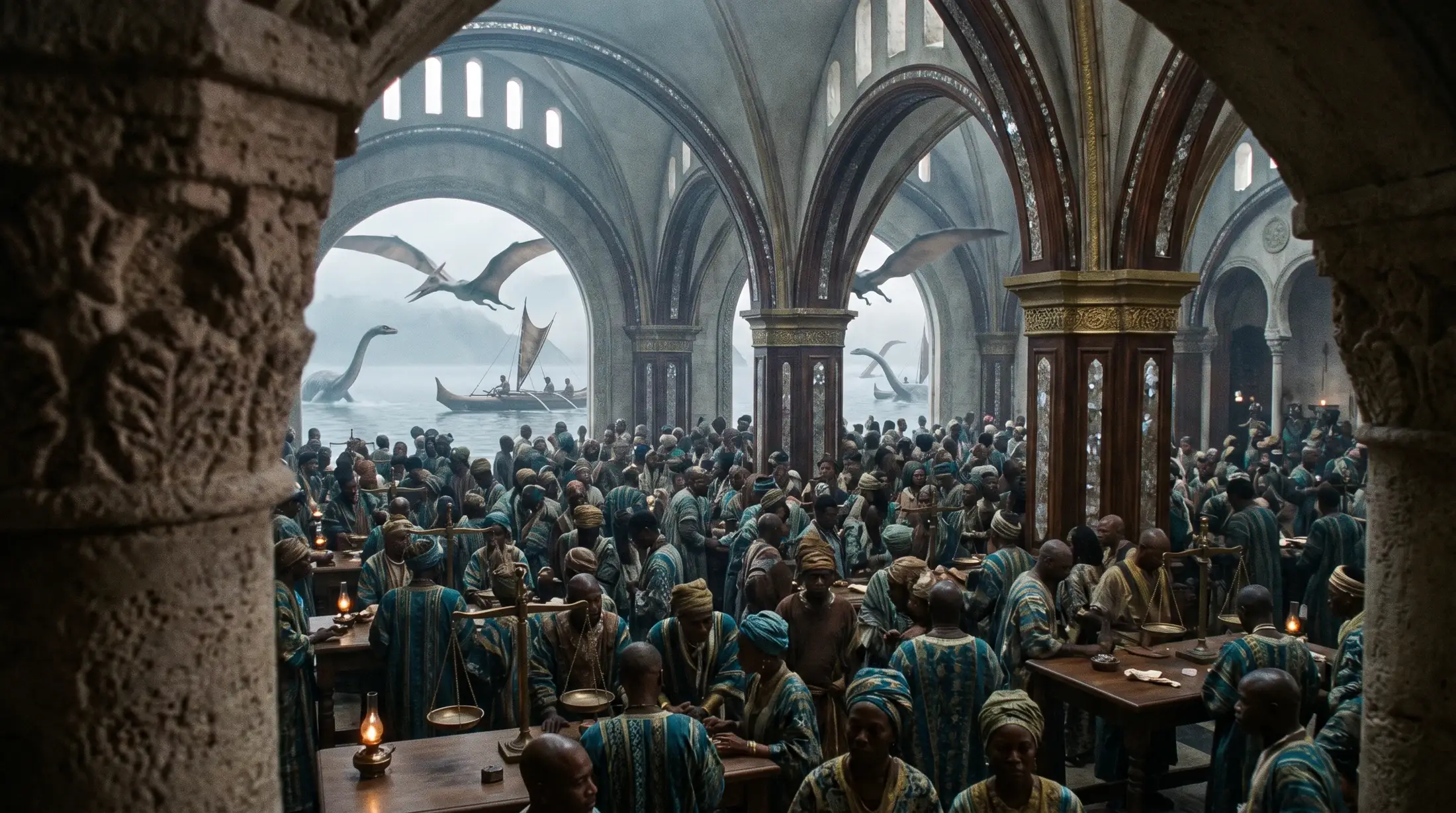
The House of Pilots
The establishment on the Pilots’ Islands devoted to the professionals of Volonian navigation.
An establishment for navigators
The House of Pilots is an establishment on the Pilots’ Islands devoted to navigation professionals. The archipelago is described as a place of schooling and technique: it brings together the House of Pilots and the School of Routes around the study of currents and migrations.
A trade of reading
A Volonian pilot reads a situation as much as recognising a passage. Season, current, cargo and towing animal change which route can be used; a way that suits a small boat does not open in the same manner to a Great Hull and its plesiosaurs. The Great Ocean pilot reads the open-sea windows on which deep fishing depends.
Relays and signals
The Pilots’ Islands belong to a network of relays. The Île du Sémaphore and its Signal Tower relay air and sea communications from a fortified lighthouse. Pilots, observers and messengers link these places, because a route is prepared according to season, animal and cargo, with relays able to pass on its changes.
A house for a trade
The House of Pilots is not a school: it is the common house of pilots once they are trained. It keeps the roll of working pilots, with their routes, certifications and availability. Shipowners and captains come there to engage a pilot for a voyage, a season or a campaign; a board shows who is at the quay, who is at sea and who will be back on the next tide.
The house sets reference rates by route and difficulty, settles disputes between pilots and lodges those waiting for an engagement. It also keeps a common fund, fed by a share of each engagement, which pays for the care of injured pilots and for the widows’ share when a pilot does not come back. In a society that protects its workers badly, the pilots have given themselves their own protection, and they are proud of it.
Route reports
On returning from each voyage the pilot files a report with the House: the state of the passes, currents observed, shoals that have moved, new wrecks, animals encountered, missing beacons. These reports are copied, sorted by route and passed on to the College of Pilots and to the crews of the Current Markers, who will go out to lay new buoys. A route is kept up to date by the sum of hundreds of small testimonies.
Reports are written in the Hand mode: the pilot commits his own person to what he saw. A false or careless report can cost him his certification, and more if a ship was lost following it. Reports on the Great Ocean are kept apart; reading them is reserved for pilots certified for the high seas, because they are one of the keys to the Volonian monopoly.
The pilot’s word
On board, in a pass, the pilot has the last word on the manoeuvre, even against a captain from a great house. The custom is old and respected, because it has saved too many hulls to be argued with. The captain resumes command once the pass is cleared; if he overrode the pilot’s advice, he alone answers for it before the Merchants’ Court and the insurers.
The House defends this authority jealously. It publishes the names of captains who have overruled a pilot, and pilots then refuse to serve them. It also defends its members against houses that would pay them to keep quiet about a dangerous passage. A pilot who sells his silence betrays all the others, and the House strikes him from its roll. Captains sometimes complain, but no serious shipowner would want a pilot who can be bought: the whole value of a report lies in the certainty that nobody has paid to change it.
A house among the relays
The Pilots’ Isles live to the rhythm of departures. Pilot families often live there generation after generation, and the children learn to read currents before they can write. From the House, messengers carry engagements to the ports, and news of the routes comes back through the signal relays, among them the Signal Tower of Semaphore Island.
A pilot engaged in Port Volon can thus join his ship at the next port of call, carried by a racing sailboat or by a relay boat. For this the House keeps a calendar of the tides of all the great ports, posted in its common room, which also serves as the archipelago’s timepiece.