

Institutions
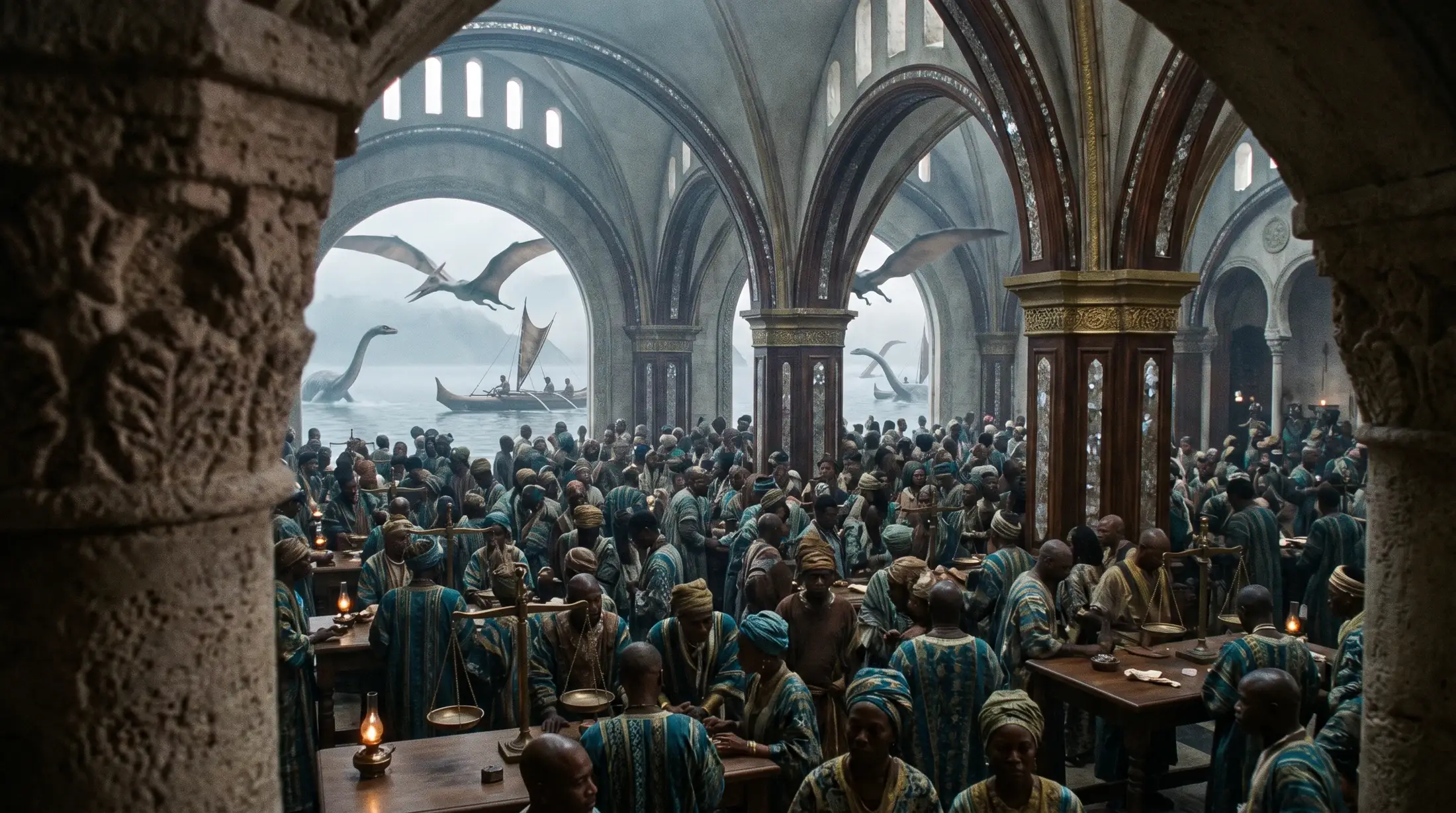
The Northern Privateer Charters
A para-state instrument of Volonia and the islands: a charter allows cargoes to be seized under a legal pretext, while whoever funds it can always deny it.
Piracy that can be denied
The Northern Privateer Charters organise deniable piracy. The captain who carries one seizes cargoes under a legal pretext; false flags and copied charters blur the origin of the order. Whoever funds it denies it officially, and double funding is common. Neressa Voran-Brisée is among the privateer captains who sail under this regime.
War below the threshold
Modern privateer charters were born in the first resin wars, when Volonia went round Orlantis by way of the Broken Isles. They belong to irregular private war, the kind that stays below the legal threshold through pirates, companies or clients. The captain raids only against defined targets; their charter, flag and insurer bind them, and their backer can always disown the charter.
A sheet and its clauses
A privateer charter is a sealed deed, in the most binding mode of Vòlon. It names the captain, the ship as it appears in the Register of Hulls and Routes, the authorised targets and the length of the cruise, counted in due dates. The targets are defined precisely: a flag, a route, a type of cargo, sometimes an enemy house or a forbidden port. Outside those targets, the privateer becomes a pirate again.
The charter also fixes the division of spoils. One share goes to the backer, one to the crew by rank, one to the insurer covering the ship, and one, often forgotten in the stories, to the widows and families of those who die on the cruise. Finally it names the port to which prizes will be taken for judgment. There the Merchants’ Court, competent for cargo rights, decides whether a prize is good or must be returned.
Why “Northern”
The Northern charters take their name from the republic’s northern routes: towards Orlantis and Urnok, towards the Archipelago of the Silver Wind, and through the sector of the Northern Broken Isles. They owe nothing to the Pirates of the North, a sovereign maritime civilisation with its Three Blacks; chartered privateers avoid them rather than fight them. The charters are used mainly in waters where Volonia, the island republics and the interests of Orlantis contend for the passages.
Double financing is old there. The annals speak of a War of the Two Piracies, in which each side funded pirates against the other and peace was made without a single fleet battle; it was from then on, people say, that piracy became an instrument of state. Since then the same charter can circulate in several copies, and the same captain can carry two papers in two different chests.
Living under charter
Aboard a privateer, the charter is kept in a watertight chest to which only the captain has the key. It is shown to ships that are stopped, read to the crew at departure, and sometimes burnt when it becomes compromising. Sailors know what their paper is worth: it protects them from the rope as long as the backer does not disown it, and it is worth nothing the day he declares he has never heard of it.
Neressa Voran-Brisée, a privateer captain under this regime, is known for traits that say much about the trade: she takes apologies for confessions, hates humiliating a beaten crew, calculates in her head faster than her clerks, recognises every wine while almost never drinking, and, in a life spent on the water, is afraid of plesiosaurs. Her name carries the mark of the isles: the Northern privateers often come from old island families that Volonia has pushed to the margins, and puts back to work.
False flags and copies
False flags and copied charters are a craft of their own. Discreet workshops in the grey ports know how to remake a seal, age a wax, imitate a jurist’s hand. A good copy lets a pirate call himself a privateer, or a privateer hide who really paid him.
The prize judges know this, and compare every charter presented with the registers of the houses that supposedly issued it. A seal its alleged owner does not recognise is enough to turn a prize into theft and a crew into a pirate band. The risk is part of the price: captains who sail with a doubtful paper demand bigger shares, and the backers quickest to disown pay the most.