

Places and landscapes
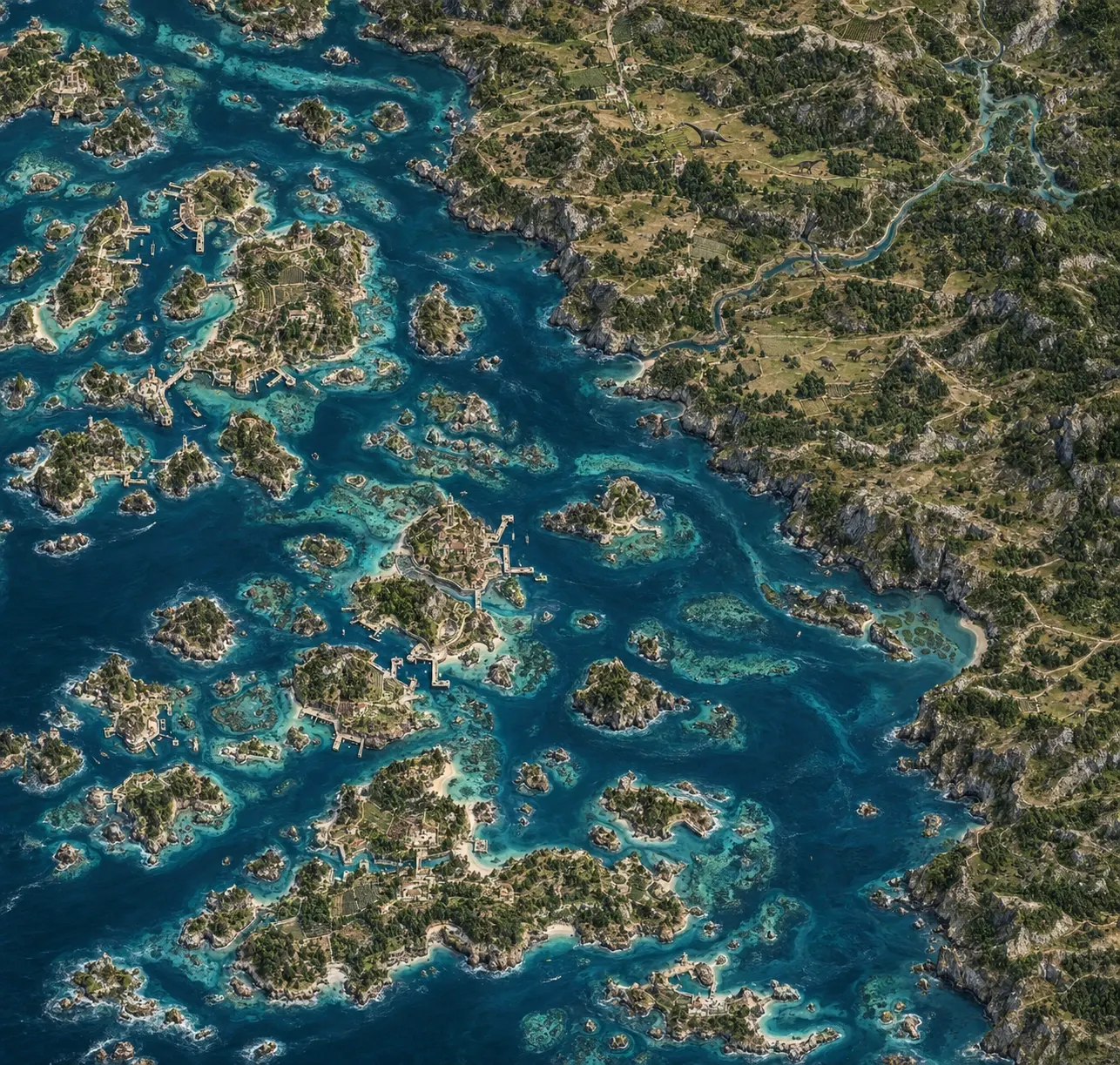
The Pilots’ Islands
A training archipelago for learning currents, routes and their changes.
Knowledge with a place of its own
The Pilots’ Islands form an educational and technical archipelago associated with the Pilots’ House and School of Routes. Currents and migrations are subjects of study there. A route’s name thus extends into knowledge passed on to others.
Reading a route according to cargo
Volonian navigation distinguishes ocean routes from coastal sailing. Season, current, cargo and draught animal change the usable course. Pilotage therefore means reading a situation as much as recognising a passage: a route suitable for a boat does not automatically offer the same possibilities to a Great Hull and its animals.
The ship works with its animals
Plesiosaurs participate in towing, construction, transport and rescue. Human underwater methods require breath, harnesses and equipment. Learning a route therefore involves several bodies, each with its limits. Maritime knowledge connects currents to manoeuvres and to the real possibility of resuming work after a crossing.
An archipelago cut out for learning
The Pilots’ Isles owe their role to their geography. Within a few dozen kilometres, the archipelago brings together almost every difficulty a pilot will meet in his career: narrow passes between two reefs, tidal currents that reverse twice a day, shifting shoals, unsheltered bays and deep channels where great hulls can manoeuvre. Each islet serves as a lesson; students know their names and their traps before they know their beaches.
The House of Pilots and the School of Routes occupy the two largest islands, with their halls, practice quays and lodgings. The other islets carry observation towers, training beacons, shelters for the pilot boats and a few fishing hamlets whose families have supplied part of the students for generations. The archipelago’s tide tables, posted at the entrance of every hall, are the first that newcomers learn by heart.
The archipelago’s visitors
The archipelago also attracts visitors who have no wish to become pilots. In certain seasons, the surrounding waters are crossed by bands of wild plesiosaurs and great shoals of fish, and the cliffs shelter pterosaur colonies. Final-year students take boatloads of Volonian and foreign visitors out to the observation points under their masters’ supervision; these outings, much sought after by the capital’s wealthy families, bring the School part of its budget.
The masters also see them as an exercise. Steering a boat full of nervous passengers close to wild animals, reading current, swell and the beasts’ behaviour all at once, teaches a future pilot to decide quickly. The visitors leave with stories; the students, with a mark in their logbook.
The pilots’ wall
On the highest of the islands, a long stone wall carries the names of pilots who died at sea. Each name is carved with its route and the season of its loss, and the School’s graduating classes are gathered there on the day they leave. The ceremony follows Volonian rites: a bell, a witness and the reading of the deed. For pilots whose bodies were never returned, the College buys back a bell or pays a share to the widows, as duty towards the drowned requires.
The island families live to the rhythm of these departures. Many of their children become pilots, others builders of pilot boats or watchmen. Volonians say the Pilots’ Isles have more names on their wall than inhabitants in their hamlets, and it is hardly an exaggeration.