

Institutions
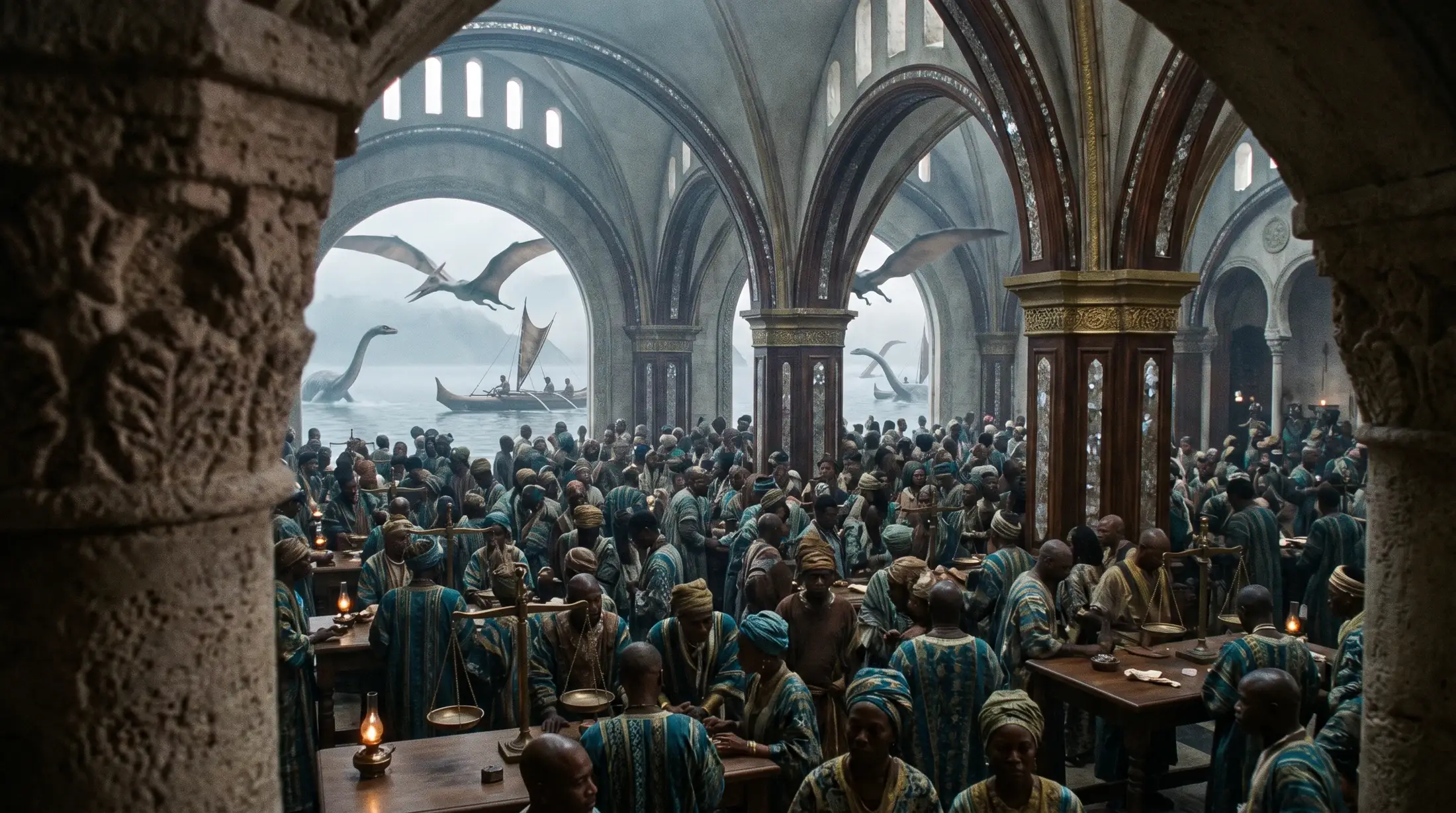
The Merchants’ Court
Volonia’s commercial and maritime court: bills of exchange, losses at sea, cargo rights and contracts.
A court of contracts
The Merchants’ Court rules on bills of exchange, losses at sea, cargo rights and contracts. It sits in Port Volon, alongside the Grand Comptoir and the Stake Chambers. Its subject is not ordinary crime but commercial dispute: who owes what, to whom, and on what grounds.
The loss of a ship or damage to a catch raises questions of liability as much as of money. Maritime law frames disputes between people and houses whose goods, labour and commitments meet on the same route.
The evidence of a case
The Court relies on information produced elsewhere. The Register of Hulls and Routes records a vessel’s tonnage, ownership, condition, guarantees and pilots. In Marévant, risk chambers and observatories bring together navigation reports, ship characteristics and loss histories. The loss broker and the maritime-clause lawyer are among the trades that prepare these cases.
Beyond the dispute
Not every financial offence remains a commercial dispute. Petty fraud brings fines, seizures or bans. Major fraud — a hidden beneficiary, a double register, bribed collectors or untaxed political money — is constitutional treason and can lead to a public execution in a maritime theatre.
A hearing at the Tribunal of Bills of Exchange
The Merchants’ Court sits in Port Volon, in the building the quays call the Tribunal of Bills of Exchange. A case is heard by three judges: a merchant, a sailor and a jurist of maritime clauses, chosen from a list the League keeps among former shipowners, captains, insurers and brokers. Clerks register the documents, seal the bills of lading and keep the court roll.
Witnesses speak in Vòlon, and the language does part of the Court’s work. What is said in the Sealed mode binds the house that covers the statement; what is said in the Hand mode binds the person who saw or acted; what is said in the Mist mode is not evidence and cannot be admitted. A judge readily interrupts a witness to ask which mode he is speaking in.
The pace follows the water. Ordinary cases are pleaded “in the hold”, in the seasons that follow. Those concerning a perishable cargo, a living animal or an immobilized ship are judged “at the quay”, within the day, before the next tide has changed the value of the dispute.
Judging a loss
The judgment of loss is the Court’s most frequent act. It decides the case of a lost cargo, a sunken hull or an animal that died at sea, and sets what the insurer must pay, and to whom. Each party arrives with its documents: the hull book and the Register’s certificate, the insurance contract, the ship’s log, the signals received during the crossing, the pilot’s records.
The death of a draught plesiosaur gives an idea of the questions asked. The master of traction must state in the Hand mode how many hours the team pulled, when it was relieved, what it ate. A veterinarian examines, where possible, the body brought back by a Récupérateur d’Épaves; the loss broker compares the loss with the animal’s registered value. A beast killed by exhaustion is not a beast killed by a predator, and the clause that covers one does not always cover the other.
When cargo has been thrown overboard to save the ship, the Court applies the rule of general average: the loss is shared among all who had an interest aboard, in proportion to their share.
What the Court can order
The Court does not merely say who is right. It orders payments, seizures and forced sales at auction, enters its decisions in the Register of Hulls and Routes, and can strip a captain or a broker of the right to sign deeds in the Sealed mode. Quays dread this last penalty: a man deprived of his seal can no longer guarantee a cargo, and often joins the sealless sailors looking for a berth without cover.
Cases of very great fraud take another form. When the collectors of Vaesh or a judge uncover a hidden beneficiary, a double ledger or untaxed political money, the Court sits in plenary session, all chambers together. If treason is established, the sentence of the Closing of Accounts is pronounced before it, and its public execution takes place in a maritime theatre.
Between these two extremes, most judgments are settled in money. Houses often prefer to come to terms before the hearing, in the neighbouring rooms, rather than have their documents read in public.
Pleading when one comes from elsewhere
The Court also judges foreigners, provided the contract was signed in a port of the League or names it as judge. Merchants from Urnok, Korathi shipowners and brokers arriving from Sand Port with Arkhan cargoes come to plead there. Deeds are drawn up in two columns, in Quay Notation and in the partner’s language, and an interpreter of Route-Cant assists parties who do not speak Vòlon.
This openness makes the Court’s reputation. A judgment from Port Volon is known in most of the trading posts of the known world, and many foreign contracts name the Merchants’ Court precisely because neither party wanted to plead in the other’s country. For the republic it is a service as much as a justice: every foreign lawsuit brings clients to the city’s insurers, money-changers and clerks.