

Armies
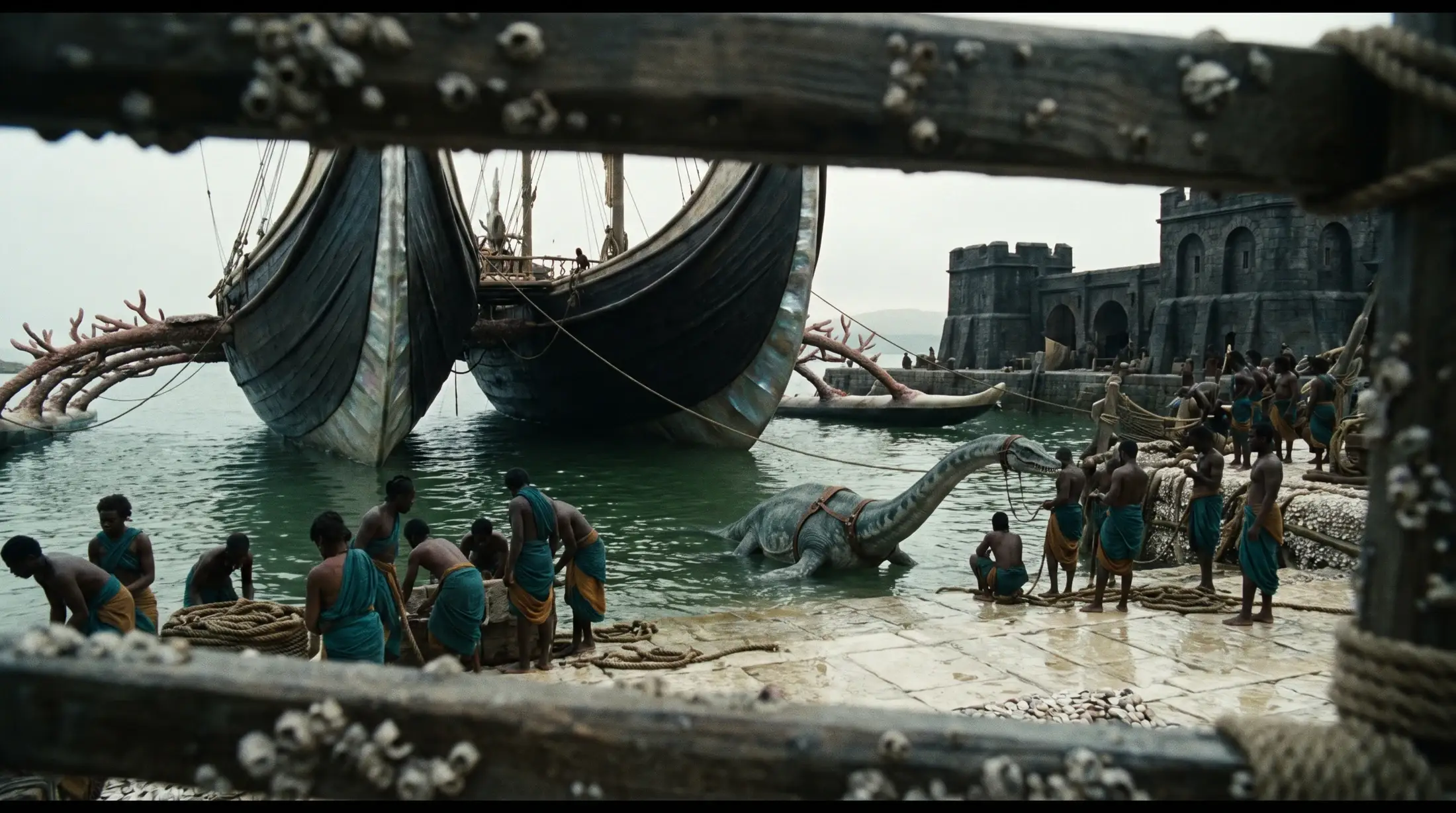
The Fort de Marée
A slow floating fortress (“Tide Fort”), armed with all-round artillery and nets, which defends straits and anchorages.
Guarding a passage
The Fort de Marée is a defensive ship. It carries all-round artillery and nets, and covers a strait, a mooring or an anchorage.
Its plesiosaurs give it only limited mobility: it is built to hold a position. Seventy to one hundred metres long, it carries eight hundred to twelve hundred people.
A fortress on the water
The Fort de Marée resembles no other Volonian ship. Its hull, almost as broad as it is long, is made for stability rather than speed: it carries a raised platform in the centre and, all around the deck, ballistae mounted on pivots that can fire in every direction. This is what sailors call its circular artillery: a Fort de Marée has no weak side to present to the enemy.
Its nets are its other weapon. Weighted with lead and sea teeth, they are stretched around the hull from long spars, below the surface and above the deck: the first stop swimmers, enemy divers and small craft, the second the pterosaurs that would try to swoop on the ballista crews. Seen from afar, a well-rigged Fort seems to sit in the middle of a web.
Placing a fort
A Fort de Marée moves little and slowly. Its sails serve mainly to position it; its plesiosaurs, harnessed in teams, tow it to its post at the mouth of a strait, a pass or an anchorage. There it drops several heavy anchors and, when the coast is close, ties itself to the land with chains or cables. It can stay like this for a whole season, resupplied by Greniers du Large and relieved by boats.
Its position is chosen with the pilots. It must command the channel without hindering friendly ships, stay out of range of enemy war engines set up ashore and have water deep enough that low tide does not ground it. The Fort de Marée owes its name to this constraint: it is placed according to the tides it will have to hold.
Months in the same place
Eight hundred to twelve hundred people live aboard a Fort de Marée, often for months without moving. Ballista crews, net teams, sea crossbowmen and contract companies rub shoulders there with carpenters, cooks, plesiosaur keepers and a physician. Days are spent in firing drills, in maintaining nets and ropes, in line fishing over the side and on watch.
Boredom is the most constant enemy. Captains organize tight watch rotas, shooting contests and regular reliefs by boat; contract companies are paid by the season, with a bonus if the Fort has had to fight. Veterans say a Fort’s crew can be recognized by its patience, and that it fights all the better for having waited long.
To hold, not to pursue
In the Admiralty’s doctrine, the Fort de Marée is a gate. It closes a strait while the Coupe-Courant stretch their chains and the fleet manoeuvres elsewhere; it covers an anchorage where the teams rest and the Greniers resupply; it protects the entrance to a port during a siege. It is never sent in pursuit of an enemy, and its officers are ordered not to leave their post, even to finish off a fleeing opponent.
Its weakness is well known. A stationary Fort can be bypassed, brought under fire from engines set up on the coast, or attacked from below by a great marine predator seeking its keel. That is why it never fights alone: Harponneurs and Frégates d’Écume stay at its side, and its surface nets are doubled when great reptiles are reported.
In peacetime
In peacetime, Forts de Marée spend most of their lives in the shelter of a ring-bastion or a League roadstead, half disarmed. Their reduced crews maintain them, and one is sometimes moored at the mouth of a pass threatened by pirates, or before a port closed by quarantine, so that no one forces the sanitary blockade. Their presence is often enough: few captains try to pass beneath artillery that can fire on every side.