

Places and landscapes
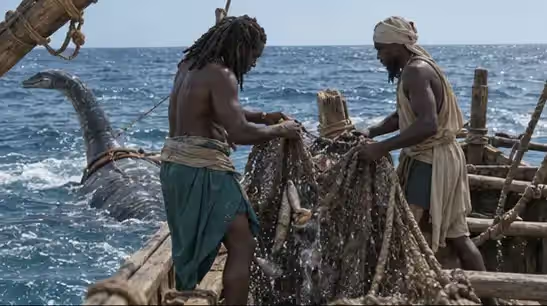
The Great Ocean
The realm of distant crossings and ultra-deep fishing, which Volonia is the only great power to exploit regularly.
An ocean for a single power
The Great Ocean is the realm of distant crossings, ultra-deep fishing and ocean resources. Volonia is the only great power to exploit it regularly: its Great Hulls, ports, plesiosaur breeding and traction teams let it reach waters too far for the other nations. It draws from this a near-monopoly on ultra-deep fishing and on certain ocean products.
That capacity came before finance. The domestication and breeding of plesiosaurs made towing, large construction and the regular exploitation of the Great Ocean possible; the cargoes that came back from it gave rise to the need for credit and insurance.
Going out and coming back
Great Ocean fishers carry deep nets, processing workshops and supplies. Plesiosaurs handle the nets, work around the shoals and carry the catch; ships must keep water, food and animal rations for the voyage home. Current charts and navigation windows decide a departure as much as the expected value of the catch.
The ship of this trade, the Pêcheur du Grand Océan, is seventy to one hundred and twenty metres long and carries four hundred to nine hundred people, with its sails and six to twelve large draught animals. This distant-fishing industry was not born of war: it is what later makes it possible to maintain powerful squadrons.
Knowing and valuing
The Institut des Pêches Profondes studies the shoals, resources, quotas and mapping of the Great Ocean. The Bourse des Grandes Captures values the catches and the materials brought up from the depths. Fish, oils, bones, pearls, shells and other biological materials then pass on to workshops and markets. The Great Ocean pilot is one of the trades of this economy. Finance rests on these material flows: it advances funds, spreads risks and settles long-distance transactions.
Fitting out a campaign at sea
A fishing campaign on the Great Ocean is prepared like an expedition. Ships leave the fitting-out ports of Velasar, Marévant and Girvane, towed by their fishing plesiosaurs, for several weeks on the banks. Bottom nets, long lines, barrels, grey salt from Vaesh for the salting holds and above all the animals’ rations are taken aboard: a working plesiosaur eats nearly ninety kilograms of fish a day, so that a team of ten beasts swallows almost a tonne of food daily.
It is this hunger that sets the length of a campaign. The first catches go to feed the teams; the hold only really fills once the animals are sated. Great fishing fleets therefore travel with Greniers du Large or put in at island relays, and the master of traction counts his rations as carefully as the captain counts his barrels.
What the open sea hides
The Great Ocean is the domain of long storms, of swells that come from very far away and of great wild reptiles. Free mosasaurs and pliosaurs follow the shoals there, and a fishing ship that crosses their path can lose its nets, its animals and sometimes its hull in a matter of moments. Pilots of the Great Ocean learn to read the signs: a shoal that scatters for no reason, seabirds moving away, plesiosaurs refusing to go forward.
Flat calm is another danger. When the wind drops for days, it is the traction teams that bring the ship home, and their fatigue becomes the measure of the crew’s survival. Lost campaigns leave names on chapel walls and widows’ shares in the houses’ accounts. No shipowner sends a fleet out to sea without a Hôpital des Marées, or at least a ship’s doctor on every vessel.
What comes back from the great depths
On their return, the holds deliver goods that no other power brings back regularly. Deep-water fish, salted or dried, keeps for months; squid and belemnites provide flesh, ink and bait; marine reptile oil, clearer and dearer than ordinary fish oil, lights the salons and greases delicate mechanisms. The teeth and ivory of the great sea creatures, bones, pearls from the deep banks and the sea amber cast up by the great animals complete the cargoes.
These catches pass through the Exchange of Great Catches, which grades them and sets their price. Some go to Volonian workshops, some abroad, always through the republic’s agents: Korathi workshops, Urnokian houses and Ishtiri trading posts thus buy produce of the Great Ocean without ever seeing an offshore bank.
Why the others do not go there
The other powers have navies, but not the means of the open sea. Ishtir’s galleys and patrol boats guard its coasts; Urnok’s grain cogs hug the shore and almost always have their cargoes insured in Volonia; the dhows of Sand Port run down the coasts of Arkhan. None of them has at once plesiosaur lines selected over centuries, hulls large enough to carry stores and workshops, pilots trained in high-sea windows, and a network of ports able to repair and feed a fleet on its return.
Volonia sees to it that this lasts. Its pilots do not conduct foreign fleets out to sea, its charts of the Great Ocean are not for sale, and its yards do not deliver Pêcheurs du Grand Océan abroad. Even for Volonians, the Great Ocean remains largely unknown: the exploited banks form only a fringe of it, and the most experienced pilots say the charts stop well before the sea does.